

JimmySwill
Villager
Hey all. Wayfarers RPG is back as Wayfarers Complete, available at: https://yeoldegamingcompanye.com
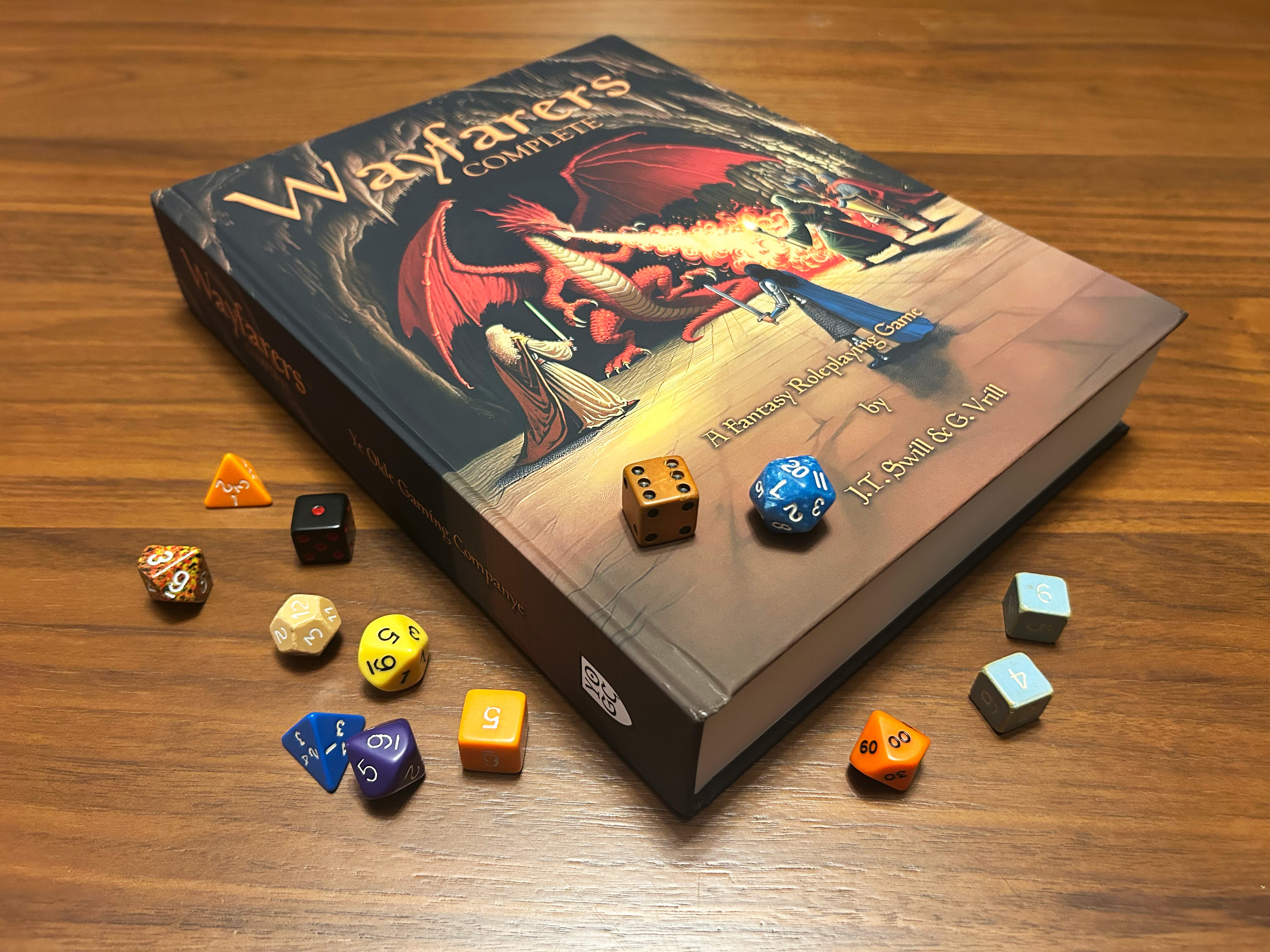
Following the release of the original hardcover in in 2008, in 2012 we published a 2nd Edition of Wayfarers with Mongoose, splitting the rules into 3 softcover books. That form never felt right to me, and since then, I have been intent upon updating, expanding, and compiling everything into one complete tome.
Wayfarers is a personal collaborative project that started with a home-brew system our group ran in the late 1980s into the mid-1990s. The game has been described as a simulacrum in that it plays like a D&D-like fantasy RPG, but it is not a retro-clone. Some have said that it has 2E vibes and 1E/2E aesthetics. That has a lot to do with when the system was born, as well as my personal tastes. Wayfarers is not a rules-light system, but game play is quick and familiar. The underlying design principle is customizability, without becoming generic.
Aside from a classless skill point system, one thing that stands out is how proficiencies in Wayfarers are resolved. Wayfarers uses a d20 pool (one d20 for each proficiency rank, keeping the highest). Modifiers and target numbers don't creep as a result. Also, the non-proficient 2d20 take-the-lowest mechanism makes a strong distinction between having the proficiency or not but allows everyone to try.
A mana-like spell point system for Ritual magic is fairly unique, as well as spell consolidation or substitution for Faith magic; Priests can substitute any higher circle spell in their repertoire with a lower circle one, or they can combine two lower circle ones to get one of the next higher circle.
The discipline options for combat make for several different strategies for fighter-type characters. You can use your weapon for defense, sacrifice attacks for accuracy, disarm, etc.
In addition to the Player's, Game Master's, and Campaign Setting all in one book again, there's newly added magic items, creatures, example characters, Game Master resources, art, and numerous updates to the text and rules (d20 initiative, PC health points, creature stats, armor impedance, etc.). Finally, the World of Twylos has been renamed to the World of Narbohring. This is how we knew G. Vrill's campaign setting, and we decided to use its original name for this final edition.
Here's an overview of the system:
Wayfarers is d20-based. It's based on a home-brew skill system our group first created in the early 1990s. In addition to the d20, you use all the regulars: d4, d6, d8, d10 and d12.
Wayfarers plays quick and easy like many d20 systems but has a lot of options for character customization.
Characters have five attributes: Agility, Endurance, Intellect, Presence, and Strength. Initial abilities are point-buy and can be raised with skill points.
Combat: Attacker rolls 1d20 to hit. The target is the Dodge score of the opponent. A character's base Dodge score is equal to his/her Agility score. Combat is straight-forward and round-based, but characters (especially warrior types) often have options to use disciplines to modify their attacks/defense.
Armor absorbs damage. Bulky armor can lower your Dodge score.
Skill Points and Skills: Characters achieve levels and spend skill points on (56 standard) disciplines (mostly martial and magic) and (44 standard) proficiencies (skills and knowledge).
Example discipline: Charge: 4 skill points. Weapon class specific: Weapon Mastery I in weapon classes D is a prerequisite for Charge. The character may add an additional 1d6 points of damage when charging into melee combat with the weapon and scoring a successful hit. In addition, the character may apply 1d6 points of damage when receiving the charge of a melee opponent and scoring a hit.
Example proficiency: Lock-picking: 2 skill points per grade (agility). Lock-picking is the ability to open padlocks, door locks, and similar mechanisms. In most cases, Lock-picking requires special tools such as tension wrenches and picks.
Proficiencies are used by making proficiency checks where the target number usually something between 5-25. Characters are initially non-proficient but can achieve up to IV grades in a proficiency. When making a check, the character rolls 1d20 for each grade in the proficiency he/she has, and the highest roll is kept. For example, a character with Lock-picking Grade III tries to pick a lock, he/she rolls 3d20 (9, 12, and 17); 9 and 12 are dropped so the result is 17 (plus or minus any agility modifiers). Non-proficient characters roll 2d20 and keep the lowest score.
Magic: There are four types of Magic. Hermetic (wizards) and Faith (priests) Magic have 8 Circles of spells, and Hedge (illusionist/artificer) and Ritual (shaman/witch) Magic have 5 Circles of spells. Each has their differences in the types of spells that can be cast, and how their spells are memorized/granted. Ritual magic uses a spell point/formula system. There are a lot of spells.
Game Master Resources: There's a lot here. Breakdowns of each proficiency, a compendium of magic items, discussion of the game mechanics, how magic items may be made, optional rules (races, combat rules, disciplines, proficiencies, psionics), useful lists, over 250 creatures with descriptions, pre-made NPCs, etc.
The World of Narbohring: Narbohring (previously known as Twylos) is Gregory Vrill's expansive, vivid, and wholly unique world and campaign setting. You just have to read it to appreciate it, but it is a world full of flavor and ideas. The Narbohring section is 140 pages.
There's also a large appendix that contains two small modules as well as many useful reference charts and tables.
I'd be happy to answer any questions.
Cheers,
-Jimmy
p.s. If anyone is serious about reviewing Wayfarers Complete, DM me.






