General RPG DiscussionDiscussion of all RPGs and non-system-specific topics. DM/GM/player issues, settings, etc. Rules discussion belongs in one the forums below.
Some Basic Information on the Developmental Background of this Setting: This setting, Terra-Ghantik is several years old. (Parts of it decades old in development.) It began as an experiment in world design spurred on by some friends of mine.
In my early twenties I stopped playing games altogether and got on with many other things in my life. In my mid-thirties, after having gotten married and returning home some friends asked me if I would DM for them. (Most of my older friends had either gone into service and been stationed elsewhere, in other parts of the world than me, or had moved after attending college. But eventually I made new friends after returning home and some of them had interests in gaming. And my own children were getting older as well and had expressed interest in gaming.) So with these various requests I said I would try and develop a new playing world (my old ones had been burned in my twenties) but that I wanted some time to develop a world setting and milieu that we would all like. So I asked them what they wanted and they told me, and I likewise thought about what I wanted to do and experiment with, and taking all of that information into consideration I set about designing a stable, consistent world for them to play in.
The first thing I wanted to do was create an historically based milieu, because we all have large and long term interests in history, and because real cultures, societies, military matters, people, and events interest most of us far more than purely fictional things. The next thing I wanted to do was create a setting in which the players could explore real moral and religious themes. Some of my would be players had expressed major disappointment at D&D and most fantasy game approaches to religion, and how shallow most religious and spiritual affairs were in-game. I couldn’t have agreed more, especially regarding the Cleric.
So after some experimentation I decided to ditch the D&D approach to religion altogether and instead let people play their own religion. If they were Christian then their character could be that as well, or they could be Jewish, Buddhist, whatever they chose. (Indeed one of my original goals of the setting had been to develop a “Christian version of D&D,” but over time I came to realize that this would be counter-productive, for reasons that might not initially seem obvious. If everyone in a game is Christian then Christianity is never challenged because there is nothing really in the background of the setting to challenge Christianity. [Monsters and evil would be available to challenge the morality of character action, but that would be a reflexive challenge, not an interesting or demanding or evolutionary challenge.] It would be the same as if a Moral or Religious Monopoly existed in the game world. Or let me put it this way, just imagine if everyone in our world were Christian. It might seem a sort of ideal situation in some way, especially for Christians. But would it be? In actuality? Such a monopoly, as with any monopoly would likely lead to complete and total stagnation of the evolution of Christian ideals and behavior. Without allies Christianity would not grow wiser, without opposition Christianity would not evolve and improve; I am not talking so much about the ideals of Christianity, many of which I think should remain stable and unchanging, but about the expression and behavior of those ideals as evidenced by how Christians act. Therefore I strongly suspect and believe that competition from friendly or allied religions does Christianity good, as it causes and promotes self-reflection, as does outright opposition from hostile opponents, as this forces the religion to grow, develop, and adapt in this world. Every force or organization in existence needs a reactionary force to push against, as well as allied forces with which to operate in conjunction in order to reach cooperative objectives. When a thing remains unchanging and unchallenged it cannot grow and is not motivated to grow. In other words competition promotes a nature of both striving and thriving, whereas everyone inflexibly and uncritically accepting the same ideals and motivations for every action in the world can in time only likely lead to stagnation and quite possibly a state of slow corruption and decay. Therefore in the game world I wanted this setting to be Christian friendly, and I wanted the players to feel free to play their own religious beliefs, but I did not want to dictatorially limit the religious expression of this setting to Christianity, as I felt that would not bring out the best in any player or situation, Christian or otherwise. Furthermore I also didn’t think it likely to allow the setting to raise and wrestle with difficult and dangerous real world moral questions if the religious context were inflexibly set beforehand. An inflexible context leads to inflexible and non-innovative answers to difficult dilemmas. And one goal for this setting was definitely as a background in which to present difficult real world moral dilemmas in-game. So instead I opted for a Christian-influenced, but not necessarily Christian dominated setting that nevertheless allows as much religious choice for the player as does our own world.)
Therefore the players were free to play their own religious background, but they could also if they wished play a character from another religion. As far as religion goes I wanted the players to have as much freedom of religious exploration and expression as in the real world, but not be limited to artificial and unreal religious pantheons and organizations to which they would likely feel no real association, sympathy, or interest. But whatever the particular case of their choice they would be free to play a character with a real religion, given the time frame of the setting. It wouldn’t be an artificially created stick-man religion in which the player would have no real stake, or no real set of core beliefs at all, instead he could be playing something real which made real moral, ethical and spiritual demands of the player and his or her character, within the structure of the game setting.
Because of the religious background of the setting I also wanted analogous real historical cultural ties that the player could associate with his character. For instance if a player were going to have a character that had a real religion, it seemed to me that he should also have a real culture, and that this culture should both place demands upon the character and should give the player a feeling of real association and sympathy with the society, nation, and world that his character inhabits. For instance, imagine you are playing a character who is American, if you are American, or Japanese, if you are Japanese, or Irish if you are Irish, and how much more likely you are to instinctively and deeply associate with your own culture than that of let’s say, the entirely fictional Thorodium Excellency of High Somersault. Truth is the best the Thorodium Excellency of High Somersault can do is poorly and palely approximate some real culture, and the likelihood of that culture or government exciting any real loyalty or sense of association with a player within the setting is very remote indeed. So I expanded upon the idea of both the religious and cultural associations of the setting to give the players things they could instinctively and personally relate to within the setting almost as if they were real associations in our real world. (If the Thorodium Excellency of High Somersault is obviously based upon a real culture then it can very well evoke in the player feelings of natural association and sympathy, but probably not to the degree of the associations already evident in his mind and experience as invoked by his real culture, present or past.)
I call this type of resonant relationship between the player and the setting he explores “Sympathetic Association.” I think it is an important idea behind fictional world creation that transforms a setting from being a mere plastic stage backdrop into a milieu that the player can become excited about and can personally relate to. The setting becomes important when the background is something that the player can naturally understand and associate with, and his sympathies are stimulated when it is enough like his own real world culture, religion, background, and interests, to seem “more real, and more important” to him. He can recognize aspects of himself within the background world and he can sympathetically associate with those aspects in the setting. When his gaming country is attacked in war it is like he has a personal stake in the matter. When his hometown is attacked and burned, he associates with that in an almost personal rather than merely imaginative way. In other words places in a game setting do not remain mere geographical points of vague interest with funny names, or bases out of which the player disinterestedly operates, but rather the setting becomes a far more “real place” with real interests, concerns, and obvious risks
However I also didn’t want to create merely another version of the Western European Medieval Milieu. I wanted to create a setting that would evoke natural Sympathetic Association with the players, but a setting that was also new and unique and unknown in many ways compared to most settings. Something out of the ordinary and generally unexplored as both a game and fantasy setting. The reason is obvious. I wanted something new, creative, stimulating, and provocative.
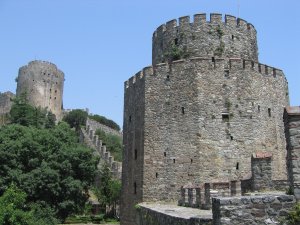
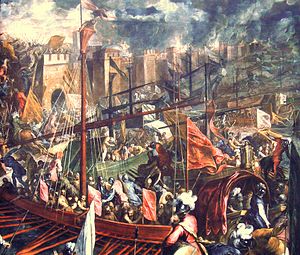
I originally considered Eastern Europe, Russia, and Japan as possibilities, and a friend of mine also suggested Malta (which I seriously considered for a long time as the base of operations out of which the characters would adventure). But after about a year of historic research I finally settled upon the idea of the Byzantine Empire and Constantinople (a favorite historical place of personal interest for me) as the likely setting, and after discussing that idea with my potential players they all agreed that it sounded like a very good possibility. That only left the exact era to be decided and after a bit of more research I decided that the era of about 800 AD would offer a number of interesting historical, background, campaign, and adventure possibilities. It was close enough in time and nature to cultures most all of the players were familiar with to seem welcoming and to evoke sympathetic association (indeed much of Western Culture is derived from Greek, Latin, and Byzantine societies, not to mention the Judeo-Christian religious background of Byzantium), but alien and unexplored enough as a game setting to place along the “frontier of the world,” so that one could always find “new and unfamiliar things” to explore.
In designing any setting for any reason or purpose, mythological, gaming, literary, etc I always desire to create places that are both well-explored and civilized (and the Byzantine Empire was probably the most highly civilized culture in the world at that time) and areas that are “frontier,” wild, untamed, and unexplored. The Empire had various barbarian tribes to the East, West, and North (some of them very powerful), the Persians, Muslims, and Indians to the Farther East, and much of unexplored Africa to the deep South. They were surrounded by both highly evolved and ancient civilizations, and by cultures and societies that were barbaric and new and on the fringes of the known world. The potentials of the milieu seemed nearly inexhaustible to me. So I set about constructing the setting based upon my historical research (which I had been conducting for a long time, not just for gaming purposes), and by including augmented elements of my own design.
Note: For those of you unfamiliar with the term Vadding, it is a real world skill set or avocation practiced around the world. The Vadders described below were developed or based upon real Vadders, plus my own experience at Vadding, which began when I was but a teenager.
Vadding helped me become a much, much better infiltrator, and investigator, and Intel analyst, and I found the skills I learned through Vadding invaluable in certain situations later in life. For instance Vadding is certainly a useful skill or set of skills to know when operating undercover. The pictures included in this section come from real Vads and real Vadders.
Nowadays Vadding is often called "Urban Exploration."
If you would like more information then see these links:
As I said the Vadders in my game are based on real world Vadders.
As anyone can see Role Playing Games like Dungeons and Dragons that require sneaking into or infiltrating dangerous places and ruins is obviously a form of imaginary Vadding. I've always thought of D&D as Vadding for the Mind, or a form of mental Vadding. There is a natural correlation and intersection between the two activities.
At some later point when I have the time I'm going to write a thread and article on The Elements of Vadding and Survivalism in D&D and other Role Playing Games.
The Vadders
Name: The Vadders, also known as The Infiltrators.
A description of the Vadders. A very small minority of Player Characters are also Vadders, (though they do not readily reveal their identity as Vadders to anyone else, including family members, or the party with which they adventure), with a slightly greater number of Sharpers being Vadders as well, due to their backgrounds. It is even possible for certain Types such as the Nyedry, Onsrof, Lhuylel, etc. to be Sharpers, and with training to become Vadders on Earth.
General Information: The Vadders could be said to exist as a type of Guild organization, though one of a very unusual type. They have no strict rules of membership, no basic organizational structure and no common purpose or goal. What is known about the Vadders, or Infiltrators, as they are often also called, is that they usually, but not always exclusively, exist in medium to larger urban areas. Vadders are far more common in the West than the East, but some vadders can be found almost anywhere in the world.
Since Vadders have no common organizational structure they also have no localized or central meeting place of their own, no group meeting house, no place at which they congregate as a large group, no known common method of communication or contact. It is thought that one may only find a Vadder by knowing what or whom to look for and that they will only be discovered as individuals, not as a group or party. The solitary nature of the Vadder is an assumption by those who are not Vadders, it is not a known statement of fact.
Goals & Ideals: Vadders have many separate and divergent reasons for why they Vad. Some Vad because it is a compliment to their already developed skills of thievery, vandalism, and spying. Others Vad for the sheer thrill of exploration and for the pleasure of knowing things few others do. Some vad to learn secrets and to trade in secrets. Some vad for military or law enforcement reasons. Some vad because they enjoy the activity. Some vad as training. And some vad because they love the sensation of danger involved. No single reason exists for Vadding. No single type of individual or class need be, or need not be, a Vadder.
Leadership: There is no known leadership since no hierarchy of any kind exists. Leaders sometimes emerge among small parties of Vadders or in a particular location, but no larger structure of leadership or command or discipline can be said to exist.
Inner Workings: Vadding is the art of Infiltration. It is usually, though not always, a set of specific skills practiced in urban environments. Vadders are sneakers, stealthily making their way into and out of and around areas without drawing attention to themselves or alerting anyone to their presence. If discovered most vadders will flee. If cornered they will have an already well developed cover story and will try to talk themselves out of trouble rather than fight.
Vadding involves infiltrating both occupied and unoccupied areas of an urban environment where people are not usually allowed to go, and escaping again without being detected or apprehended. Between the time periods involved in the first infiltration and the escape almost anything else can happen, and often times will happen.
A typical set of Vadding skills might include: Buildering (the climbing, penetration of, and exploration of buildings), Roofing (reaching and exploring rooftops and moving from roof to roof without being detected), Subterranean (the exploration of subterranean areas of a city; building foundations, waterways, sewer systems, underground storage and merchant routes, old tunnels, etc), Lockpicking and Lock-cracking, Hacking, Surveillance, Cover Story and Negotiation, Archaeological (exacavation and ruins) and Architectural Exploration, Exploitation, Sneaking around places quietly, the art of Urban Camouflage, and Urban Espionage, and so forth. This is not necessarily an exhaustive listing of Vadding skills.
Most vadders carry tools and are expert tool-users and/or toolmakers. Most are also adaptive toolmakers, constructing their own tools in the field if necessary. Most will carry a small set of survival and escape tools with them, often in a small backpack. Some wear a belt with tools attached, and most wear dark or camouflaged clothes to hide their infiltration of an area. Commonly carried tools include: small thieves picks and tools, special tools such as cones for amplifying sound, Vadding keys, disguise kits, colored lenses, light sources, mapping tools, survival gear, and often individually created tools and devices which are unique to a particular vadder.
A Vadder can be practically anyone although certain classes of people gravitate towards the art of vadding, while other classes eschew Vadding and think it beneath them. Those classes and individuals which normally consider vadding beneath them are Nobility, Paladins, most Clerical Types, most Fighters and Soldiers (excluding Scouts), some Wizards, Tradesmen, Craftsmen, Rulers, Bureaucrats, Administrators, and the Academic Classes (excluding students who often make fantastically good Vadders).
Those classes and individuals which naturally gravitate towards Vadding include Rogues of all kinds, Thieves, Assassins, Scouts, and Agents, as well as Rangers and Vigilantes, Law Enforcement, some Merchants, Spies, some Clerics and Missionaries (such as those who work among the poor or who adventure), some Monks, the Bard, naturally inquisitive individuals who love to explore, children (mostly young boys), street urchins and orphans, anyone who loves to know and/or trade upon secrets, and natural loners. Sharpers and acers also often make excellent Vadders. Theses are of course generalizations, and no absolute hard or fast rule can be developed about who or what will become a Vadder. Anyone who has an interest or is so inclined may take up Vadding. It is even rumored in some areas that certain rulers will disguise themselves and vad among the lower classes and more troubled areas of their city to better understand the common opinions of their subjects, and to gain information about the undergorund activities at work within their area of command or influence.
Two player classes, the Barbarian and the Druid make excellent Rudders, a special type of Vadder who tends to vad in outdoor or rural environments. Rural Vadding is called Rudding and rudders tend to vad by infiltrating farms, villages, country houses and manors, outposts, trade routes, caravan routes, mountainous areas, and abandoned ruins found far from any present day or known urban setting. Rangers, Scouts and Vigilantes often make excellent Rudders as well, and will often infiltrate and explore fontier criminal hide-outs as well as enemey outposts.
Vadders are well known as being secretive infiltrators and guides into troubled areas of a city, often helping people enter areas through commonly unknown passages or by unique means, such as through climbing and roofing techniques. They are also often known to have many "underground contacts" and can use these contacts to help others infiltrate areas of an urban environment that most people could never reach, or even come to know of, by legal means. Vadders, being very secretive are not well known, nor even well known of, but can prove invaluable in situations requiring infiltration.
Finally, most Vadders are loners, preferring to operate alone, and to keep their vadding activities a secret to most everyone except their very most trusted friends. However sometimes one may encounter a small party (usually of no more than five individuals) of people who vad as a group. Even in player parties it is not unknown for one or more members of a group to be covert vadders, while the rest of the group is totally ignorant of the vadding skills of the secretive vadder in their midst.
Game Mechanics: May be employed by the DM as NPCs, as allies or as enemies to the playing party. A playing party, or an individual character, may attempt to find a Vadder to train them in the art of infiltration or may simply attempt to learn the skill and art of infiltration by simply taking up Vadding, or learning by trial and error. A particular DM may decide for themselves how to exactly structure the skills of the Vadder and what types of vadders are allowed and how they may interact with the player characters.
And of course any player character that desires to do so and can find a Vadder to train or sponsor him may become a Vadder. A lengthy training process is usually involved however, as well as a certain degree of expense, although the expenses required to train as a Vadder are considerably less than that required to become a Sharper or Acer.
The Sharpers and the Acers: being a brief description of two of the Variant Character Profession Types of Terra (our world).
The Sharpers and the Acers are two special types of variant Professional Career paths that can be undertaken by a player in Terra Ghantik. Both, as do the Amaconoi, follow an unconventional or unorthodox career progression that is sometimes very different from those who follow more normative adventuring career paths (though it is somewhat of a misnomer to call adventurers “normal”).
To become either a Sharper or an Acer places more extreme demands upon a character than even those demands forced upon a more normal “adventuring professional,” and therefore the expense in time, money, resources, dangerous training, and so forth dissuades many from the attempt. Nevertheless some adventurers decide to pursue these career paths despite the danger and cost.
The Acers, also known as The Amateurs
The Acers are a group of individuals who eschew the typical adventuring career path and who seek to avoid the strict and regimented professional path of advancement taken by most adventurers.
Instead of taking a career in a single profession (or class) the Acer prefers to learn skills and capabilities of as many professions as he or she has interest in. Therefore the Acer might decide to learn certain skills possessed by Rogues, decide to learn the fundamentals of science and related technical skills like a Wizard, may learn some of the combat capabilities of the Soldier, and may even learn the meditational or prayer techniques of a Hermit, or the rhetorical or instrumental skill of a Bard.
The Acer does not attempt to be any one thing. Furthermore he does not seek to be an expert on anything in particular, but rather he is a type of what would later be called, The Renaissance Man, or the Polymath. He can do a bit of everything (or rather a little of everything he desires to do) and usually does those things quite well (especially in comparison to the general public).
He will never be the expert combatant that the Soldier becomes, but then again, he has no desire to be a Soldier, but merely to know how to fight better than most other men. He will never be the proto-scientist that the Wizard is, but if he wishes he will come to understand far more about the fundamental nature of the universe than the great majority of people. Acers are usually highly valued for their wide range of skills and capabilities (depending upon personal interest, training, and experience of course) among adventuring parties, but to the general public they are often referred to as the Jack-of-All-Trades, either derisively, or admirably. A minority of adventuring professionals (especially many Rogues, though ironically enough to the general public Acers and Rogues are often synonymous terms) through look upon the Acers as Amateurs and are distrustful of them. Hence, their second and more common appellation to the general public, the Amateurs. The Acers, however, have adopted the term amateur as a sign of respect among themselves, and Acers will often excitedly discuss their own peculiar and individual capabilities with others of their kind, each anxious to learn of some new skill or capability in the other. Some believe that there is a sort of Guild or group association among the Acers, but this is unknown for certain.
What is known is that the path of the Acer is often an expensive proposition. They must find different individual experts in any skill or capability they wish to master to instruct them and the training process is often quite expensive. Thankfully, due to the wide and varied range of skills and knowledge possessed by most Acers, especially as they age and gain life experience, they often require no more, or even less, time than non-Acers to master specific skills or capabilities. Most of those who train an Acer however will not reveal higher-level professional knowledge to the Acer, considering that proprietary to their profession. For instance a Soldier might very well train an Acer to fight very well, but not train the Acer for combat as well as he would another Soldier under his command. However some Acers develop a bartering system of “favors” with which they can trade for more advanced training, and some develop long-term relationships with their trainers and masters and eventually some masters are willing to teach some Acers even their most advanced techniques, skills, training, or knowledge. Acers however are not limited to gaining the skills and capacities of the various “adventuring professions.” They may seek to become trained in, and proficient in, any profession, from bookbinding to philosophy to banking and money lending to hunting. Anything an Acer desires to learn he can pursue, given the proper training and trainer, and given the necessary time and expense to master the subject, skill, or capability. Some Acers even become de facto Sages, the type of Sage who has an encyclopedic range of knowledge and skills. Though most Acers, even into old age prefer the active life to the sedentary or academic life.
Most Acers, however, compensate for their lack of more sophisticated expert knowledge regarding any given specialty or profession they train in by mastering a wide and sometimes even staggering array of knowledge and capabilities in a variety of different, complimentary, or related subject matters. In addition many Acers are superb toolmakers and tool-users, making them very useful in a number of circumstances.
Acers are often highly valued as “independent agents” or lone operatives, and sometimes Acers become Vadders as well, so that they also become excellent infiltrators and spies. For this reason, many Agents and Scouts (Rogue Types) often consider the Acer a sort of direct and dangerous competition towards their livelihood and are therefore generally hostile towards Acers. However many Bards consider Acers excellent and fascinating companions, as do Wizards and Monks. Vadders often think of Acers as some of the most proficient of their kind.
The Sharpers are not to be confused with the Amaconoi (the Polyprofessional or the Multiclassed) as they are a different type of individual altogether.
The Sharper is not an individual who chooses two professions to pursue simultaneously, nor is he an Acer who chooses to pursue many different skills and capabilities from a wide range of occupations but concentrating upon none. Rather he is an individual who chooses to pursue a single occupation or profession but also has an interest (or interests) in other subjects of personal concern which he then seeks to add to his overall repertoire of skills and capabilities.
In this sense then the Sharper is like a normal adventuring professional who also chooses to pursue some skills and capabilities of other professions in basically the same way as does the Acer. The Sharper however, unlike the Acer, does choose a single profession upon which to concentrate and never changes his profession, nor does he seek to pursue any other profession to the same degree of intensity as he does his given profession, but he rather seeks to enhance his own professional capacities with skills and capabilities from other classes. Generally speaking the sharper usually limits his cross-classed repertoire to those skills normally associated with the “professional adventuring classes” because of the time and expense involved in becoming trained in these “outside capabilities.” It is, however, not unheard of to discover a Sharper who knows how to dye silk or how to farm or how to make candles or whittle a flute from a Fir branch.
Sharpers may come from or originate from any class or profession, and then learn certain skills and capabilities from any other class or profession, though usually in the same basic way as does the Acer, including the time and expense devoted to the acquisition of whatever they desire. As is the case with the Acer many other professions are sometimes leery and suspicious of the Soldier who wants to learn how to pick a lock or the Agent who desires to know how to mix chemicals together to create a toxic cloud of chlorine. Indeed sometimes the expense and training requirements for Sharpers are even more exorbitant than that of the Acer due to this lack of trust on the part of distrustful trainers. And sometimes the suspicion is even justified. For this reason many Sharpers often seek training in disguise, or under a false or assumed name and occupation.
Sharpers often spend less time directly “in the field” than many other adventuring professionals due to the time they spend training in “unusual” capabilities. Sharpers after all must spend time “sharpening” themselves. However, when Sharpers do take to the field to go adventuring they are called Sharpers for a very good reason. They are often at a very real and practical advantage in comparison to their non-Sharping associates. Sharpers are often the very most capable professionals in any team of adventurers, as well as often being the most versatile and adaptable in any given situation. Sharpers wear their un-official title as a badge of honor and many others respect their remarkable array of practical capabilities. When a Sharper also becomes a Vadder he or she usually develops over time a “clientele” of powerful and wealthy individuals or organizations who tend to employ the Sharper for secret or clandestine missions.
Oddly enough because of their tendency towards secretiveness and to spending time away from their adventuring group pursuing their individual training interests many Sharpers are also looked upon as being loners, outcasts, anti-social, eccentric, or are even viewed with mild suspicion by their own comrades. Sharpers rarely discuss with anyone what skills or capabilities they are trained in (this is often a requirement imposed upon them by their trainers) until such time as their skills and training are needed. Therefore, to many of their friends, associates, and companions they are simply “away again pursuing their own private interests.”
Because of this tendency to engage in enigmatic and unexplained behavior, and because Sharpers sometimes disappear without warning for large periods of time to pursue secret training, they are occasionally referred to by their underground name, the Cryptoi.
The Amaconoi appear in both our world (Terra) and in the Other World (Ghantik), though usually in different forms, or ways. The Amaconoi are simply characters who at one time or another, or through one means or another, have pursued more than one adventuring profession (a character may pursue any number of non-adventuring professions and still not be considered Amaconoi, though such professions may yield character benefits beyond that of a normal adventuring character, but in this case I refer specifically to what is often called the “multi-classed”).
In our world, the Amaconoi is called Polyeoma. In Ghantik the Amaconoi character is called Endeilr, meaning, literally, the Opportune.
A character may become Amaconoi in one of three ways.
1. He may begin his adventuring career in any profession. At any time after first level he may then take on a new profession, assuming he can find someone to help him train for his new career. He may then continue on, devoting himself to whichever career at any given time he so desires. For instance, a character may begin as a Barbarian in our world and later become a Bard. For one adventure, or campaign, he may concentrate all of his efforts and training upon his profession as a Barbarian, and for another campaign or adventure concentrate all of his efforts and training upon being a Bard. He may continue in this way building up proficiency and levels in any manner he chooses for either profession and at any rate of progression he so desires.
2. He may begin as described in the first pathway, or example cited above, but once he takes upon himself a second profession then all gained experience, as well as advantage gained from training or from any other means is then split evenly between his two various professions.
3. He may begin his adventuring career with two separate professions from the outset, and as he gains proficiency and experience then all advantages are evenly split between the two various professions.
The exception to the three ways or paths for becoming Amaconoi is on Ghantik where the third way (or starting with two professions) is the common practice. Though the Adharma (giants), do sometimes follow the first and second way of becoming Endeilr.
The Amaconoi never become Acers or Sharpers, they are considered a type unto themselves. However, any Amaconoi may become a Vadder given time, training, and proper expense.
This post was inspired by this thread. I had planned to talk about magical items in a later post but I found the thread I referenced interesting and so I thought I’d go ahead and describe how magical items work in Terra Ghantik.
I should note that some of these ideas I borrowed from already existing games, some are of my own invention, and many are personal modifications of ideas derived from famous myths, legends, and fantasy material (non-gaming material). In other words I took ideas and incidents from famous myths, legends, fairy tales, and stories and converted those ideas into a form suitable for my setting and game.
First of all, in our world (Terra- or Earth) there are no magical items because Arcane magic, known as Elturgy, does not exist upon our world. Rather a form of supernatural magic does, referred to as Sorcery, and Divine “magic” does as well, referred to as Thaumaturgy, but thaumaturgy, taken from the Greek term, really refers to Miracles, and not the typical form of arcane-related magic normally found in fantasy game settings. And Miracles work in a very different way from magic, which I’ll describe in detail in a later posting, though I have already alluded to it in previous posts in this thread.
Relics and items of minor sorcery work in ways quite similar to those described below as regards Elturgy. But the sources of sorcerous and relical powers are very different from those of Ghantikan Elturgy, and even from one another.
To briefly summarize Sorcery, or Ilurgy, as it is described in Ghantik, is created when Sorcerers and Warlocks and Witches (not to be confused with witches who are old women sometimes known as “wise women”) make pacts or agreements between themselves and nefarious and evil supernatural agents or beings, such as demons and devils. The supernatural beings grant Sorcerers and Warlocks and Witches, on our world, limited use of their own capabilities (the capabilities of the demonic force or being) for awhile, to achieve certain ends, or in exchange for extended periods of service. So items of Sorcerous power are ensorcelled by the demon, devil, supernatural agent, or Sorcerer or Warlock or Witch that creates said items. Items created by sorcery or by pacts with demons usually transfer some type of curse, great or subtle, to the owner or user, and such items usually exact a cost for use or ownership.
Relics on the other hand are the remains of famous persons, usually a Saint or a Martyr. The power or powers of said relics originate and draw from the spiritual power passed on through the item by the original possessor. There is no pact or agreement between the Saint or Martyr and a particular item or individual, but rather the spiritual and/or psychological force of the original owner embues or imprints or becomes transferred to the item (usually one the owner had possessed for a long period of time, or during an important and numinously potent or miraculous event) in a more or less permanent manner. In addition to whatever thaumaturgical power the relic possesses it also usually passes a benefit or blessing to the owner or user, and sometimes these blessings become long lasting or even permanent, depending upon the power of the relic itself.
Relics of great power (usually the bones of famous Saints and Martyrs) are handled differently and usually possess powers that are not only different in kind from lesser relics, but also far greater in degree of power and potential than that of lesser relics. I will detail these types of Relics in a later post, when I also discuss powerful Elturgical Artifacts and Devices. Relics are not indigenous to Ghantik.
As for magical items in Ghantik, (items that have been transformed in nature due to intentional and direct exposure to Elturgy, or through powerful but indirect contact with Elturgy) I shall now describe their nature.
Elturgy can and does alter inanimate objects and items in some ways that are vaguely similar to the effects it has upon living things on Ghantik. It can cause subtle transformations in inanimate objects, or it can radically transform such objects rendering capabilities no normal matter possesses.
In describing such objects and items I should make it clear that in the setting of Terra Ghantik combat is not an activity that is anywhere nearly as common as in many other D&D or fantasy settings. Combat is a more rare but deadly serious business, and is often lethal to one or more characters. Therefore characters do not engage in combat unless really necessary because when one does it is an extremely dangerous affair. And even if everyone survives it often leaves wounds and scars and injuries that have dramatic and life-long effects. So it is not an activity to be undertaken lightly. For that reason typical Weapon and Item features of a + 1, or +2, or +3 (or whatever the case may be) combat to hit or damage advantage are downplayed in favor of far more versatile combat, and non-combat advantages. The advantages that even weapons possess as a result of Elturgical “force” and enchantment tend to be far less of a direct numerical game-combat advantage and far more of a wider range of unusual potential capabilities. This is also true, or perhaps especially true, of items which are not weapons, and which by nature possess an even wider range of other, non-combat functions. However it is also common for even weapons of an Elturgical nature to possess non-combat advantages.
First of all I should state that many items perform Elturgically according to the skill and capabilities of the possessor or owner. An Elturgical weapon or item may yield no seeming advantage at all to the inexperienced owner. In game terms this means no +1 (or whatever the number may be) to hit or damage bonus. However as a user gains skill (sometimes level advancement, sometimes simple familiarity with the weapon or item) and experience an item may show definite and previously undisplayed advantages. Both combat and non-combat advantages. In this sense many weapons and items, especially more potent items and weapons act as if “Items of Legacy,” similar to the Weapons of Legacy book. The powers inherent in the item, and the capabilities they can transfer to the owner increase over time. However unlike Items of Legacy such Elturgical items do not follow a prescribed or a necessarily proscribed path of “empowerment” which unfolds level by level, but rather the powers and capabilities each item possesses and can transfer tend to be unique, and can transform over time. (Relics can sometimes, though more rarely, do likewise, according to the nature of the owner.) Which I’ll discuss the implications of in a moment.
So as the skill and capabilities of the user increase, along with his or her familiarity with the item, the item becomes more and more “Resonant” in regards to that owner. The items begin to resonate with the nature of the possessor. This can have several different effects simultaneously, or many different progressive effects. These effects are usually dependent upon the nature and intensity of the Elturgy that created or transformed the item. Lesser or less powerful items have fewer resonant capabilities than higher-level items.
For instance in the case of Elturgical weapons the general course of development followed in Terra Ghantik for such items is as follows:
Low Level Weapon – renders one combat advantage, and two non-combat advantages.
Mid Level Weapon – renders two combat advantages, one of which may, or may not, be a bonus to hit or damage as skill increases, and yields two or three non-combat advantages
High Level Weapon – renders three combat advantages, one of which will be accuracy and/or damage related, and three or four non-combat advantages.
A combat advantage may be a bonus to hit or damage as is normal with standard D&D, or it may greatly increase the odds or effectiveness of a Critical Hit, or the weapon may “lead towards vulnerabilities” - always striking the most vulnerable area on an opponent, or it may be especially potent against a particular enemy, or it may greatly frighten, horrify, sicken, or even enchant an enemy or opponent. Other combat advantages may be to increase the inherent combat skills of the user, to assist in the ability to parry, or perform more complicated combat strikes or maneuvers, to increase the strength or dexterity or constitution of the user, to yield temporary resilience to the user, to assist with “saving throws,” to encourage and embolden allies, and so forth and so on. No two weapons tend to have the same exact properties. For instance the Holy Avenger Durandal and the Holy Avenger Excalibur do not possess the same capabilities merely because they are both Holy Avengers. Many factors, including the nature of the wielder, go into the formulation of what capabilities an item or weapon may possess, and what capacities it or the owner may manifest as a result of these factors.
Non-combat advantages may include, but are not limited to, such things as rendering skill advantages to the user (multiplying skills that the user already possesses or sometimes rendering skills the user has never previously possessed), creating illusions, finding water or increasing survival capabilities, knowing direction, scrying, amplifying intuition, repelling evil or Korruhn (monsters), increasing Charisma or Charm, enchanting others, creating music or poetry, assisting with memory or useful as a mnemonic aid, intensifying Elturgy, or augmenting magical power, giving a comprehension of other languages, or yielding clairvoyance, granting a resistance to toxins, purifying food and water by touch, etc, etc. And as with weapon combat advantages no two weapons or items possess exactly the same non-combat capabilities. As a result of this every magical item and weapon is Unique. Unique not only as to its own nature but unique in how this nature interacts with any particular user or owner at any given time.
Transformational Nature - Because of the fact that every item and weapon is unique such objects may transform over time. For instance just as a weapon may become more powerful over time as the wielder becomes more skillful in its use and more familiar with its nature, so the object may change and alter in power and scope of power. A Transforming Weapon, for instance, may change or transform by becoming more powerful, or unique (thereby changing it’s Wyrd), or may transform so that it becomes attached to a particular individual and thus can only be wielded by that individual (more thoroughly ascribed by Destiny). And as time progresses and the nature of the wielder changes (e.g. if he takes upon himself a new Profession, or if he becomes a Sharper or a Vadder) then the weapon or item may itself change to reflect the altered nature of the owner. This property of the weapon or item is called its Transformational Nature. Most Elturgical items of a mid to higher level possess this capability, as do some relics.
Radiance, or Seepage – An item or weapon may begin to radiate or seep Elturgical power that can then be employed by both the owner and sometimes by allies. Such radiance allows a “flow” into the surrounding environment that can then be tapped by user or allies for different effects, such as to amplify or augment or extend spells, charms, or enchantments. It can also be used to augment or enhance other powers, or to concentrate Elturgical force in both strategic and tactical ways. Usually this occurs as result of great power being expended suddenly, (radiance) or as a result of long and strenuous effort or due to exposure to tremendously powerful fields of Elturgical energies (seepage).
Resonance – An item or weapon may under certain conditions resonate in the presence of Elturgy and in the presence of other effects. For instance resonance is similar to radiance and seepage and may be triggered by the same types of circumstances, such as sudden, violent, and strenuous effort, or due to exposure to a very powerful Elturgical field of force. However resonance is the opposite of radiance in the fact that the item or weapon does not seep or radiate Elturgical energy, rather it begins to either entrain to the forces around it, or the item or weapon begins to absorb Elturgical energies into itself, which then augments the capabilities of the item or weapon. This “resonance” can then be used by the wielder or the item to augment already existing capabilities, or sometimes it can produce entirely unique, one-time effects (see below, Unique Effects). Resonance can also be created by the wielder. For instance if the wielder takes some particularly heroic, or ingenious action, then this will sometimes create a “resonance” within the item or weapon which will greatly amplify the Elturgical force already inherent within the object. In higher-level items and weapons extreme acts of heroism, bravery, genius, self-sacrifice, etc on the part of the character will often create a sense of sympathetic harmony with an item so that it creates a sudden and intense release of energy, capability, or Unique Effect.
Unique Effect(s) – Some items or weapons, especially higher level ones, will sometimes display entirely unique or one-time effects. Sometimes these are user-desired effects, and sometimes they display spontaneously from the weapon or item itself. Unique effects are tremendously powerful actions or reactions that result from extremis and acute danger and are usually preceded either by Elturgical Radiance or Resonance, though this is not always the case. Unique effects usually only occur in situations where the life of the wielder or owner is directly, violently, and mortally endangered. In such cases sometimes the wielder can “call upon” all of the stored Elturgical reserves of a weapon or item in order to create a situation or circumstance that defeats death or staves off defeat. In such cases however the weapon or item usually becomes “exhausted” and either shatters or loses all Elturgical power and becomes magically inert. Lesser Unique Effects sometimes occur seemingly as a result of the actions of the weapon or item itself. In such cases the item or weapon usually survives the Unique Effect, though sometimes in a form of diminished capability or capacity. Unique Effects such as these are usually manifested through the appearance of some capability that the item has never demonstrated before (or which may even be antithetical to its nature) and will never demonstrate again.
Enhancements: Dipped in Blood, Hammered in Quicksilver – Certain items and weapons are made more potent through unique methods of creation, recreation, or enhancement. For instance an item might be dipped in the blood of a unique creature that thereby renders it some of the unique properties formerly possessed by that creature. Or the eye of a monster may be interwoven into an item so that it allows the user to see in the dark or see magic, or evil. Or an item might be created or forged using rare and precious and arcane materials that also render to the object unique properties. In any case no two items will possess exactly the same enhancements as a result of unique exposure or creation. For instance one sword, forged using Elturgical Quicksilver may be extremely dexterous and nimble, another sword forged in the same way and using the same Quicksilver may produce an “intemperate weapon,” or one that glows hot when used, and becomes cold and icy when sheathed. The properties exhibited by enhancement, as with all of the other properties of Elturgical items and weapons are limited only by the imagination. In addition some items and weapons may be continually enhanced throughout their life cycle. However the more powerful an item or weapon becomes, and the more often it is enhanced, the more difficult it becomes to add new enhancements. To do so requires greater cost, energy, and Elturgical force. And some enhancements will cancel each other out.
These are some of the capabilities and properties possessed by items, weapons, and other devices set in Terra Ghantik. Some of these properties and capabilities were created as a result of the needs of the setting itself, and some for my game (which I am still writing) called Transformations, and which takes into account the background milieu of Terra Ghantik. In any case I did not wish to create the standard and easily anticipated items and weapons of a typical D&D game. I wanted unique creations more similar to myth than an “industrial mode of magical mass-production” of items. There are no +1 swords and no wands of fireball. Instead each thing is a force unto itself, and this is how I see magic. As a unique force prone towards expressing itself in unique and individualistic ways.
Because of these properties and capabilities players and characters often spend much time, energy, and sometimes research and capital (in-game) discovering things about the items they gain possession of. And because such items tend to become more and more “resonant” over time (towards the owner or user) and because such Elturgical items tend to become Transformative over time players rarely abandon magical items. Such items usually become life-long or career long possessions and are often handed down by characters to their progeny or to their closest and dearest friends.
Artifacts, extremely powerful Devices, and Major Relics I handle in a somewhat different fashion that I’ll describe and detail in later posts.
I've been really busy lately Wombat. My oldest daughter is join the CAP, in the exact same squadron in which I used to serve. I may even put back on my uniform and do some teaching. It's interesting because soon we will have both an air show and a national cyber-warfare exercise (which I'm looking forwards to helping the red team with, if I'm allowed). And some SAR and survival work in which I am well trained.
My youngest daughter has been performing in both choral works and plays, and I've been trying to help my wife with her new business. I'm now on the nominating committee at church which is a lot more work than I' thought it would be, cause they also now want me to be their official writer. So I've been jumping. Happily engaged at a lot of things, but tired and heavily involved.
But I'm gonna keep working this project as I can because I plan to tie this setting directly into Transformations, the fantasy-game I'm writing. So I'm gonna keep at it, and I do appreciate your patronage. And the patronage of the others who are reading it. Hopefully it is enjoyable to some, and helpful and/or interesting to others.
No Wombie, assuming you were being serious, I certainly didn't take it as a slam. I'm not easily offended at all nor do I usually assume the other person is trying to imply something negative. That's just not my natural way of looking at things.
I just wanted everyone to know that every now and again I'll be so busy with work or other matters I won't have time to participate in threads, even my own, the way I might like to. This is kinda relaxing and recreational to me, it allows me to "get away" from work, cases, family and church affairs, and other matters, and sort of relax a bit. I do appreciate the interest though.
By the way, while you made me think of it, if you, or anyone else has some question about some aspect of the setting, or some part of the setting or how I've constructed the game you wish me to write or talk about, then feel free to suggest what you wanna hear about.
I'd be happy to let you or the other readers hear about anything they want to hear about, so it's more interesting to them.
See ya.
P.S.: Yeah, my daughter, who just became a teenager is entering the same Civil Air Patrol squadron I was in as a kid. It's a much bigger and better squadron now. Far less drill, back then we were directly associated with the Air Force, but now it's a lot looser and more academic and science oriented. Back then it was sorta like ROTC training for the Air Force, or pre-Air Force for kids. Still heavy Air Force in some ways though. (My old man had been Army Air Corp.)
Yeah they still drill and test and have to physically qualify to earn rank, but it's a lot looser now and they build hovercars, and conduct aerospace projects (back in my day I ranked mostly in Civil Defense and space program projects), and cyber-warfare, and scientific experiments and so forth. I hope that like me she'll get involved with NASA. They also do a lot of SAR work, which I did too, and next to Civil Defense and flying was my favorite thing. They'll also do Disaster Relief (the new Civil Defense), and I hope to help instruct them in counter-terrorism training. The other day I actually found my old radiological training instruction manual form one of my CD courses and my old commander found some of our old Geiger Counters. They're antiques now. Back in my day we only had a couple of girl cadets. Now they're quite a few of them. One of em even took a national merit award. I think she'll like it. It'll teach her a lot about discipline and self-discipline.
This Thread has really interested me. A lot. For a number of different reasons. Not least of which is game development.
I recommend the discussion over there.
It has led me to consider the idea of professions or "classes" specifically for females. In addition I am developing two "Types" for female characters in Terra Ghantik (as well as for my game Transformations, linked to, but independent of this setting) which I'm calling for now the Lady and the Maiden (working terms). There may also be a couple or more of Types for non-human female characters. This may become more like a non-combat Role, but may not. I have some non-combat "Role" ideas as well.
I'm also now considering a couple of Types for male professions as well, the Nobleman and the Gentleman.
And I'm also toying with the idea of different "Careers," independent of chosen profession, that a character can undertake over the course of their life.
For instance every character could have an adventuring profession, or in some cases more than one adventuring profession, but also have a number of different "Civil Careers" over the course of their life which are either compliments to their Adventuring Professions, or are simply unrelated careers that may help them in other ways, such as politically, religiously, or just with personal interests.
I'll return to all of this later after I've thought more on it, and studied some things.
I also like Mal's idea of a wide range of capabilities outside of "adventure type skills" which I may just write into the Career Paths. Or it may end up being a sort of additional set of options for character development.
I'll be honest with ya YSIM, I'm not an especially big fan of approaching every new type of character idea as a class either (see the Vadder).
I do though see people inventing or modifying classes all of the time, especially for particular settings.
And I get your point I think about the Lady not being so much a Class, as a Type (or maybe you were implying a Career).
Classes though are basic archetypes in D&D, and so common and ideas and easy to understand.
I've though, because of this thread and because of other ideas I have previously had, begun to consider the possibility of developing things outside of and independent of class, which would function similarly to class in some ways, but would be very broadly free and subject to open-ended role-play in other ways. So that players would be free to role play more easily and to develop their characters in a much broader, and perhaps far deeper, fashion.
The things I am considering for character development include things like:
1. Professions or Vocations - adventuring Professions or "Callings,' or what is commonly called class, though profession would operate in a little more open and less regimented fashion
2. Roles - both Combat and Non-Combat roles. These roles would be to establish roles within the group, team, or adventuring party itself.
3. Types - as per what I discussed above, these would be mainly very broad social and cultural and gender types. Things like the Lady, Maiden, Nobleman, and Gentleman (and their opposites) that I mentioned before. In some ways these things would be "social roles" and in other ways social and cultural types.
4. Classes - in this case I mean actual and real social and political and economic classes, including the ability to take on those responsibilities appropriate to your "station" in life if you wish. This would include Kingmaking, the ability through personal and Heroic action to gain a reputation and to advance to become a publicly acknowledged Leader, or Leader in your field.
6. Variant Professions - such as the Acer and Sharper
7. Poly-Professionals - characters with more than one adventuring profession
8. Civil Careers - such as I am considering from the game you mentioned. These would be careers that you undertake over the course of your life that are not adventuring professions and may or may not be helpful in adventuring situations, but are definitely helpful in the broader society and culture. You could have a number of careers and career paths over your life.
9. Real World Skills and Abilities - skills and abilities that the player possesses that he would like his character to possess as well, as long as they are setting appropriate
10. The Great Man or Woman (the Maestro) - I need perhaps to settle upon a different term for this but it would similar to the political idea behind Kingmaking, but it would carry no overt police power. Instead it would carry great social, cultural, and perhaps religious, academic, and organizational prestige. Over time a character could work his or her way up to being Great. Great as in considered great for and within his culture, society, people, or group (or perhaps the world) - becoming an acknowledged Hero, Genius, Doctor (not necessarily medical doctor, but as in Doctor or PhD, the acknowledged expert), or Saint.
11. Civic and Organizational Interest(s) - these could be anything from a Guild membership to being the civil defense or militia leader of the local town to assisting the local hospital and church rescue and treat survivors after an earthquake.
(12. Personal Interests - sort of developing on Mal's idea of developments regarding a "wide range of activities," interests, skills, or hobbies, that a character might undertake but which would not necessarily have any direct adventuring (using the term adventuring to mean dangerous infiltration or expedition) benefit or relationship, but could be of real benefit in other ways. And example would be a guy who studies etiquette customs of other cultures because it interests him and is therefore occasionally called upon by the emperor as a court-advisor. He could get paid for such activities or rewarded in other ways, as well as receiving experience or "favors" from time to time. Or it may just be that such activities add to his "reputation" and the way in which he is viewed favorably by others. I may just work this idea into the Civil Careers paths though, but it would be considered more of an amateur career than a professional one.)
You put all of these things together and you have a lot of opportunities for role play over a very broad spectrum of activities (it would also be very hard for the DM not to have something to play), and you make characters far more like Real People, many of whom, if not most of us, have a wide range of professional, civil and civic, religious, political, cultural, societal, and amateur interests. Characters could then branch out and practice far more in the way of role play than hack-hack/slash-kill (though I got nothing against outright physical heroism and gritty adventure in and of itself) and dungeon crawl, and could instead also pursue numerous other in-game (and out of game) interests.
Such a system, if that's what you wanna call it, of "Complex Character Development" would both help to develop far more well-rounded characters and allow DMs so inclined to develop far more interesting and varied adventures that also help to develop "in-depth" their particular world setting. Instead of their world being just a storehouse for ruins and dungeons (I like dungeons and ruins, I explore ruins as much as I can, but no world could really function if it's main or only product was "ruins") it can then become far more a "real-world" with diverse and distinctive cultures, societies, religions, peoples, etc. And the charters could be more that way too.
Because they have avenues of interest to pursue and advance in other than just the ruin-adventure path.
If anyone wants to comment about any of these things I'll be happy to listen to what you have to say.
The Process of Invention: Real World and In-Game Inventing, and how it affects some of my real work, as well as my setting.
The Silkârjen – in the Museum Thread I discuss the artefact of the Silkârjen.
Briefly, in this thread entry, I’m going to describe how I developed the Silkârjen and the idea for the Silkârj. The other day I was working upon an invention regarding radio. As many of you may know old radios used crystals that vibrated at certain frequencies in order to function. While working on my invention the idea occurred to me, what if a crystal already possessed the necessary energy within itself to both intercept and translate radio waves without the need for the corresponding electromagnetic (interpretive) machinery? The idea occurred to me to either miniaturize the necessary machinery and then insert it directly into the crystal (the machinery inserted into the crystal rather than the crystal inserted into the machinery) or transpose all functions of the machinery and then wrap that around the crystal like a net. You could then shape and insert such a crystal directly into your ear like a hearing aid and if necessary it could use biological (probably electrochemical) energy as a power source. Though my initial idea was simply to either A.) use the enwrapping net to gather energy, or B.) set the crystal vibrating and then allow it to continue vibrating at necessary frequencies through sympathetic entrainment (in this way maybe even the human body could act as either an radio amplifier, a radio in and of itself, or as a biological antenna). In any case if it worked you could shrink an entire radio down to the size of a crystal (it would be extremely durable and hard to break) that you could insert into your ear like a hearing aid. Perhaps even small enough to go unnoticed. The Intel gathering value alone would be enormous as such radios could also be modified to be used as hearing aids and to intercept encrypted signals and scrambled frequencies (it wouldn’t have to descramble such frequencies, just intercept and record, or intercept and retransmit to a different receiver). It would have numerous communications and perhaps even decryption applications.
After working on these ideas and sketching them out some I started thinking, well, how would I interpret the same sort of device for my gaming world? As a non-technological device or artefact? I like these kinds of exercises because by comparing and contrasting the process of real invention with that of imaginary invention I often develop ideas, inventions, and systems that cross-pollinate and cross-fertilize each other.
I already had the basic outline of what I wanted to create with my real world invention-idea; so then it was just a matter of reverse-engineering the process for the same sort of artefact for Ghantik and Samarkand. Then I had to decide who would build it, how it would be discovered and developed, and who would be best equipped to make the most efficient use of it. Since in this particular case it would be a magical and non-technological device I thought about how it would function in confusing or unknown ways, and how it might malfunction and what the danger of that would be. I am still developing the potential of the device however, as is the case with my real world idea. However the in-game invention is much, much larger in scope and function, and based more upon the Echelon System in how it operates. It is not in this case a small piece of personal technology, but rather a large-scale sort of magical version combination Echelon communications surveillance network and DEW line. Although I’m considering this “system” as the basis for another real world invention, a netted and skinned radio telescope which would be in orbit and the entire “skin” of which would be a dual reception/amplification scope. Anyway the result of those ideas in game terms was the Silkârjen.
I haven't had much time to work on this thread (or anything else leisure or entertainment centered) lately. But I thought I would post some cross-linked material from other threads that also cover how things work in, or on, Terra-Ghantik so that related materials could all be discovered in one place. Not all of these links deal exclusively with matters concerning Terra-Ghantik but most, for the most part, are about Terra-Ghantik in some respect.
I'll get back to contributing to this and some of the other threads when I can.