D&D 5E (2014) Tidbit for monster design

The Grimlock is not a bag of hp - it's an ambush predator from the underdark, with stealth trait and capabilities. Assuming it gets Surprise, just multiply it's damage by 4/3 and see if it works then imo. Same for the Twig Blight, ambush trait means surprise round of damage. Needle Blight seems fine though, the hp and AC are a little low, but it has a ranged attack that does normal accuracy and slightly more damage than average.
 

log in or register to remove this ad

Oh, no, no, no! That's not what's going on at all (clever guess from my scanty info though!)

You probably already know this, but I'll briefly explain for anyone following. There are only 4 values that go into the equation that produces CR: HP, DPR, AC, and AB. That's it. There most definitely are many other factors that effect CR, but the way they do it is by altering those 4 values into the effective values that actually end up being plugged into the equation.

The DMG describes what, for purposes of the not terribly accurate DMG version of the monster building rules, those other values are that alter the basic 4 and what alterations they make. The official CR calculator spreadsheet's data entry page seems to show that at least some of those alterations are similar to the real monster math, but not all of them are.

Exactly how all of those alterations to the basic 4 values are done is unknown. In order to figure that out out, we need to first discover the correct equation, and then test--as far as is possible--each alteration independently.

Those 61 basic monsters are all of the monsters that I can be sure have no features that would affect their HP, DPR, AC, or AB. They just have the raw stats and nothing that might modify them. No saving throw bonuses. No damage resistances or immunities. No features that cause you to make a saving throw, or impose a condition. Etc. They are your "boring bags of hit points". Many of them are beasts. None of them have a CR above 7. Honestly, if there were as many monsters like that as people think there are this would be a lot easier to do! (It's actually likely that there are other monsters whose additional features have no effect on CR, but from the input form and info we do have, and lacking the full instructions of how to use that form, I can't be sure.)

So what's the importance of the basic monsters? Limiting initial trials of proposed equations to them is the only way to make sure the equation works right. The correct equation should work on 100% of basic monsters. Then I can move on to trying to discover how all the other variables actually adjust the 4 basic values, in order to fully reverse engineer the math.

However, I'm stuck at 95% of those monsters, and can't find any way to do better.

The 2 monsters that won't work with anything I can even think of are the twig blight and the needle blight. They both always come out weaker than the CR the MM gives them, regardless of what variant of what equation I use. Since they were in the original Starter Set that predated the MM by like half a year it's possible that they hadn't refined all the math (and, AFAIK, they never change the listed CR of a monster after publication), or even that they just decided to cheat, because they preferred that the CRs of the three blights ended up as the published 1/8, 1/4, and 1/2, rather than the 0, 1/8, and 1/2 they probably actually are by the official math. If it's the latter, it's quite possible they did that before they decided to stop doing that and be strict about using the results the equation gives them--which I think they have been doing since the MM
Oh! In that case, I have another guess what the problem might be. Blights have False Appearance. The most likely reason they aren’t lining up with your equation is that WotC assumed they would get a surprise round, so that’s messing up the functional damage output portion of the equation. Try adding an additional round worth of damage to their damage output, without adjusting their functional HP and see if that fits.
The other anomaly depends on which equation I use. I've developed several which end up with only 3 failures, but can't get it down to just those blights. The one I posted also fails on the grimlock--which is the most common one to take that honor. I have no explanation whatsoever for it. It just doesn't come up with enough XP to push it into the listed CR 1/4. Now, there are some equations that will get it there, but they are at least a little more complicated, and instead fail on different monsters. The one I'm most comfortable failing on is the myconid sprout, because there is an easy mistake that could have been made when entering its data that could cause it. But again, it just seems like the equation(s) that give us the grimlock as an inexplicable failure are more likely to be accurate.
Yeah, that checks out with my guess that they’re assuming a surprise round, because grimlocks, while they don’t have false appearance, do have stealth proficiency and advantage on stealth checks in rocky terrain. You’re treating these as “basic monsters” but WotC is treating their stealth features as a potential source of DPR. Though, in the Grimlock’s case I’m more inclined to assume that they’re factoring stealth into the attack bonus and ac rather than assuming a surprise round.
So that's what those 61 basic monsters are and why they are absolutely critical to everything--they are the ones that all have to work.
What are those monsters? I would not be surprised if the anomalies are likewise due to them not being as “basic” as you’re assuming.
 

I couldn't tell you the relation between xp values and anything else, but I can tell you those assumptions are wrong.

PC accuracy is assumed to rise, it only starts at 65% at level 0 with a +0 weapon. Accuracy rises with every +X weapon, to 85% assumed PC accuracy, at least in the math. It is why both DMGs say explicitly you should use +4 weapons and armor.
DMG 2014 p284 and DMG 2024 p58 if you want to check

Monsters also grow more accurate, they go from hitting on ~13s (40% accuracy) to hitting on ~9s (60% accuracy). Your 50% works as an average of this. Both sides have the same increase of 20% accuracy as you level. If you are assuming XP relations based on accuracy, you need to start there.

When I ran the math, the levels where accuracy rises for PCs are assumed to be 2, and every 5 levels after. So 2, 7, 12, 17 for +1, +2, +3, and +4 weapons. That worked the best for PCs, but I couldn't say for monsters.

Hope this helps!
Does accuracy really rise? When I look at some reconstructions of existing monster math (like Blog of Holding's Monster Manual on a card), it seems like monsters' AC increase is in almost perfect lockstep with PC's ability score and proficiency bonus increases.
Capture d’écran 2026-01-27 à 09.35.18.png

I don't have the exact calculations I ran before in front of me, but what I remember was that the to-hit probability for PCs was almost always 65%, only going up to 70% in some cases and then going back down the next level. This also seems in-line with the 2014 design team's explanation that they did not factor in magic items to encounter balance, so they're supposed to be pure bonuses that you can do without.

What I'm more interested in is reverse-engineering an "expected average PC health/DPR" chart based on these numbers, and I think we could do that if we knew a bit more about the designers' core assumptions about how an adventuring day was going to go. @Sword of Spirit says that monsters have baseline hit probability of 50%, and that makes sense to me (because people perceive equivalent losses worse than equivalent gains, monsters should probably hit less often than players do in order for a fight to "feel fair"). We could then multiply a monster's DPR and the number of rounds it's expected to survive with the monster's to-hit probability to calculate the amount of damage, then do this for a whole adventuring day's worth of encounters, and theoretically we'd get the amount of damage the PCs are expected to suffer from during an average adventuring day. And that might give us what the end of a full day of average encounters is supposed to feel like. Should all of the PCs be 1 HP away from death? Do they need to take a total amount of damage that would require them to spend half of their Hit Dice during Short Rests inbetween? All of their Hit Dice? If we know the amount of total HP monsters have throughout an adventuring day as well as the amount of damage an ideal-type "limited-use feature" for a PC is supposed to deal, can we calculate how many of their limited-use features are they expected to expend?

I'm honestly not fully equipped to do all of these calculations by myself, and the TTRPG people around me aren't so mathematically-minded either, so I feel like I'm ruminating by myself when I think about this stuff. So apologies if my post feels too convoluted or too much, I'm just really excited that other people are running the math in similar ways to the 5E chassis!
 

Does accuracy really rise?
Yes. If accuracy is 65%, then with a +1 sword accuracy rises to 70%. Magic weapons are assumed in 5e, just not hard level-locked as they were in 4e.
What I'm more interested in is reverse-engineering an "expected average PC health/DPR" chart based on these numbers...

I'm honestly not fully equipped to do all of these calculations by myself, and the TTRPG people around me aren't so mathematically-minded either, so I feel like I'm ruminating by myself when I think about this stuff. So apologies if my post feels too convoluted or too much, I'm just really excited that other people are running the math in similar ways to the 5E chassis!
I have those numbers, at least on the PC side. That said, there are some hard assumptions in the numbers that 5e only somewhat supports RAW. After all, saying +4 items are assumed is nice, but WOTC never printed any, did they? It's hard for the numbers to ever match when the expected state of play is simply never supported. Maybe if more people made their own magic items with the extensive tables in the DMG and followed its instructions I suppose!

Average PC health is a d8 hit die with +2 Constitution. Simply because while there are d10 classes and d6 classes, on average the hit size of a party will be d8 in size.

Average PC damage is modeled quite closely by spell damage for AoE spells. Or more specifically, in 5e, Aoe save-for-half spell damage is modeled on the average damage a weapon character deals in a round against a monster of the same CR as the character's level.

This is important: every class in the game does the same damage on average, and that damage matches spell damage.

Part of the reason I am so adamant about magic weapons, and their accuracy increases, being assumed, is the math doesn't work unless they are there.


To prove this, simply try four different regular 5e (2014) classes at level 5 with +1 weapons:
a fighter with a polearm and the polearm master feat (or any weapon feat and its associated fighting style, they all work)
a dual-wielding rogue who gets advantage and sneak attack, but has no weapon feat until level 10
a ranger using a longbow and hunter's mark, no weapon feat
a monk with a staff, who flurry of blows once per three rounds of combat and has the damage averaged

Really, go try it.

No way they all deal the same damage, right? Turns out they do! At level 5, they all do an average of 21 damage per turn. At level 11 with a +2 weapon, they all deal 38.5 damage. (Ranger and Monk match at 5, but don't at 11 without a 3rd attack. WOTC screwed up the attack progression on them)
Spells you get at 5th level deal 21 damage, and spells at 11th level 38.5 damage. Barring the "outlier" spells such as Fireball.

The expected damage, after accounting for accuracy, weapon feats, and +1 to +4 magic weapons at levels 2, 7, 12, and 17, matches spell damage pretty much exactly. (Spell damage gets squirrely above spell level ~6, because there are simply fewer AoE for half spells at all printed at those levels)

Character level REAL DPS based on fighting against average equivalent CR monster. +X items at 2, 7, 12, 17

lvl 1- 7 (10)
lvl 3- 14 (+1)
lvl 5- 21
lvl 7- 24.5 (+2)
lvl 9- 28
lvl 11- 38.5
lvl 13- 45.5 (+3)
lvl 15- 52.5 (2nd Feat)
lvl 17- 59.5 (+4)
lvl 19- 66.5

Spell AoE/half damage by character level, from the DMG
lvl 1- 7 (10)
lvl 3- 14
lvl 5- 21
lvl 7- 24.5
lvl 9- 28
lvl 11- 38.5
lvl 13- 45.5 (42) --> spell damage chart in DMG starts being wrong this level, parentheses is DMG value, Actual value is 4.285 TTK as the other levels are. DMG value is with only one Feat and only +2 magic weapons.
lvl 15- 52.5 (45.5)
lvl 17- 59.5 (49)
lvl 19- 66.5 (-)
lvl 20- 70


Side note, the spell damage charts in both DMGs are mostly correct but also lie for no reason. 1st level spell damage is average 10, not 7. PCs with weapons do about 7, unless they have a Bonus Action attack, in which case at level 1 they do about 10 average damage per round. Also, the 2024 DMG lies about level 2 spell damage, claiming it is lowered when not a single spell actually got its damage nerfed. I just assume it's policy at this point.

The average time to kill (TTK) of a PC against an on-level CR monster in 5e is ~4.285 to 4.6 turns

 
Last edited:

That said, these assumptions have some problems:

Firstly, many classes do not scale attacks per turn past 2, which trashcans their DPR at higher levels. 5e was not designed for high level play for many classes. Ranger and Monk should have attacks scale as Fighter. Barbarian should get a third attack at 11, but their level 20 feature makes up for a fourth attack. Paladins do not need a third attack at 11, but do need a third attack at level 17/20. I don't consider a Warlock a weapon user, but the pact of the blade probably needs some scaling as well.

Feats are technically optional rules, but are hard assumed in this math.

Magic item guidance by level is sparse at best. Magic items are not an optional rule, but the advice is pretty much "do whatever you want". In 2024, they printed a magic item by level chart for the party that does not scale with party size.

Spell outliers like Fireball and Meteor Swarm make this relationship in actual play tepid at best. 70 damage at 20? Meteor Swarm deals 140.

Why should a monster last 4+ turns against a PC? if you halve monster hp, they last just over 2 turns, meaning you can simply slot one monster per PC and have a working combat. Much simpler. 4e doubled monster hp, did 5e do that too?
 
Last edited:

Great info. I would really like to get into a thorough discussion of all of this stuff, but I don't currently have the time. I want to drop a few bits of info at least though.

WotC may have used different assumptions which appear contradictory to accomplish different things. Example: The CR calculations assume no magic items and a 65% chance to hit a monster. The monsters in the MM better fit a 65% chance to hit with magic items. They have less HP to balance that.

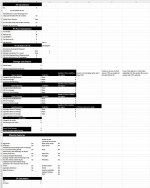
The idea that grimlocks and blights have their base stats altered to account for their surprise capabilities has merit. To make it work, there has to be a way to include the alterations in one of the fields of the CR calculator input form I've attached. They use this form to enter data, and it spits out the correct CR at the bottom.
 

Attachments

  • crcalculatorinputpage.jpg
    crcalculatorinputpage.jpg
    278.6 KB · Views: 28

For anyone (like @tomedunn ) trying to figure out why the formulas cease working above CR 19, this is in the 2014 MM Errata:

dragonxp.jpg


There appears to be a pattern. It looks like the XP values for 20+ may have originally been lower (and scaled significantly slower).
 

The idea that grimlocks and blights have their base stats altered to account for their surprise capabilities has merit. To make it work, there has to be a way to include the alterations in one of the fields of the CR calculator input form I've attached. They use this form to enter data, and it spits out the correct CR at the bottom.
It’s a bit kludgy, but just double their round 1 damage, under the assumption that they get 1 extra round of damage.

Would also explain why these monsters got buffed in 2024, where being surprised just imposes disadvantage on initiative instead of functionally granting your attacker a free extra round of attacks. CR had to remain the same, despite losing a lot of their damage output.
 

It’s a bit kludgy, but just double their round 1 damage, under the assumption that they get 1 extra round of damage.

Would also explain why these monsters got buffed in 2024, where being surprised just imposes disadvantage on initiative instead of functionally granting your attacker a free extra round of attacks. CR had to remain the same, despite losing a lot of their damage output.
The more I thought about it, the more skeptical I became that something like that actually affects CR. Too many other things that don't but should affect CR if that were the case, and the list of actual toggles to turn on seems woefully inadequate.

Anomalies caused by data entry errors are the bane of this whole project. With hundreds of stat blocks or more, there are almost certainly going to be at least a few straight up mistakes like that, where someone typed the wrong thing or forgot to round correctly.

But now that I have a formula that I think is likely to work, and I'm starting to test it out to identify how individual features work, I'll run into more of them, and I'll have to try to explain them. I'm much more comfortable with anomalies when I can see, "Ah, here's where they may have made a simple mistake!"

The equation I'm going to use to see what I can determine is:

hyptheticalequation.webp


I derived that formula by trying a lot of different variants of it (and a couple different types of formulas) and adding a new element into my analysis: 2024 versions of the basic monsters. I did this because, while some of the rules have changed, I bet they still use the same equation. Turns out, while there are some basic monsters that aren't basic in 2024 (because they impose conditions), the equation works for almost all of the other one: including the blights, the grimlock, and the myconid sprout! The only one it doesn't work for is the cyclops.

That formula works for all of the 2014 monsters except the blights and the myconid sprout. (You may remember that I had to choose between whether the grimlock or the sprout didn't work, and went with grimlock just because I liked the look of an equation a bit better, but this new evidence changed that.)

The cyclops not working in 2024 can be explained as a mistake if they were assuming that it still worked like 2014 and you could make 2 club attacks OR 1 rock. The damage is too high because of being able to throw 2 rocks. It works with 2 club attacks if you assume that imposing the Prone condition is worth 4 hp or less virtual damage, or if they only count doing it once (since it's probably not very effective to divide your attacks between 2 PCs).

That leaves all the remaining basic monsters working in 2024 (minus the 9 that don't exist or became non-basic).

So for 2014, the focus of this work, that just leaves the blights. The twig blight came out in the Basic Rules 2 or 3 months before the MM, so it's possible that they hadn't fully refined the formula yet. If I start seeing some other anomalies in monsters that are in the initial Basic Rules, I can look into that. The needle blight didn't come out until the MM, so it doesn't have that potential explanation.

For purposes of plausible explanations so I can continue to move on, I assumed the twig blight was mistakenly given one less HD than it should have (which fixes it, and is what 2024 does). I further assumed that they wanted there to be a relationship between the twig, needle, and vine blights, where they are CR 1/8, 1/4, and 1/2. Since they never change the CR on a monster and the twig blight's actual CR (with this formula) is less than its listed one, they had to do the same thing with the needle blight to get that. (If you give needle blight another HD without doing that to twig, it could throw off the intended balance between them.) It's a stretch to get that specific on how they might have messed up 2 of the blights, but given that the equation works just fine with 2024, I'm going to accept it for now and move on.

There are other reasons I really like that formula compared to all the many other ones I've attempted, including how it compares to the "accurate" formula I played with where you directly adjust HP by hit chance, and AC by to be hit chance instead of approximating it by adding AC and AB (as the above equation does).
 

Remove ads

Top