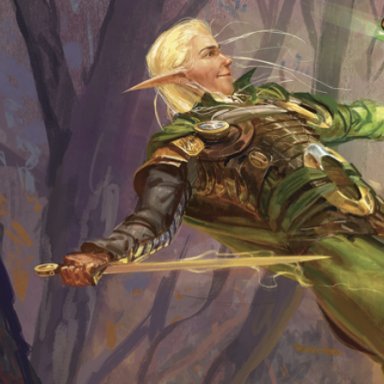
Dungeons & Dragons (2000) was a passion project turned cinematic disaster

Hey, something I've been wondering occasionally. Waaaaaaay back when this film was new, someone posted a great review of it on Usenet, probably rec.games.frp.dnd and maybe other places. It was one of those really funny grandstanding ones, but despite pointing out many flaws the reviewer couldn't really bring himself to hate it, basically considering it good dumb fun if you could switch your brain off sufficiently. To mention a couple specific lines I particularly liked, Profion was described as "a remarkably lifelike Jeremy Irons muppet" and there was a bit about how Thora Birch couldn't wait to get it over with so she could get on with poisoning her agent for getting her the part. If it's got those two bits in it, it's the right review.

I wouldn't mind getting its text back if anyone happens to have it saved, or still has sufficiently robust Usenet access to find it. It deserves more of an audience.
 

log in or register to remove this ad

Hey, something I've been wondering occasionally. Waaaaaaay back when this film was new, someone posted a great review of it on Usenet, probably rec.games.frp.dnd and maybe other places. It was one of those really funny grandstanding ones, but despite pointing out many flaws the reviewer couldn't really bring himself to hate it, basically considering it good dumb fun if you could switch your brain off sufficiently. To mention a couple specific lines I particularly liked, Profion was described as "a remarkably lifelike Jeremy Irons muppet" and there was a bit about how Thora Birch couldn't wait to get it over with so she could get on with poisoning her agent for getting her the part. If it's got those two bits in it, it's the right review.

I wouldn't mind getting its text back if anyone happens to have it saved, or still has sufficiently robust Usenet access to find it. It deserves more of an audience.
I believe the text of that particular review can be found over here, as well as on over on rpg.net.
 

Dungeons & Dragons (2000) was a passion project turned cinematic disaster 25 years ago, a diehard D&D fan defied the odds to make his dream movie — it was a total disaster

I got the impression while reading this the writer was trying to rehab the movie and Courtney Solomon. I'm not sure the fan base will agree. What say you, the fan base?
Back in the day, as we approached the release of the film, that was the narrative WotC shared . . . the plucky kid who brazenly walked into TSR's offices and convinced them to give him the rights to the D&D movie . . . he then struggled through a decade of development hell but persevered to make his dream come true . . .

If I remember correctly, turns out, Lorraine Williams was AUNT Lorraine Williams to young Courtney Solomon. She simply wanted to keep the profits within the family. Similar to the Buck Rogers deal, where TSR published several attempts at TTRPGs and board games . . . Williams is the sister of Flint Dille, both of the Dille Family Trust that controls the Buck Rogers franchise.

EDIT: You know, I probably should have researched before posting (I know . . .). I can't verify this memory of mine by a quick Google-search. But Solomon was friends with Flint Dille, Lorraine Williams brother. I can't verify that Solomon himself was related to Williams. Sorry for that.

Courtney began his career producing a not-very-good movie. Despite his family connections at TSR and in Hollywood. And to the best of my knowledge, has made a decent career of producing even more not-very-good movies since then. It blows my mind that this was a valid and successful career path for the guy, but here we are.

The article in the OP certainly seems like its blowing smoke up somebody's . . . well, not sure of the author's point, but Solomon is no unsung or underappreciated Hollywood talent. Just one of many mediocre folks making mediocre films in Hollywood.
 
Last edited:

Solomon doesn't technically name Williams in this interview from when he was doing the circuit for An American Haunting, but it should be obvious that's who he's talking about.

Interview: INTERVIEW: COURTNEY SOLOMON (AN AMERICAN HAUNTING) | CHUD.com

Q: How did that sort of affect the way you approached this? You didn’t like the way Dungeons and Dragons turned out. Now you’re coming out with your next film, how do you make sure that you do like this one?

Solomon: I wrote this one. So that made it a lot easier for me. I mean Dungeons had a lot of stories. I know I don’t really talk about it all that much but it has a lot of stories behind it because I got those rights when I was like nineteen or twenty and that company changed ownership many times. And when I originally got them, being so young with no track record, I gave them director approval on the rights agreement, I gave them script approval on the rights agreement. Things a studio would never, ever give.

Q: The company at that time was –

Solomon: TSR. And the woman that owned it was like a trust fund baby and she got this company for like, I believe you know, a couple hundred grand from Gary Gygax because he spent it on some coke binge or something – as the story goes. I can’t validate if that would casbe true or not. But that’s how the story goes. So she picked it up, and when I went in to her and I came up with this whole thing, when we did the script for example, she was like, ‘I want to make toys.’ I’m like, ‘Lady, your audience doesn’t want to buy toys. That’s not who the D&D audience is. You gotta make a different film.’ She didn’t care.

And what happened was, you know, long story short, you know. I got, you know, Jim Cameron to agree to do it at one point in 93. She sits at the Bel Air Hotel Restaurant [with Cameron], she folds her arms, she looks at him and says – its 93 – she says, ‘What are your qualifications to direct this film?’ I was like, ‘OK, Jim, please don’t kill me right now. I know about your temper, please don’t do it. Ok.’

Look, at twenty-three as a producer, I originally only intended to produce Dungeons and Dragons. That was the thing, I could get the rights, go to Hollywood, get a big director like Jim Cameron, hey I brought her Francis Coppola, I brought her Renny Harlin in the early 90’s. At that point these people were hot, and she turned them all down, she had the approval.

So then she lost her company – what a surprise – about three years later and Wizards of the Coast bought it.
The guy who ran Wizards of the Coast stepped into it like a lucky naughty word, you know, he’d gotten Magic: The Gathering, made a ton of money really quickly, bought the Dungeons and Dragons company and at that point I had gotten involved with Joel Silver. We had rewritten the script to be a good script that should be D&D, we were attaching a filmmaker and we had it financed for a decent amount of money. And that guy came in and he started a lawsuit with us just as we were about to shoot. So financing, everything all falls through, we have to fight with these guys. We settle with them because their lawsuit was bogus and we’d been working on it for six years. But part of the settlement was we had to go within a certain amount of months and start production on the movie or we’d lose our rights entirely, that was just the easy way out because who gets into this to fight a lawsuit.

At that point my investors had put a lot of money in, they said, ‘You know this movie better than anybody. You’re directing.’ I’m like, ‘I don’t want to direct this movie.’ And then, part of the settlement was, I got stuck having to do the script that she originally approved many years earlier. And they did it on purpose because they wanted the whole thing to fail. I was like, ‘You guys are fools. It’s your property, why do you want to do this?’ They didn’t care. The guy just had blinders on. So, whatever, we had millions in, time in, everything else, we had obligations to people so that’s it. That’s not how you want to direct your first film. My original plan was, I’m going to produce this, start to make a name in Hollywood, learn from a big director and then go to direct my first movie.

OK, all said and done, and there were a lot of problems afterwards, all said and done, great learning experience. What did I bring back to it? American Haunting. Looking at it, I know what I did wrong personally. I knew what I wasn’t in control of personally Dungeons and Dragons. So I tried to learn as much as I possibly could.

Now, Solomon is clearly doing everything he can to promote himself in this interview. And he's ostensibly talking things up to be edgy rather than a historian. And his language is questionable at times. But there it is.
1765691905024.png


I think Solomon's story is true . . . enough, from his own point of view. Williams saved TSR and also killed TSR. She wasn't the evil monster many old-school fans want her to be, but she did make a lot of questionable decisions while at the helm. I do think Solomon is overstating Williams turning down famous directors . . . directors are attached and then leave films all the time, it's not out of the ordinary.

I'd be curious if Peter Adkinson (founder and head of WotC at the time) has ever spoken about the project from his point of view, or anyone else involved from WotC's end of things. I doubt Adkinson and WotC wanted the movie to fail, they certainly promoted the hell out of it leading up to its release. They certainly tried to regain the rights from Solomon, as they (rightly) felt he wasn't up to the task. But once the legal battle was over, they promoted that film hard. To the point I felt a little betrayed after I saw the film . . .
 

Forgive me for taking this quote with a huge grain of salt.: "TSR owner Lorraine Williams allegedly refused both Francis Ford Coppola and James Cameron as directors." :rolleyes:

Sure she did. Add that to the list of her alleged crimes against the fanbase. That's some quality reporting.

It’s all based on quotes from Solomon from another article but to your point, who knows if any of that is true. To this day, Williams still doesn’t give interviews about TSR decisions. It feels like just more mythologizing going on. When someone gets Cameron, or Coppola, or Harlin to say “Yeah, I was looking at a D&D movie back in the 90s, but the owners of the game didn’t want me near it.”, THEN I’ll believe it.
 
Last edited:

It’s all based on quotes from Solomon from another article but to your point, who knows if any of that is true. To this day, Williams still doesn’t give interviews about TSR decisions. It feels like just more mythologizing going on. When someone gets Cameron, or Coppola, or Harlin to say “Yeah, I was looking at a D&D movie back in the 90s, but the owners of the game didn’t want me near it.”, THEN I’ll believe it.
I would pay good money for Williams own detailed account of TSR events.


I've definitely read articles or seen YouTube videos with all this information before, and my real question remains unanswered, namely how did someone with no apparent experience get handed the D&D movie (and seemingly on the strength of a vision for the movie which, judging by the end result, was pure generic fantasy)? How did the project continue to get the greenlight when he turned in a terrible script?

Hollywood accepts undercooked premises and terrible scripts all the time, but usually you have to have star power or at least an established track record to get this much financing for something this terrible.

It’s all based on quotes from Solomon from another article but to your point, who knows if any of that is true. To this day, Williams still doesn’t give interviews about TSR decisions. It feels like just more mythologizing going on. When someone gets Cameron, or Coppola, or Harlin to say “Yeah, I was looking at a D&D movie back in the 90s, but the owners of the game didn’t want me near it.”, THEN I’ll believe it.

I'd believe that production companies associated with those directors showed interest in optioning the rights, or that people pitched D&D movies suggesting these names to direct. But if any of these directors was serious about directing the sort of movie which could be branded as a D&D movie I think not getting the D&D licensing would not have been a barrier and they would have made some sort of medieval fantasy movies. D&D has lots of specific monsters, spells, settings, and ludonarrative conceits that players might fixate on as making it distinctive, but to the general public it's generic pseudo-medieval fantasy, and from a 1990s Hollywood's perspective only the marketing department care's about D&D branding. I just find it really improbable that Francis Ford Coppola was jazzed about making a fantasy movie, but then, upon being denied the use of the Greyhawk setting or Owlbears or something, just shelved the project.

But the few people who really know (or knew) aren't talking. Maybe James Cameron's Avatar series somehow started out as a failed attempt to make a live action version of the D&D cartoon series.
 

I'd believe that production companies associated with those directors showed interest in optioning the rights, or that people pitched D&D movies suggesting these names to direct. But if any of these directors was serious about directing the sort of movie which could be branded as a D&D movie I think not getting the D&D licensing would not have been a barrier and they would have made some sort of medieval fantasy movies.

Yeah, there’s different levels of interest and involvement, and a good portion of it just amounts to name dropping.

I will say - given Solomon was a twenty something year old when he directed the movie, it is an accomplishment that he was able to get the movie made with the cast that it had. Most people don’t even get that far. I just think there are some tall tales being told here.
 

Remove ads

Top