D&D 5E (2014) Is Point Buy Balanced?

You don't have to roll all 18s, the same would be true if you rolled all 13s or all 4s.

It's true that both the Standard method and the Point Buy method encourage score dumping. The difference though is that with the Standard method you're not making a 27-point cookie. You're unlikely to roll up a set of scores that equals 27 points.° You might end up with a 23-point equivalent, a 36-point equivalent, or even an unevaluatable set of scores.

Dump scores are the problem. Not low scores. Not average scores. Not even high scores. Dump scores are not the same as low scores. Low scores are low, but Dump scores are lower scores that enable another score to be higher.

This all originates from Arrangement of scores. For instance, if we rolled this set of scores (3, 4, 4, 4, 4, 4,) and rearranged them then 3 would be the dump score.°°

Yes, 10 is just an average score. But it is a Dump Score of you placed it in an ability so you could use your 12 or your 15 for something more useful.

° This may not be true. I'm still cracking at the math to find the answer.
°° If we placed that 3 the in a score to enable another score to be a 4. But, there's not much difference between a 3 and 4 anyway.
Is there any way to arrange scores without dumping one?

If I have the following set to arrange: 18 17 16 15 14 13, then I must put the 13 somewhere - is that a dumped score?
 

log in or register to remove this ad

Is there any way to arrange scores without dumping one?

If I have the following set to arrange: 18 17 16 15 14 13, then I must put the 13 somewhere - is that a dumped score?

To a point, I think. How much of it is depends on the difference between what a 13 does for you and a 14 (or even a 15). I'd say in D&D 3e or 4e, it'd be a pretty mild dump because the difference is pretty mild.

On the other hand, if you've got all scores that are 14 or higher except one 10, I'm betting most people will hunt the attribute that least matters to them (traditionally for a lot of characters Charisma, but that may be less true in 5e) to put that in.
 

To a point, I think. How much of it is depends on the difference between what a 13 does for you and a 14 (or even a 15). I'd say in D&D 3e or 4e, it'd be a pretty mild dump because the difference is pretty mild.

On the other hand, if you've got all scores that are 14 or higher except one 10, I'm betting most people will hunt the attribute that least matters to them (traditionally for a lot of characters Charisma, but that may be less true in 5e) to put that in.
By that definition, arranged scores always includes a dump stat (unless all of your scores are the same.)

If that’s basically always happening, how is that a problem for the game? 5e definitely works, and works well for more players than every other edition combined, so I really don’t see how it could be a significant issue with the game.
 

So, just to make sure I get it, rounding up an odd attribute to an even could be occurring every 4 levels if someone wished?

When you hit certain levels you can either get 2 points to add to whatever ability scores you want or a feat. Some feats give you a relatively minor benefits to a specific stat. So you get proficiency in Dexterity saving throws and a +1 to Dexterity.
 

By that definition, arranged scores always includes a dump stat (unless all of your scores are the same.)

If that’s basically always happening, how is that a problem for the game? 5e definitely works, and works well for more players than every other edition combined, so I really don’t see how it could be a significant issue with the game.

I think you can argue there usually is a dump stat of some sort; the only exceptions I can see is when, for whatever reason, you're working with a bunch of stats in tight range (if you've got three 14's and three 12's to work with, its hard to say which one is the "dump stat" in practice).

And I'm agnostic about how the array or point assignment works out at least. I think there's fair evidence that for a lot of people random gen doesn't, but some people love it and I don't know why they'd love it any less in 5e.

Basically there may be people who are hostile to dump stats, but the only degree to which I might be one of them is preferring a game not really having anything you want to dump, but given I know a very small number of games that do that (because its hard) its not a big criticism.
 

When you hit certain levels you can either get 2 points to add to whatever ability scores you want or a feat. Some feats give you a relatively minor benefits to a specific stat. So you get proficiency in Dexterity saving throws and a +1 to Dexterity.

Ah, its not generic so much as a benefit of some specific feats. Got it.
 

The problem is I'm not just interested in the average here, but the variance. That's always where the problems with most systems with random gen land.
This is accounting for the variance.

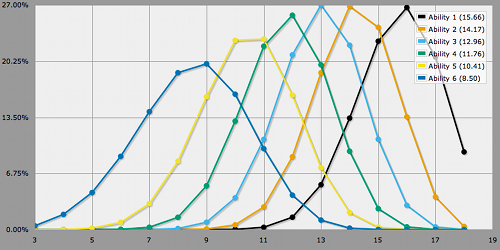
When you roll six sets of 4d6k3, there will be a range for what "the highest stat of that set of six" is. That range will be narrower than the range for just any result of 4d6k3, because you're specifically selecting for the largest one. The peak will be further right and narrower than the peak of just any general roll would be. Likewise, the peak for the single lowest stat will be narrower and further left.

Here's the chart, if you want the variance component added in.
6_abilities.png

The chart only explicitly lists the average values. The SDs, in order 1, 2, etc., are 1.43, 1.44, 1.46, 1.53, 1.66, and 1.95.

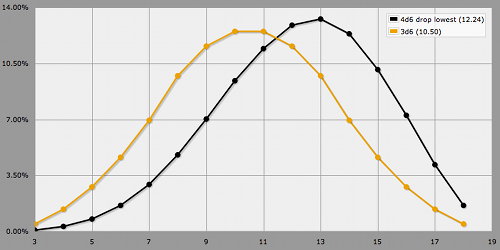
This chart, by comparison, shows the difference between 3d6 and 4d6k3.
4d6dl_vs_3d6.png

The SD for 4d6k3 is 2.85--significantly greater than even the distribution for the worst stat, and almost double that of the highest stat.

I dunno. If you have placement choice, I'd still call assigning the low stat to the one that matters to you least fits the definition of "dump stat" I've always seen. Its not a tradeoff per se, but its still taking advantage of the lack of impact of that particular attribute on you to dispose of a low value.
What definition would that be? I'm genuinely curious.

I think you can argue there usually is a dump stat of some sort
My problem is the "of some sort" here. I believe "dump stat" is a fairly strong term. Not like ironclad unequivocal, but for it to be a "dump stat" it has to be more than "I ended up having to choose something for the 7 I rolled to go in".

To me, "dump stat" means that you actively picked something to pull points out of, knowing the cost would be minimal. Merely having some lowest score is insufficient for that. Rolled stats are not totally immune to having a "dump stat", but they have at least a little bit of protection against that simply because you can't pull points out of anything to put into anything else. At least not with current rules. There were, I'm given to understand, ways to massage the old strict rolling method, where you could pull points out of stat X to put into stat Y, but at a 2-for-1 rate.

So...yeah it's the "of some sort" that I'm having issues with here. I see the term as being pretty clear in meaning, requiring some degree of minmaxing to qualify, even if it's just a little bit. Regardless of method, but especially if you roll stats, something is going to have to be the lowest number (possibly multiple somethings). Like if I roll and get {18, 15, 14, 13, 12, 10}, is it really warranted to say that if I put the 10 in Dex that Dex is my "dump stat"? Or Cha or whatever. It just feels...off to refer to something you absolutely have to assign at some point as being a "dump" stat solely because every ordered set of numbers necessarily has a least element (though there may be multiple instances of that least element). The {4, 4, 4, 4, 4, 3} array, or its twin, the {18, 18, 18, 18, 18, 17} array, illustrate what I mean by this--can we honestly call something a "dump stat" if you put a 17 into it?

 
Last edited:

This is accounting for the variance.

But it can't, because that's only statistical. It can't deal with what individual events can occur by its nature. Whatever the statistical expectations are, two occurances can still vary excessively as long as there's any significant variance at all. That doesn't mean it doesn't expect to be tighter than the straight roll, but it still exists.

What definition would that be? I'm genuinely curious.

I kind of just stated it; you dump the low roll in the stat that doesn't matter to you.
 

But it can't, because that's only statistical. It can't deal with what individual events can occur by its nature. Whatever the statistical expectations are, two occurances can still vary excessively as long as there's any significant variance at all. That doesn't mean it doesn't expect to be tighter than the straight roll, but it still exists.
Er...that's...that's exactly what statistics is for?

Are we using different meanings of "statistics"? The whole point of statistics is that it is used to analyze spread and variation. That's why it exists as a formal science. It would be like saying that arithmetic can't handle square roots. Of course it can, we built it (in part) to handle them!

My whole point here is that the variance isn't all that significant, and I can say that affirmatively because statistics can handle variance--and can compare the variances of two different distributions. In this case, I can tell you that over 92% of arrays have their highest stat being at least 14 (the second-highest might also be 14, to be clear.) That's precisely how we account for variance; yes, it is possible that a lower value could result, but within a reasonable range of statistical analysis, that variance is constrained.

I kind of just stated it; you dump the low roll in the stat that doesn't matter to you.
Then by definition every person always dumps at least one stat. Even if their stats are {18,18,18,18,18,17}. That seems...a pretty weak and impoverished definition of "dump stat", as it refers to behavior almost* everyone must engage in.

I had a much longer spiel here, but I think it's better to be pithy: I think for something to be a "dump" stat, it requires player intent. If you just happen to have already assigned your other scores and you're left putting the final, lowest value in the last open spot, it doesn't matter whether that value is 17 or 7 or 3. If, however, you intentionally put the lowest value in the place where you believe it will hurt you least, then yes, that's a dump stat. I might even call it that if it is a 17, though I do personally feel that degree of difference has some impact too.
 

I just said so. Like in that very post?

The point-buy method is, in part, designed in order to approximately match the spread of using the advertised rolling method as written. If you chop off the bottom third or quarter of it, you are very directly making PB-based characters weaker--or, if you prefer, making all characters stronger (on average) since a rational player will choose to roll under such conditions.

E.g. let's say we switch from regular 4d6k3 to the same, but you reroll all 1s, meaning it's functionally 4d5k3+3. Not only does this raise the average by a meaningful degree, it also narrows the spread, making nearly all values (over three quarters!) 12 or higher. This is functionally equivalent to throwing out any array which generates a value lower than 6, and makes 6 extremely rare (0.16% of single rolls of 4d5k3+3.) Most stats will be 12, 13, or 14--but you have a very good chance of getting at least one 18, which, at least in 5e, isn't possible via point buy, because the highest you can buy is 15. In fact, you have more than a 1-in-5 chance of rolling at least one stat higher than you could possibly buy.
OK so far - I see no problem with someone starting with an 18.
So...you'll rarely, if ever, have any downside from rolling--worst you're even remotely likely to get is a single 7
Using our usual 5d6drop2 I've seen a pretty good number of 7s and 6s - and even lower - over the years (including two 4s rolled almost simultaneously by different players; both players put the 4 into Int and the party's overall thinking capacity dropped like a stone when those two came into play).
--but you get a whole bunch of upsides. That distorts the power curve of the game in many ways. Sure, the GM can try to compensate by (for example) just pretending that your level is 1 higher than it really is, or whatever, but that's a kludge, not a solution.
Ideally the power curve is already flexible enough that this doesn't matter in the slightest. It's the same issue, from a different direction, as having uneven character levels within the party: the math should be more than forgiving enough to allow it and if it isn't, there's a problem.
With 5e already being...tenuously balanced at best, this could very easily result in tearing the whole thing wide open. One of the bigger problems of an already unbalanced game; there are degrees of imbalance just like balance, but it's far easier to accidentally make things much worse than it is to make things much better. Patterns are easy to break and hard to build from scratch, that sort of thing.
Agreed that it's easier to unbalance things than to balance them. The more important questions, though, are how much imbalance - particularly imbalance in the immediate here-and-now - is acceptable, and-or whether anyone at the table really cares.
 

Enchanted Trinkets Complete

Remove ads

Top