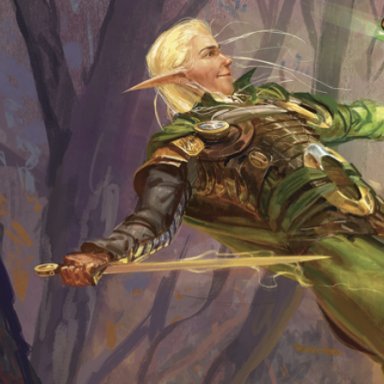
Leon Barillaro Joins Wizards of the Coast as D&D Designer

Barillaro started working for the company this year.
1767641429087.png


Leon Barillaro has also joined Wizards of the Coast as part of the D&D design team. As announced on their social media page, Barillaro is an experienced RPG designer with numerous third-party supplements on DMs Guild. They have design credits with MCDM, Renegade Games Studios, and EN Publishing as well. Per their Linkedin, Barillaro is working as a game designer for the D&D team.

Barillaro joins James Haeck as a new employee at Wizards of the Coast, with Justice Arman also receiving a recent promotion within the company as well. All three have similar resumes, having built up their resumes on DMs Guild material and third-party work before hopping over to join Wizards of the Coast in an official capacity.

 

log in or register to remove this ad

Christian Hoffer

Christian Hoffer

Congratulations to them; as @darjr said, I much prefer Christmas hiring to Christmas firing.

That said...am I the only one thinking these are a lot of high-profile hirings? That is, WotC hasn't exactly filled the calendar with a bazillion new releases. We've had a whole thread just to say "Nothing To See Here: Unstated Release Schedules Are Totally Normal".

Anyone else getting the idea that this might be the absolute very first step, or maybe zeroth step, as in "forget the planning stages, we're preparing to plan for the planning stages" levels of we-are-just-warming-up, toward 6e?

Maybe I'm just not used to hearing so many hirings and promotions in a short period of time. Maybe I'm just huffing the hopium that we might finally get a new edition. Maybe I just have pareidolia. But this looks suspiciously like preparation, especially since 5e itself was developed by an admitted skeleton crew with many delays (remember when conversion docs got delayed for literal years because ONE guy got jury duty?)
IDK, but I find it unlikely. I don't think you usually hire a bunch of new people to start writing a new edition. That doesn't make sense to me for a lot of reasons.
 

log in or register to remove this ad


This kinda disappoints me, because it’s not likely to happen again this way. Today if some kid wants to break into the industry, they’ve gotta throw their stuff into the ocean of content on DMsGuild or DriveThruRPG and then self-promote on social media and hope it gets traction somewhere (not to mention compete against the flood of AI slop). Far more kids are able to get their stuff “published”, but getting “published” is now trivially easy and doesn’t indicate even the slightest editorial oversight anymore. And there’s no guarantee anyone will even look at it. At least in the magazine days, if you got published that was a guaranteed stream of eyeballs on your work.

Idk, I’m just wistful for aspects of pre-digital life. I never submitted anything for publication (that I recall; I’d probably remember that, right?) so maybe the way things are today aren’t truly so different
It very much disappoints me. I still miss Dungeon Magazine. I've got mixed feelings about being the last ever Editor in Chief of the print incarnation of it, but most of them are pride at getting as many great authors published in it there before the end.


I know they have done the list before, but let me see if I can figure it out:
  1. OD
  2. AD&D 1e
  3. AD&D 2e
  4. 3e
  5. 3.5e
  6. 4e
  7. 4e - Essentials
  8. 5e
  9. 5e24
@Parmandur is that correct?

I mean by standard textbook definitions of "edition," they are probably correct.
Wikipedia counts 12 editions!

1974 (Original)
1977 (Basic Set 1st ver.)[1]
1977 (Advanced D&D)
1981 (Basic Set 2nd ver.)
1983 (Basic Set 3rd ver.)
1989 (AD&D 2nd Edition)
1991 (Rules Cyclopedia)
2000 (3rd edition)
2003 (v3.5)
2008 (4th edition)
2014 (5th edition)
2024 (Revised 5th edition)

It's missing your 7th edition -- 4E Essentials.
 

How does your list go?

It would be kinda fun to start referring to it as 9th edition!
Well, I lead with the caveat that I am not including OD&D or anyBasic, so that my list is also absurd. Just counting all versions of first parrt D&D I think I came up with seventeen distinct variations.

But for ninth, I am sticking by a more traditional publishing understanding of the term "Edition" for the PHB and DMG at least (2E complicates the MM on this point), with the distinction being a book called "Players Handbook" or "Dungeon Masters Guide" with a distinct ISBN assigned, so:

  • Original 1E AD&D
  • mid-80s 1E refresh, which got new ISBN numbers due to the number of changes though in our usual gaming parlance we consider this the "same edition"
  • 1989 2E AD&D
  • mid-90's 2E refresh
  • 3E
  • 3.5
  • 4E
  • 5E 2014
  • 5E 2024

So, nine typical editions of the PHB and DMG set (MM optional). Somewhat idiosyncratic, but considering 3.5 the sixth iteration of the AD&D core set makes more sense to my mind than a "half edition" at any rate, and this cuts across the question of how similar any new version is. 2024 is a lot less radical than 4E or even 3.5 (maybe 2E even), but a more significant change than the black cover 2E refresh.
 

I know they have done the list before, but let me see if I can figure it out:
  1. OD
  2. AD&D 1e
  3. AD&D 2e
  4. 3e
  5. 3.5e
  6. 4e
  7. 4e - Essentials
  8. 5e
  9. 5e24
@Parmandur is that correct?

I mean by standard textbook definitions of "edition," they are probably correct.
Not quite how it squares in my mind, though I think that is a reasonable list, too. Main thing to me is that pretty much any attempt to clearly enumerate the variations of first party D&D (let alone the myriad variations of actual D&D!) is a fraught exercise that is going to be mostly based on marketing.
 

Wikipedia counts 12 editions!

1974 (Original)
1977 (Basic Set 1st ver.)[1]
1977 (Advanced D&D)
1981 (Basic Set 2nd ver.)
1983 (Basic Set 3rd ver.)
1989 (AD&D 2nd Edition)
1991 (Rules Cyclopedia)
2000 (3rd edition)
2003 (v3.5)
2008 (4th edition)
2014 (5th edition)
2024 (Revised 5th edition)

It's missing your 7th edition -- 4E Essentials.
That's a pretty good list...to be ludicrously complete, one could add as you say 4E Essentials (which kind of lives in a strange offshoot world like BD&D?), the refreshes for "1E" and "2E", and the final "Black Box" edition of Basic...but I think that even may be missing something.
 

Wikipedia counts 12 editions!

1974 (Original)
1977 (Basic Set 1st ver.)[1]
1977 (Advanced D&D)
1981 (Basic Set 2nd ver.)
1983 (Basic Set 3rd ver.)
1989 (AD&D 2nd Edition)
1991 (Rules Cyclopedia)
2000 (3rd edition)
2003 (v3.5)
2008 (4th edition)
2014 (5th edition)
2024 (Revised 5th edition)

It's missing your 7th edition -- 4E Essentials.
I'm not super fond of that list because it intermingles branches. Including Basic D&D/Rules Cyclopedia is like calling your uncle an ancestor.
 

Enchanted Trinkets Complete

Remove ads

Enchanted Trinkets Complete

Remove ads

Top