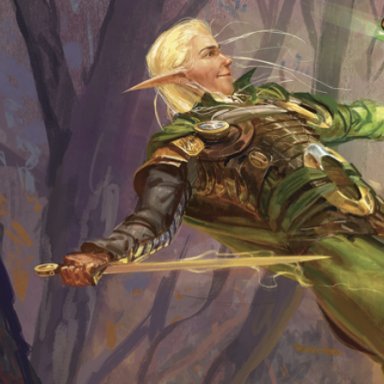
Why on earth would a group of PCs with any sense of self-preservation want to make a combat the least bit more challenging (i.e. dangerous) than they have to?
"Hey, I know, let's walk out of our hiding place and challenge those 20 Orcs to a fair fight! I mean, sure, they could easily kill two of us in the process, but that'd be way more fun than shooting most of them down from here and not taking a scratch, right?" Players who run PCs who think like that really do deserve to have those PCs die. Over and over again, if necessary.
Co-operative storytelling means you're co-operating to tell a story, but says nothing about what that story might consist of.
Yes, but that game is simulating what, in terms of the characters' reality?
Combat as war, where blood flows, survival is job one, and characters (and opponents) die in messy fashion?
Or combat as sport, where dramatic poses are struck, the foes die cleanly, and nobody else comes to any real harm?
I think that the reason that modern D&D doesn't tend to get into the above example is less about
combat-as-war being less popular (although it is), and more about
gaming-as-war being less popular.
People are playing more heroic characters, and adventures have become more about achieving a specific end rather than killing anyone in a specific uniform/of a specific race. D&D had its roots in wargaming, but attitudes have changed over the decades.
Thus the interest in wiping out 20 orcs before they can react has waned, since "They're orcs" is no longer a valid reason to kill them. If the party has the opportunity for a perfect ambush, it stands to reason that they could avoid contact completely. Or the characters may wish to actually talk to the orcs to find their intentions before deciding that they need to be killed. That won't stop them stacking the odds, but it precludes just murdering them before they are aware of the party.
To me, "cinematic" means what it says: the combat you see in a movie, whether it's Errol Flynn striking dashing poses during swordfights or a Marvel hero (any of 'em!) holding the "hero's landing" pose for a second or two or whatever.
And why does it work in conema but not in the game, you ask? Because in cinema you already know who's going to win, every time, which makes it inherently less entertaining and so they have to add extra entertainment to compensate; while in the game the outcome of any significant fight should never be nearly that certain and that uncertainty is itself the provider of entertainment.
There are other styles of film around, and even if the former are the only kind that you go to the cinema to watch, there is other media.
The Lord of the rings combat is often a bit too flashy, but some of the stuff like the Game of Thrones/Knight of the seven Kingdoms and similar is less so.
Now you can get less-cinematic combat in media, where things are set up so their opponents can't respond, and so the heroes are just killing their way through to show off how badass they are. But that form of set-piece combat is less common in modern D&D due to the above attitude change.
The post I was replying to when I first brought this up had as its main point somethng to the effect that trivialized combats aren't fun and so the game has moved to make it much harder to trivialize them, part of said movement being the softening of surprise benefits.
To me, this sounded like the game wants players to ignore tactical advantage and character self-preservation in favour of "cinematic" combats, which from the point of view of the characters themselves seems bag-o'-hammers dumb.
Not at all. If the PCs can set up a situation that's so one-sided that the combat's not even worth playing out (the point being made in the post I quoted) then so can the PCs' opponents. As the PCs losing a fight without it being played out wouldn't be good for the game, the flip side is that the so-called trivial combats that the PCs would normally win should (and IMO must) also be played out.
That, and I've on numerous occasions seen things go horribly wrong for parties even in the most trivial of combats. Dice can be stern masters sometimes.
The most famous example of this is the end combat in A3 Aerie of the Slave Lords, where the PCs are supposed to be captured in order to set up A4. The module takes it as a fait accompli that the PCs will lose and be captured.
When I ran A3 I ran this combat in full, and I'm glad I did; of a party of (I think) 8 characters, three or four escaped and fled while the rest got captured. From there, I ran it split-party for the rest of that adventure where half the party was operating outside the slavers' dungeon and the rest were operating inside it.
It's less likely in 5e than older editions, to be sure, but a trivial combat going sideways can still happen. A party of 8th-level characters vs lowly bandits can still get hammered if the PCs all roll 1s and the bandits hit 20s every time; and disallowing the chance for that to occur, no matter how remote that chance may be, IMO defeats the purpose of using dice in the first place.
There is always the potential for a lateral adjustment of the aggregate, but respect of the time of the people involved in the game is also a thing. Different DMs are going to draw the line in different places, but there is some point where a combat is so trivial, it is not worth wasting the half-hour or whatever of game time on.
Even if your neck is tingling and your spidey senses are on full alert, how can you effectively dodge something you don't see coming?
People have more than one sense.
People who often enter into dangerous situations where they rely on those senses can get
very good at paying attention to them.