Dark Legacies Campaign Guide

JoeGKushner

Adventurer
Dark Legacies Campaign Guide
RSP002
ISBN: 0-9735654-1-1
MSRP: $26.95
Format: 160 pages, perfectbound

The Dark Legacies Campaign Guide is a dark fantasy d20 System sourcebook that provides expanded rules and complete setting information for Dark Legacies, including:

Unique prestige classes tailored to low-magic gaming
Advanced technology, including battlesuits and armored transports
Rules for holy and demonic items of power
The Abyss on Earth: a codex of demonic creatures and supplemental encounter guidelines
Complete geography, history, and setting information for post-Reversion Earth

[imager]http://redspirepress.com/images/cover_dlcg.jpg[/imager]
 
Last edited by a moderator:

log in or register to remove this ad

Gritty game gets its setting

Dark Legacies Campaign Guide
Written by Yuval Kordov, Matthew Ruane, Duane Wheatcroft
Published by Red Spire Press
www.redspirepress.com
ISBN: 0-973564-1-1
RSP002
160 b & w pages
$26.95

Dark Legacies came out last year as one of a handful of options for running the d20 system in a grim and gritty fashion with rules to put players at the mercy of the GM by lowering the magic threshold and removing easy access to healing and traditional magic items. While the original book did a good job of laying down the ground rules, it didn’t provide the reader with an idea of what the campaign setting was like.

Enter the Campaign Guide.

Clocking in at 160 black and white pages in soft cover format for $26.95, the campaign guide is competitively priced. I’ve seen hard covers at this page count for $30.00 such as Northern Crown. For a few dollars more, perhaps it would’ve been hard cover? One of the strengths of the book compared to other products I’ve seen though, is the detail paid to art. While Adrian Smith, master of all things Warhammer and Warhammer 40K is not alone this time, the company has done an excellent job of insuring that all of the art is dark and detailed and doesn’t fall behind the standards Adrian sets. Joining Adrian this round, are Paul Davidson, John Gravato, Ted Pendergraft, and Jonathan Standing.

The Campaign Guide uses standard two columns formatting. The black and white coloring works against the page formatting, as it appears that the pages are supposed to be script from an ancient book, but the black and white gray scale makes it look a little dark on the outer, black edges. Margins are good on all three sides with a tight inner margin. Chapter names are at the top of the page next to the page number at the outer edge. Text is small but not difficult to read. Headers are bold and larger than standard text. While there is no index, there is a detailed table of contents.

Broken up into eight chapters, the book starts with an idea of what life is like in this new Earth. This includes things like a calendar, the climate, ecology, new disease, and the megacity. The megacity should be an old concept to anyone from Warhammer 40K even though it’s not a “Hive” city so to speak. Instead, these are large cities where you have some measure of security from the outside terrors, but have to worry about the inner corruption, including cults and your fellow man whose out for his own survival.

In broad strokes, the world is covered in chapter two, Geography. This includes the basics; Corelands, Eastern Ridge, Ban Got, Dwer Zotha, Burning Wastes, and Afflicted Territories. Under each broad region, such as the Corelands, you’ll find the countries within it. For example, the lands of Ilfernac, with the capital of Vience, is found under the Corelands section. You’ll find out the geographical features of the region, government, typical life and society, and details on the major cities. This includes name, population, and current status and brief history. A lot of ideas are touched on here, but none go into great detail.

This is good and bad, because some people like handholding. Some people like mega supplements. I know I enjoy the City State of the Invincible Overlord for the amount of detail it provides. The good news though, is that the reading isn’t dry, and actually has numerous plot seeds stuffed into each section.

Want a game with spies, intrigue, and double-dealing? Set it in the city of Montrey, where the ruler, Abril Lycene, is between the Vanguard of the Sovereign and the Daughters of Beyella. Want a game of Inquisitors hunting evil? Have the party act as raiders in the city of Galli, where “Plague bearers of Maeseral’s Devot…worships hideous winged demons…” How about a fairly standard style dungeon crawl? Use Vella, a city that boasts “an extensive subterranean world…” where treasure maps are sold in the streets themselves.

It’s not that these ideas are presented as such, but rather that the writing is exciting enough so that you have options, as opposed to limitations.

My only big disappointment with this section, is that we have no maps. While we do get some artists’ perspective of some of the areas, there are no actual maps. For example, it’s nice to see the semi-hidden city in the Burning Waste and the Brigg’s gathering in their tribes, but in some ways, the old 2nd edition Forgotten Realms Adventure hardcover set some standards that I’d like to see followed in terms of providing tools to the GM. Small loss though as such maps would take away from precious text or raise the page count and price. A book under $30 is fairly rare these days.

One of the things about the organization is that the book really needs to be looked at the whole way through at least once. Several of the organizations mentioned in the various geographical entries for example, have more details under chapter four, organizations. For example, the Ascendancy Inquisitori or Black Knives can both lend different types of campaign concepts ranging from demon hunting inquisitors to rogues out to make a buck for themselves. Each organization includes symbol, background, membership process, goals, power center, hierarchy, and relationships with other organizations.

After the fluff comes the crunch. And a lot of crunch it is. The book starts by noting that almost all of the PrCs from the Dungeon Master’s Guide are not appropriate for the Dark Legacies campaign and only the duelist is suited for the campaign. That’s okay as we have numerous PrCs in chapter four, prestige classes. The section starts off with Avatar “a self-appointed incarnation of Azrae on Earth”, and ends with the Wretched. These individuals are worshippers of Maeseral, the Dark Legacies equal of good old Warhammer’s Nurgle.

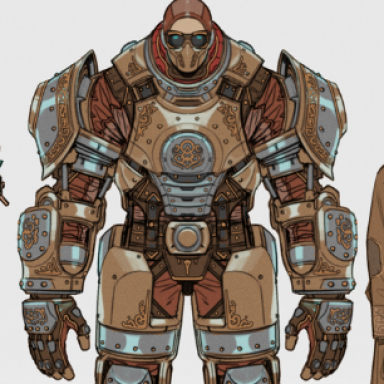
Between those, we get a lot of options. For instance, the Blessed Daughter’s are members of the Beyella Divinity that are in essence, masters of style and assassination, including poison use and advancements in sneak attack dice damage. The Combat Inventioneer is another favorite because we get the details on the battlesuits. They can built their own battlesuits that advance as they do with hit points, armor bonus, damage reduction, augmented strength, pressure threshold, fuel capacity and fortification against criticals. The fuel capacity is how long they last when feed as it’s a steam-powered vehiclde while the pressure threshold is how many actions the suit can take before being rebuilt. The actions can be regained if the pilot takes no actions, and free actions don’t expend any pressure. It’s not a super detailed system, but rather one that gets the character and his machine into the game.

There are some other interesting choices here, but I’m not going over all of them. Well, one more, the Tor Bul, a Brigg that is a champion and defender of Ban Got. I like it because it shows that not everything has to be about the humans.

The prestige classes do a good job of being prestige classes. They’re not generic little sets of abilities and powers. They start with a quote, go into some background and detail, and then move into the game mechanics. While it’s not as detailed in fluff as some of the recent Wizards of the Coast material, many of these PrCs already belong to an organization and have more details through that venue.

Chapter five, advanced technology, is a bit too brief for my taste, coming in at something like four pages with some examples of the level of technology. It’s okay, but after reading it, I don’t have a good grasp of what’s normal and what’s extraordinary. For example, the armored transport is huge coming in at sixty feet in height and three hundred feet long and capable of motion. Some different types of war machines, like steam catapults and flamethrows, also make a brief apperance with the steam-driven assault repeater. Good stuff to have in a fight, but a tight focus.

One of the areas that the initial book left for this one to handle, was items of power. Ever since I first read the Elric series in the eighties, I’ve always had a special place for demonic and holy weapons in my heart. Here, the items are powerful because they’re so rare, not necessarily because they’re D&D powerful. For example, items of power with four qualities are equivalent to artifacts in the core rules and no item can have more than a +2 enhancement bonus of any one type. However, an item of power doesn’t have to have an enhancement bonus as a prerequisite for other qualities. The example in the book is in essence a +0 sword with the Flaming quality. The rules provided cover both separately, holy and demonic items to keep things challenging.

One of the things that looks to have followed through from many eras, is that demonic items can often have side effects that have to be resisted or fought against. This includes everything from nightmares to abyssal plague, where the user’s body begins to break down. It’s good stuff and would be perfect for a game where demonic magic isn’t having enough negative effects to represent it’s inherent evil.

Chapter seven, The Abyss on Earth, provides some ideas on how to run the game. This is information that I felt should’ve been in the core book for GMs new to the game who didn’t want to slaughter the party in the first combat. It includes things like low-magic considerations, and adjusting monster abilities or which monster abilities are probably not good to use in mass. For example, since there are no restoration magic, ability and energy drain should be used sparingly.

For those wondering what monsters make a good fit into the setting, they provide a breakdown by type. For example, while there aren’t any giants or fey creatures as they’re normally represented, there are lots of animals and monstrous demons that take the place of dragons.

The section includes demon, a new creature type that is a subtype of Outsider. This includes the details of what this type gets per hit dice (fighter bab, good saves across the board, high skill points and a ton of abilities), as well as several example creatures like the Charnel Beast or Servitor.

The book wraps up with chapter eight, adventure ideas. These start with a title, such as Nightmare in Drogus, then follow up with a summary, environment, plot points, and notes. Useful stuff for starting off at different areas and since there are no game stats provided, the GM can adjust it for whatever level he needs. Not saying I wouldn’t love to see Goodman Games or another company come out with some specific low-magic adventures mind you.

Overall, the book does what it sets out to. While maps and more material on the cities would always be nice, the book does a good job of providing adventure seeds throughout the text. There is room for expansion in any number of areas, from adventurers to city books, but for the GMs who enjoy taking the bare bones of a laid out setting, the Dark Legacies campaign guide does a great job. For players, they now have the options of using battle suits and constructing holy and demonic items. What more could anyone ask for?

 
Last edited:

Dark Legacies Campaign Guide
Written by Yuval Kordov, Matthew Ruane, Duane Wheatcroft
Published by Red Spire Press
www.redspirepress.com
ISBN: 0-973564-1-1
RSP002
160 b & w pages
$26.95

Review by Baragos

Last year Red Spire Press released the first book for their gritty low-magic fantasy setting, Dark Legacies. The first book, titled Dark Legacies: Player’s Guide contained a wealth of information on the setting, including the races, new and revised classes, feats, equipment and a new magic system, that all helped to create a feeling of darkness and grittiness. It also hinted at the setting behind those rules, in it’s descriptions of races and classes for instance, and in the chapter dealing with religion in Dark Legacies. What it “lacked” was any detail on the setting itself.

Now, with the release of the Dark Legacies: Campaign Guide the setting comes truly alive.

The book is 160 pages in black and white, with 1 page used for the Open Game License, 1 for credits, and 1 for a table of contents. The remaining 157 pages have two columns of text in a very readable font, with a small very stylish border giving a feeling of old documents. The book contains 55 masterfully done drawings by Paul Davidson, John Gravato, Ted Pendergraft, Adrian Smith, and Jonathan Standing. Adrian Smith, who did all the art for the Player’s Guide, including the cover, has also done the cover for the Campaign Guide, and he doesn’t disappoint. Neither do the four new artists, who manage to capture the tone and feel of the setting, and of the first book to an astonishing degree. The book is divided into 8 chapters and contain 23 tables, the largest part being Prestige Class tables.

Here follows a brief description of the chapters:

Chapter 1: Life on Earth
The book starts with a chapter detailing stuff like the calendar, a brief but interesting timeline, notes on climate and living conditions, especially in the megacities, and my personal favorites, diseases. The stuff is relevant without being too dry. It is especially interesting, in my opinion, because so much of it is remarkably similar to things from the real world (which makes sense, since the setting is set on Earth in a distant post-apocalyptic future). The part on life in the megacities is realistically harsh and brutal, unlike many “soft” fantasy versions of life in big cities. And the section on diseases, as I previously mentioned as a personal favorite! Unlike standard D&D, where you just get the rules for how diseases affect PCs and NPCs, in Dark Legacies they have been tied into the setting, so that you will actually read about cities affected by Black Lung, for instance.

Chapter 2: Geography
The chapter on Geography starts with the nations of the Corelands, Ilfernac, Precaea, and Sarlat, followed by a section on the Eastern Ridge, then the various non-human regions, ending with a section on Afflicted Territories, basically everything outside the “civilized” lands. Each nation gets a brief overview, followed by a section with more detailed looks at geography, major cities, and the like. And in this chapter the book really shows its value. Every page contains information that could make an interesting adventure, but at the same time the world seems alive in some way. Unlike some fantasy settings, where the world seems like a playground existing solely for the sake of the PCs, here you have international and national politics, intrigue, and “action”. The chapter briefly mentions some important individuals, with only race, class and level, but on the Red Spire Press forum there’s a thread with stats for most, if not all NPCs mentioned.

Chapter 3: Organizations
Then follows the chapter on some of the major organizations, from the Abominari, a group of Hybrids formed in response to the Cleansing of the Prelace, to the different inner circles of the churches, to the Seaborne, an organization of Novag merchants and traders, transporting people and cargo along the length and breadth of the Corelands, and even beyond if the prize is right. Each organization has a brief overview, followed by details on membership, goals, power centre, hierarchy, and relationships with other organizations and nations. Like the geography chapter, one needs not look far for plot ideas.

Chapter 4: Prestige Classes
The book contains 16 prestige classes, ranging from self-appointed demon lords, to agents of the four churches, to Novag Combat Inventioneers. Often when I find new prestige classes all I see is a selection of cool abilities, that do not seem to have any real place in the setting, but in this case I was pleased to see that every prestige class was a bit of the setting. Several of the organizations detailed in the previous chapter gets a prestige class, as well as a few prestige classes for some of the different non-human races. None of them seem broken, though there are some that will be better suited for certain types of playing than others. It is difficult to pick a favorite among the 16, but I have a soft spot for the Combat Inventioneer, who can build a steam-powered battle suit and is very skilled at hunting demons.

Chapter 5: Advanced Technology
The chapter on advanced technology is only 4 pages long, but it manages to capture the role of technology in Dark Legacies. Dark Legacies is an early industrial setting, with manufacturing plants, smog-covered cities, and disease-filled sewers. Technology in Dark Legacies is more a part of the scenery than of the action, similar in many ways to the technology seen in films like Bladerunner.

Chapter 6: Items of Power
The next chapter details Items of Power, this settings version of magical items. Just as magic is very rare and dangerous in Dark Legacies, so are magical items. The chapter starts with a large section on how to handle items of power in the game and on the construction of these items, followed by a list of demonic and holy qualities that can be added to items. Unlike D&D where a longsword must be +1 before it can become Flaming, in Dark Legacies, due to the low-powered nature of magic, you can have magical weapons entirely without enchantment bonuses. They will still count as enchanted for purpose of penetrating the damage reduction of demons, etc. The list of powers is quite long, and so is the list of Demonic Side Effects. Most demonic items of power have one or more flaws, depending on the skill of the crafter, so sometimes the price of an item may seem larger than the power. But this helps create the feeling of darkness that is integral to Dark Legacies. A few examples of holy and demonic items of power follow, such as the Murderer’s Mask, in the shape of a wolf’s head, that gives the wearer Scent and the ability to send telepathic messages, but at the same time corrupts the wearer in the form of daily taint points.

Chapter 7: The Abyss on Earth
The Abyss on Earth deals with monsters and combat, and with the consequences of a low-magic setting. In addition to 13 new creatures particularly suitable for Dark Legacies, it also includes one template, the Tainted meant to replace the Fiendish template from MM, and a creature type, the Demon. Dark Legacies doesn’t distinguish between demon and devil, or any other kind of evil outsider for that matter, plus most demons have fewer special abilities, making them more specialized in nature. The chapter also talks about the other creature types, how they could be used in Dark Legacies.

Chapter 8: Adventure Ideas
The last chapter presents 8 half-page adventure ideas for use by the DM. They are varied enough in both scope, level, and setting to guarantee that there’ll be something for every group of players out there. Even if you are going to do all your scenarios yourself, they are an interesting read and might give you some ideas for twists in your own plots.

Overall Impression
The book fully lives up to the expectations I had after reading the Player’s Guide. It is very well done, with tons of ideas scattered on almost every page of the book. The art work is amazing and at a cost of less than 20c per page, I think it is worth every dime. I’d have liked to see a few maps in the book, but it is not something that ruins my enjoyment of the Guide.

Note: I am one of the playtesters of this book, as well as the Player’s Guide, but I have tried to remain impartial on this review. If anyone feels I am not, all I can say is that I am only human :)
 

In the era of d20 there has been an interesting trend to do low magic grim like settings. It seems that they are popular with one like Black Company, Thieves World, Midnight, and others dominating the scene. There is really only one true opposite of a high adventure high magic setting I can think of and that is Oathbound. I know a lot of people consider normal D&D to be high magic but as that is the base line I always think of it as average. Perhaps though with the number of lower magic options on the market and their continued success with have an impact on how the base game is done in the future. Dark Legacies is a lower magic grim like setting so add another one to that long list.

Dark Legacies Campaign Guide is the second book by Red Spire Press. This one hundred and sixty page soft bound book is also the second in the Dark Legacies product line the first being the Dark Legacy Players Guide. The first thing I really noticed in this book is the amazing art. The Players Guide also had exceptional art in it that got it an ENnie nomination and the art in the Campaign Guide is equally as good. Paul Davidson, John Gravato, Ted Pendergraft, Adrian Smith, and Jonathon Standing all have some great works in this black and white book. Many of these pieces are works that I can see hanging on walls. The layout and organization of the book is well done.

After getting and reviewing the Players Guide I have to admit I have been waiting to really get a chance to go through the Campaign Guide. This is the book with the setting and the details I thought were missing from the Players Guide. This is the book that really presents in full force the sheer scope of the setting and the fun little details that I so thoroughly enjoy. Like for instance the calendar of events presented in the first chapter. The time line starts with the Earth coming out of the abyss and is says that either the information on the years before is lost or has been intentionally obfuscated. Just that simple idea presents the many possibilities of who is hiding the info and the all important why. No hints on this are given, but it is easily enough for a good DM to really get the imagination ruling and present different and interesting plots and conspiracies to the players.

The first chapter is more then just a time line and brief history of the world. It starts with a good calendar and gets into ecology, diseases, mega cities, and a lot of really nice setting information. It really presents and allows one tom imagine how the world in a small part can work especially for the more common peoples. It has some good information on culture, quality of life, and making a living. I love how it presents that the Mega cities are terrible places to live but are still almost infinitely better then the rural places. This is not a fun and joyous setting.

The next two chapters really bring the setting to live covering the geography and the organizations. In other words places and people and that is always paramount to a game. There is a nice mix of plenty of detail to give a DM a few dozen ideas and at the same time not micro managing the setting in such a way that makes it difficult for DMs to insert their own ideas and go beyond the word and descriptions presented here. These are really the core parts of the book in setting and material. The art really reinforces the writing her presenting great pictures that show just how dark and grim the setting can be. The art is like the perfect punctuation to get across the exact feel of the setting and it is rare that art and words go together so well.

The next part of the book is the mechanics section or what are more widely called Prestige Classes. The book does a fantastic job of everything really reinforcing the setting. It starts with the Avatar. This is a priest or mage who evolves and some may call it degrades into a hybrid of demon and themselves. Over the ten levels of this class the character metamorphosis’s into something quite unnatural and powerful. It works as a great example of what the setting can do, a nicely balanced class with interesting and different abilities, and a fantastic basis for role playing a character down this potentially dark path. It is rare to have class meet that trifecta of those so well.

The other real mechanic section that brilliantly fits into the setting is the Items of Power section. In the Players Guide I found the magic section to be one of the strongest parts of that book and again I find the magic section here to be one of the best parts in terms of not just what it can do but also in the great flavor of the section. There are holy items and there are demonic items here. Or more precisely there are rules for creating them. These items do not just have powers but they can have side effects. These can include extreme cold, thinning of the air, and even causing such things as mass hysteria. There are a lot of options to allow a creative DM to really get some awesome items in existence with interesting prices for the power.

The last section covers creatures and adventures. It starts out though with low magic consideration in other words things the DM might want to think about when he is planning combat for the player characters. There are things like raising the encounter level for out numbering the party and to do the same if the party happens to have characters that are non combative. It has a minor change to damage reduction and cautions on using ability and energy drain as that become a lot more powerful here. The adventure section is another highlight in the book. It is more of adventure ideas but has some very creative options. My favorite is Prisoner 17. It offers some interesting possibilities for bringing in some different organizations and allowing the party plenty of action and role playing options in the course of this simple idea that can be made so very complex.

Dark Legacies Campaign Guide is the book I wanted and was expecting when I read through the Players Guide. It is filled with great imagery and brings this dark setting alive. It is a rare book that everything does a fantastic job of supporting the core setting and feel of the campaign world.
 

Enchanted Trinkets Complete

Recent & Upcoming Releases

Remove ads

Top