Gritty game gets its setting
Dark Legacies Campaign Guide
Written by Yuval Kordov, Matthew Ruane, Duane Wheatcroft
Published by Red Spire Press
www.redspirepress.com
ISBN: 0-973564-1-1
RSP002
160 b & w pages
$26.95
Dark Legacies came out last year as one of a handful of options for running the d20 system in a grim and gritty fashion with rules to put players at the mercy of the GM by lowering the magic threshold and removing easy access to healing and traditional magic items. While the original book did a good job of laying down the ground rules, it didn’t provide the reader with an idea of what the campaign setting was like.
Enter the Campaign Guide.
Clocking in at 160 black and white pages in soft cover format for $26.95, the campaign guide is competitively priced. I’ve seen hard covers at this page count for $30.00 such as Northern Crown. For a few dollars more, perhaps it would’ve been hard cover? One of the strengths of the book compared to other products I’ve seen though, is the detail paid to art. While Adrian Smith, master of all things Warhammer and Warhammer 40K is not alone this time, the company has done an excellent job of insuring that all of the art is dark and detailed and doesn’t fall behind the standards Adrian sets. Joining Adrian this round, are Paul Davidson, John Gravato, Ted Pendergraft, and Jonathan Standing.
The Campaign Guide uses standard two columns formatting. The black and white coloring works against the page formatting, as it appears that the pages are supposed to be script from an ancient book, but the black and white gray scale makes it look a little dark on the outer, black edges. Margins are good on all three sides with a tight inner margin. Chapter names are at the top of the page next to the page number at the outer edge. Text is small but not difficult to read. Headers are bold and larger than standard text. While there is no index, there is a detailed table of contents.
Broken up into eight chapters, the book starts with an idea of what life is like in this new Earth. This includes things like a calendar, the climate, ecology, new disease, and the megacity. The megacity should be an old concept to anyone from Warhammer 40K even though it’s not a “Hive” city so to speak. Instead, these are large cities where you have some measure of security from the outside terrors, but have to worry about the inner corruption, including cults and your fellow man whose out for his own survival.
In broad strokes, the world is covered in chapter two, Geography. This includes the basics; Corelands, Eastern Ridge, Ban Got, Dwer Zotha, Burning Wastes, and Afflicted Territories. Under each broad region, such as the Corelands, you’ll find the countries within it. For example, the lands of Ilfernac, with the capital of Vience, is found under the Corelands section. You’ll find out the geographical features of the region, government, typical life and society, and details on the major cities. This includes name, population, and current status and brief history. A lot of ideas are touched on here, but none go into great detail.
This is good and bad, because some people like handholding. Some people like mega supplements. I know I enjoy the City State of the Invincible Overlord for the amount of detail it provides. The good news though, is that the reading isn’t dry, and actually has numerous plot seeds stuffed into each section.
Want a game with spies, intrigue, and double-dealing? Set it in the city of Montrey, where the ruler, Abril Lycene, is between the Vanguard of the Sovereign and the Daughters of Beyella. Want a game of Inquisitors hunting evil? Have the party act as raiders in the city of Galli, where “Plague bearers of Maeseral’s Devot…worships hideous winged demons…” How about a fairly standard style dungeon crawl? Use Vella, a city that boasts “an extensive subterranean world…” where treasure maps are sold in the streets themselves.
It’s not that these ideas are presented as such, but rather that the writing is exciting enough so that you have options, as opposed to limitations.
My only big disappointment with this section, is that we have no maps. While we do get some artists’ perspective of some of the areas, there are no actual maps. For example, it’s nice to see the semi-hidden city in the Burning Waste and the Brigg’s gathering in their tribes, but in some ways, the old 2nd edition Forgotten Realms Adventure hardcover set some standards that I’d like to see followed in terms of providing tools to the GM. Small loss though as such maps would take away from precious text or raise the page count and price. A book under $30 is fairly rare these days.
One of the things about the organization is that the book really needs to be looked at the whole way through at least once. Several of the organizations mentioned in the various geographical entries for example, have more details under chapter four, organizations. For example, the Ascendancy Inquisitori or Black Knives can both lend different types of campaign concepts ranging from demon hunting inquisitors to rogues out to make a buck for themselves. Each organization includes symbol, background, membership process, goals, power center, hierarchy, and relationships with other organizations.
After the fluff comes the crunch. And a lot of crunch it is. The book starts by noting that almost all of the PrCs from the Dungeon Master’s Guide are not appropriate for the Dark Legacies campaign and only the duelist is suited for the campaign. That’s okay as we have numerous PrCs in chapter four, prestige classes. The section starts off with Avatar “a self-appointed incarnation of Azrae on Earth”, and ends with the Wretched. These individuals are worshippers of Maeseral, the Dark Legacies equal of good old Warhammer’s Nurgle.
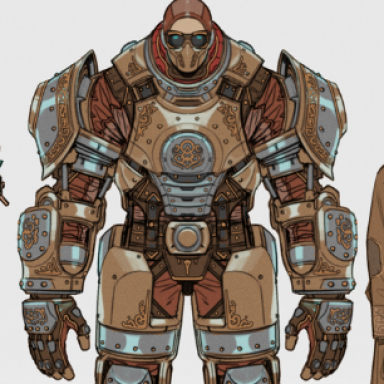
Between those, we get a lot of options. For instance, the Blessed Daughter’s are members of the Beyella Divinity that are in essence, masters of style and assassination, including poison use and advancements in sneak attack dice damage. The Combat Inventioneer is another favorite because we get the details on the battlesuits. They can built their own battlesuits that advance as they do with hit points, armor bonus, damage reduction, augmented strength, pressure threshold, fuel capacity and fortification against criticals. The fuel capacity is how long they last when feed as it’s a steam-powered vehiclde while the pressure threshold is how many actions the suit can take before being rebuilt. The actions can be regained if the pilot takes no actions, and free actions don’t expend any pressure. It’s not a super detailed system, but rather one that gets the character and his machine into the game.
There are some other interesting choices here, but I’m not going over all of them. Well, one more, the Tor Bul, a Brigg that is a champion and defender of Ban Got. I like it because it shows that not everything has to be about the humans.
The prestige classes do a good job of being prestige classes. They’re not generic little sets of abilities and powers. They start with a quote, go into some background and detail, and then move into the game mechanics. While it’s not as detailed in fluff as some of the recent Wizards of the Coast material, many of these PrCs already belong to an organization and have more details through that venue.
Chapter five, advanced technology, is a bit too brief for my taste, coming in at something like four pages with some examples of the level of technology. It’s okay, but after reading it, I don’t have a good grasp of what’s normal and what’s extraordinary. For example, the armored transport is huge coming in at sixty feet in height and three hundred feet long and capable of motion. Some different types of war machines, like steam catapults and flamethrows, also make a brief apperance with the steam-driven assault repeater. Good stuff to have in a fight, but a tight focus.
One of the areas that the initial book left for this one to handle, was items of power. Ever since I first read the Elric series in the eighties, I’ve always had a special place for demonic and holy weapons in my heart. Here, the items are powerful because they’re so rare, not necessarily because they’re D&D powerful. For example, items of power with four qualities are equivalent to artifacts in the core rules and no item can have more than a +2 enhancement bonus of any one type. However, an item of power doesn’t have to have an enhancement bonus as a prerequisite for other qualities. The example in the book is in essence a +0 sword with the Flaming quality. The rules provided cover both separately, holy and demonic items to keep things challenging.
One of the things that looks to have followed through from many eras, is that demonic items can often have side effects that have to be resisted or fought against. This includes everything from nightmares to abyssal plague, where the user’s body begins to break down. It’s good stuff and would be perfect for a game where demonic magic isn’t having enough negative effects to represent it’s inherent evil.
Chapter seven, The Abyss on Earth, provides some ideas on how to run the game. This is information that I felt should’ve been in the core book for GMs new to the game who didn’t want to slaughter the party in the first combat. It includes things like low-magic considerations, and adjusting monster abilities or which monster abilities are probably not good to use in mass. For example, since there are no restoration magic, ability and energy drain should be used sparingly.
For those wondering what monsters make a good fit into the setting, they provide a breakdown by type. For example, while there aren’t any giants or fey creatures as they’re normally represented, there are lots of animals and monstrous demons that take the place of dragons.
The section includes demon, a new creature type that is a subtype of Outsider. This includes the details of what this type gets per hit dice (fighter bab, good saves across the board, high skill points and a ton of abilities), as well as several example creatures like the Charnel Beast or Servitor.
The book wraps up with chapter eight, adventure ideas. These start with a title, such as Nightmare in Drogus, then follow up with a summary, environment, plot points, and notes. Useful stuff for starting off at different areas and since there are no game stats provided, the GM can adjust it for whatever level he needs. Not saying I wouldn’t love to see Goodman Games or another company come out with some specific low-magic adventures mind you.
Overall, the book does what it sets out to. While maps and more material on the cities would always be nice, the book does a good job of providing adventure seeds throughout the text. There is room for expansion in any number of areas, from adventurers to city books, but for the GMs who enjoy taking the bare bones of a laid out setting, the Dark Legacies campaign guide does a great job. For players, they now have the options of using battle suits and constructing holy and demonic items. What more could anyone ask for?