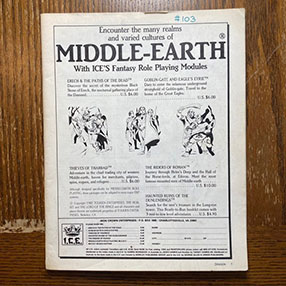
TSR Inc. published Dragon #103 in November 1985. It is 100 pages long and has a cover price of $3.00. This issue features errata, gnomes, and the future of AD&D!

The cover, titled “Birth of the Blues,” is by Robert Pritchard. Interior artists include Larry Elmore, Bob Maurus, Roger Raupp, Tom Centola, the Marvel Bullpen, David Trampier, Ted Goff, and Joseph Pillsbury.
This month’s special attraction is “Unearthed Arcana additions and corrections.” Editor Kim Mohan notes that, though TSR spent months producing Unearthed Arcana, it took readers “only a fraction of that time” to uncover a multitude of errors. What follows are 6 pages of errata, including revisions to many key tables. The book clearly lacked adequate editing and playtesting.
In “The future of the game,” Gary Gygax describes what the planned Second Edition of AD&D will be like. The intention is to combine the Monster Manuals I and II, as well as the Fiend Folio, into a single volume with new illustrations, organisation, and layout. In a similar manner, the Player’s Handbook, Unearthed Arcana, and Oriental Adventures will also be combined, with a couple of new subclasses added (the mystic, savant, and jester). The Dungeon Masters Guide will be heavily reorganized, and Deities & Demigods (retitled Legends & Lore) will be revised to focus less on statistics and more on the worship of each god. But even as this article was published, Gygax was being sidelined within TSR and would be gone completely within a year. The Second Edition would finally be published, four years later, under the leadership of Zeb Cook.
“All about Krynn’s gnomes” finishes up Roger E. Moore’s series on the demi-humans of Dragonlance. The gnomes were originally humans serving Reorx, the divine creator. They misused their crafting skills, and so the god cursed them, reducing their stature and making them obsessed with tinkering, but unable to pursue a higher purpose. Their society is highly industrialised but also absurdly bureaucratic, with the gnomes hyper-curious yet focused on trivia. I guess the “tinker gnome” archetype, which came to dominate how the game presents the race, started in Krynn.
“A dozen domestic dogs” by Stephen Inniss presents more gaming detail on these most ancient and ubiquitous of pets. He divides them into 12 categories, based on size (Very small, Small, Medium, Large) and type (Fighter, Normal, and Runner). For example, a terrier is a very small fighter, while a greyhound is a medium runner. Otherwise, the dogs differ only slightly in movement, hit points and damage. Such articles reflect the simulationist tendency then in vogue, but it is a lot of detail for a negligible impact on the game.
“The Centaur Papers” by Stephen Inniss and Kelly Adams has an unusual history. Inniss and Adams separately submitted articles on the topic, so Mohan asked for permission to combine them into one. The result is 12 pages long and covers everything from social organisation through to personal grooming. I found it less compelling than the Moore/Greenwood articles on similar topics, but I did appreciate the information on using them as player characters.
“The Wages of Stress” is a short story by Christopher Gilbert. In a near-future society, the government punishes those who cause stress and compensates those who suffer from it. Hale Rothemon figures out how to exploit the system, but things quickly spiral out of his control. It’s an intriguing premise with strong pacing and good characterisation. Gilbert is a psychologist who published a few short stories in the 80s.
“The Role of Books” by John C. Bunnell reviews the latest in speculative fiction:
The cover, titled “Birth of the Blues,” is by Robert Pritchard. Interior artists include Larry Elmore, Bob Maurus, Roger Raupp, Tom Centola, the Marvel Bullpen, David Trampier, Ted Goff, and Joseph Pillsbury.
This month’s special attraction is “Unearthed Arcana additions and corrections.” Editor Kim Mohan notes that, though TSR spent months producing Unearthed Arcana, it took readers “only a fraction of that time” to uncover a multitude of errors. What follows are 6 pages of errata, including revisions to many key tables. The book clearly lacked adequate editing and playtesting.
In “The future of the game,” Gary Gygax describes what the planned Second Edition of AD&D will be like. The intention is to combine the Monster Manuals I and II, as well as the Fiend Folio, into a single volume with new illustrations, organisation, and layout. In a similar manner, the Player’s Handbook, Unearthed Arcana, and Oriental Adventures will also be combined, with a couple of new subclasses added (the mystic, savant, and jester). The Dungeon Masters Guide will be heavily reorganized, and Deities & Demigods (retitled Legends & Lore) will be revised to focus less on statistics and more on the worship of each god. But even as this article was published, Gygax was being sidelined within TSR and would be gone completely within a year. The Second Edition would finally be published, four years later, under the leadership of Zeb Cook.
“All about Krynn’s gnomes” finishes up Roger E. Moore’s series on the demi-humans of Dragonlance. The gnomes were originally humans serving Reorx, the divine creator. They misused their crafting skills, and so the god cursed them, reducing their stature and making them obsessed with tinkering, but unable to pursue a higher purpose. Their society is highly industrialised but also absurdly bureaucratic, with the gnomes hyper-curious yet focused on trivia. I guess the “tinker gnome” archetype, which came to dominate how the game presents the race, started in Krynn.
“A dozen domestic dogs” by Stephen Inniss presents more gaming detail on these most ancient and ubiquitous of pets. He divides them into 12 categories, based on size (Very small, Small, Medium, Large) and type (Fighter, Normal, and Runner). For example, a terrier is a very small fighter, while a greyhound is a medium runner. Otherwise, the dogs differ only slightly in movement, hit points and damage. Such articles reflect the simulationist tendency then in vogue, but it is a lot of detail for a negligible impact on the game.
“The Centaur Papers” by Stephen Inniss and Kelly Adams has an unusual history. Inniss and Adams separately submitted articles on the topic, so Mohan asked for permission to combine them into one. The result is 12 pages long and covers everything from social organisation through to personal grooming. I found it less compelling than the Moore/Greenwood articles on similar topics, but I did appreciate the information on using them as player characters.
“The Wages of Stress” is a short story by Christopher Gilbert. In a near-future society, the government punishes those who cause stress and compensates those who suffer from it. Hale Rothemon figures out how to exploit the system, but things quickly spiral out of his control. It’s an intriguing premise with strong pacing and good characterisation. Gilbert is a psychologist who published a few short stories in the 80s.
“The Role of Books” by John C. Bunnell reviews the latest in speculative fiction:
- The Silver Crown by Joel Rosenberg is "entertaining reading."
- The Song of Mavin Manyshaped / The Flight of Mavin Manyshaped by Sheri S. Tepper are "soundly plotted though rather brief."
- The Secret Country by Pamela C. Dean is "great fun and just plausible enough to be thought-provoking."
- Bridge of Birds by Barry Hughart is "an unforgettable reading experience."
- Dragons of Spring Dawning by Margaret Weis and Tracy Hickman should "at last satisfy the old demands for something to read after the Ring books."
- Magic in Ithkar, edited by Andre Norton and Robert Adams, fails as a shared-world anthology because the stories "do not truly mesh into a single setting."
- The Gadget Factor by Sandy Landsman is "a fascinating tale about computer games and scientific accidents."
- "Of Nobbles and Men" by Paul Vernon brings galactic ranchers to Traveller.
- "The Saurians" by Jeffrey Bouley is a new race for Star Frontiers.
- "Tanks Again!" by Alex Curylo presents more vehicles for Star Frontiers.
- "The Marvel-Phile" by Jeff Grubb shares Marvel Super Heroes stats for Armadillo, Count Nefaria, and Hyperion.