D&D 5E (2014) Is Point Buy Balanced?

If I may ask a question, as a side comment I was going to make is otherwise liable to look dopey: as I've noted, I'm not overly familiar with 5e; my entire contact with it outside of word-of-mouth has been playing Solasta some.

Do odd numbered attributes actually serve a direct purpose in the game (historically, this was mostly not true with 3e and 4e), or only even? I gather there's some "add attribute" levels present, but that can produce some idiosyncratic results (as I've been reminded running 13th Age which does something similar) in terms of what attribute values are actually meaningfully more useful than others.
 

log in or register to remove this ad

If I may ask a question, as a side comment I was going to make is otherwise liable to look dopey: as I've noted, I'm not overly familiar with 5e; my entire contact with it outside of word-of-mouth has been playing Solasta some.

Do odd numbered attributes actually serve a direct purpose in the game (historically, this was mostly not true with 3e and 4e), or only even? I gather there's some "add attribute" levels present, but that can produce some idiosyncratic results (as I've been reminded running 13th Age which does something similar) in terms of what attribute values are actually meaningfully more useful than others.

Not really unless there's a stat drain of some sort. There are also "half" feats that give you some kind of bonus and let you add a +1 to an ability.
 

This. This is why I say that point-buy is balanced.

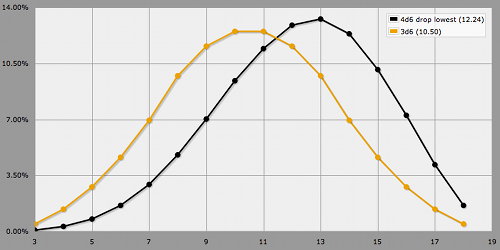
There was some discussion not long ago (in this thread) about how unlikely it was to actually roll one of the 65 valid sets of point-buy stats using the 4d6 method. I threatened to do another histogram to demonstrate that it was, in fact, very likely.

The question I'd ask is, is that true of the attribute set as a set, or only regarding individual attributes? I mean, seriously it only takes one attribute to land below (or with a four dice and discard system, more likely above) before the benefit is not as clear, at least if assign-after-the-fact is the rule.

There aren't any balance issues with using 4d6-drop-lowest, as-written. But when you start adding rerolls and other house-rules, the balance shifts and it gets harder to make that claim.

I am still unconvinced. I saw that method in use early in the hobby, and still saw some severe swings in character capability come of it (this is, of course, assuming 5e provides notable value for higher attributes; as noted I don't actually know that).
 

Not really unless there's a stat drain of some sort. There are also "half" feats that give you some kind of bonus and let you add a +1 to an ability.

How early do those kick in (I probably should know from advancement in Solasta, but I haven't done it in a while)? The reason I ask is it impacts how this will all feel dependent on how long one normally plays in a given campaign.
 

The question I'd ask is, is that true of the attribute set as a set, or only regarding individual attributes?
As a set. Here's what the curves would look like for the six ability scores, if you sorted the six 4d6DL results in descending order.


I'm not gonna do another histogram (not without a work order and a signed contract, anyway) but everything you need to build your own is in that hyperlink.

I am still unconvinced. I saw that method in use early in the hobby, and still saw some severe swings in character capability come of it (this is, of course, assuming 5e provides notable value for higher attributes; as noted I don't actually know that).
Well, "very likely" is not the same thing as "guaranteed." You will see swings, sometimes severe ones, and that's either a feature or a bug depending on the style of game you want to play. I think that's why the PHB includes three different methods with three different levels of variability (8008 possible combinations with 4d6, vs. 64 possible combinations with point-buy, vs. a single array), but all of them will "land" within the same ballpark.

How big is that ballpark? How much swing is "severe"? Those are questions that only you can answer...the math isn't going to help you there.
 
Last edited:

How early do those kick in (I probably should know from advancement in Solasta, but I haven't done it in a while)? The reason I ask is it impacts how this will all feel dependent on how long one normally plays in a given campaign.

You start getting feats at 4th and then every 4 levels. Fighters get them every 2 levels after 4.
 

How early do those kick in (I probably should know from advancement in Solasta, but I haven't done it in a while)? The reason I ask is it impacts how this will all feel dependent on how long one normally plays in a given campaign.
for most classes, it's every fourth level, there are a few martial classes that get a few extra ones but not significantly more or which affect the placement of the rest of their ASI, so a 10th solo classed character will have two +2 ASI bumps (or feats), and it is specifically every fourth level in a specific class, a fourth level fighter3/rogue1 will not gain an ASI unless they take another level of fighter or three more of rogue.
 

Dump scores are the problem. Not low scores. Not average scores. Not even high scores. Dump scores are not the same as low scores. Low scores are low, but Dump scores are lower scores that enable another score to be higher.

This all originates from Arrangement of scores. For instance, if we rolled this set of scores (3, 4, 4, 4, 4, 4,) and rearranged them then 3 would be the dump score*.
*If we placed that 3 the in a score to enable another score to be a 4. But, there's not much difference between a 3 and 4 anyway.
i agree with the first part but IMO the latter doesn't really follow, that 3 is simply a low score, you had to pick somewhere to put it, but if you had a full array of 4's and had the option to drop one of them to a 3 to raise another to 5 then that 3 would be a dump stat.
 

This. This is why I say that point-buy is balanced.

There was some discussion not long ago (in this thread) about how unlikely it was to actually roll one of the 65 valid sets of point-buy stats using the 4d6 method. I threatened to do another histogram to demonstrate that it was, in fact, extremely likely.

There aren't any balance issues with using 4d6-drop-lowest, as-written. But when you start adding rerolls and other house-rules, the balance shifts and it gets harder to make that claim.
I mean there is still the "at least one 14, positive sum of modifiers" thing, I'm pretty sure, for 5e. Which means the "worst" you can roll is 14 10 10 10 10 8. But I'm still sure that this is part of the design, if only because it has been for a while.

It's when "Oh...that's only BARELY acceptable...here, give it a reroll and you keep it as long as it's good enough."

I am still unconvinced. I saw that method in use early in the hobby, and still saw some severe swings in character capability come of it (this is, of course, assuming 5e provides notable value for higher attributes; as noted I don't actually know that).
I would argue it doesn't make that much difference. AnyDice has previously run the numbers for 4d6k3, and has shown that the Standard Array is effectively what you get when you ask the questions, "What is the average highest stat out of six? The average second-highest stat? (Etc.)" It's not perfect, IIRC the array rounds one higher value up and one lower value down, which is arguably favorable to the player but only the tiniest bit.

i agree with the first part but IMO the latter doesn't really follow, that 3 is simply a low score, you had to pick somewhere to put it, but if you had a full array of 4's and had the option to drop one of them to a 3 to raise another to 5 then that 3 would be a dump stat.
Completely agreed. Having one stat coincidentally lower than others does not a "dump stat" make.

It's instead when you intentionally gut one stat so that you can boost some other. E.g. if 10 were the default, and you pushed (say) Strength all the way down to 7, as is permitted in something like PF1e's PB rules, then that's definitely a "dump" stat. But if you roll and (say) your lowest stat is 12? You aren't "dumping" anything--you're just forced to choose something that gets your "worst" result.

 

But that just makes rolling superior to point-buy, which is kind of the problem. If you can't roll poor stats, but you can roll great ones, that's kinda unbalanced as a method vs other accepted methods, no?
No. Stats don't mean a whole heck of a lot in 5e. Class abilities and feats make far more of a difference.
 

Enchanted Trinkets Complete

Remove ads

Top