D&D 5E (2014) Is Point Buy Balanced?

I wonder what it would be like to play a 5E D&D game where everyone starts with a 10 in every stat (plus racial bonuses), and you got an ASI at every level.

But it is using the rules as written.


CleverNickName's idea of everybody starting out as a commoner with 10 in everything is balanced because all the characters have the same starting point.
🤓 Um, actually, the Commoner Array would be (10, 10, 10, 11, 11, 11). This is because the average of 3d6 is 10.5, with a point buy equivalent of 15 points. 🤓
 

log in or register to remove this ad

🤓 Um, actually, the Commoner Array would be (10, 10, 10, 11, 11, 11). This is because the average of 3d6 is 10.5, with a point buy equivalent of 15 points. 🤓

Tell that to the people that wrote the MM. :)

1767987334865.png
 

The "trick" is that the impact on balance is however felt the most in combat. Because it still is a signifcant part of the game, and it can kill the character if the party is bad at it.
While combat is a significant part of the game, it's the part that typically has the least direct impact on the world at large. Combat will win you some fights, get you some treasure, and some XP, but social/informational skills can put kings on thrones, take kings off of thrones, shift armies and sink fleets.
Your correct if all characters can roll for a single check, you can easily have the situation that the guy with the worst modifier rolls best and the one with the best rolls worst, so the guy worst at the task is the one succeeding. (And IMO, that is kinda an issue with the d20. Even though you're presumably good at it you might fail an easy task someone untrained and clueless beats because they rolled better. But that's a topic for a different conversation, I think).
That wasn't my point, though. My point was that if the DM doesn't share the DC, unless two players coincidentally among those 4 rolls 1) hit rolls within 1 of each other(15 and 16 for example), 2) the DC was 16, and 3) the guy with the +1 more on his roll was the one who got the 16, the group isn't going to know that this was the 1 in 20 times that the +1 actually made a difference.

You're rarely going to see the difference outside of combat, and while you will see it more often IN combat, it's still only going to make a difference in 1 out of 20 attacks on average.

People are better off taking a feat that actually does something a lot more often and is visible, than choosing +2 ASI to get that +1 more.
But in combat, it matters a lot, and people will choose their best stats and their dump stats accordingly - make sure this isn't going to hinder me in combat. Sure, it might be nice to have also a high wisdom on your Rogue, and you really want to find those traps, but your combat outcome is likely to be affected by the statistical long view, while your trap finding could fail even with a better bonus because you rolled a 2.
Sure. You dump social/informational stats and pump up combat. You'll do minimally better than I do with your +1 or +2 more than me. Meanwhile I'll be doing minimally better than you in the areas that have the most impact. Knowledge and information.
 

So here’s my counterpoint:

You are going to have a low score with dang near any method of generating scores that offers choice. So it’s not really accurate to say it’s an issue with Point Buy. You have the same issue with Standard Array, Roll-and-Arrange, and any variation on those except “all if your scores are N.”

It’s an issue of scores not all having the same value as each other (fir every class) - and I think the cure is worse than the disease here. Making it so that a high-intelligence low-strength barbarian is just as powerful as a high-strength low-intelligence barbarian is much more likely to wreck the class’s identity than create significantly more variety in how people play barbarians.
Yes, this is correct. Just about any method that offers choice will lead to dumping scores.° The Standard method leads to dump scores as well, I've said this several times in this thread. But, this thread is a place where the Point Buy method stands alone to defend itself without resorting to comparisons with the Standard method. The first 20 or 30 pages we were doing that, but now we're just back to Flight Club again.

° However, there are methods that offer choice but don't lead to dump scores.
 

You have to have a baseline for analysis and the average AC is probably somewhere in the 14-18 range. But unless you get to the point where the monster AC is so low you only miss on a 1 it doesn't change the average damage per turn much. The average damage per turn is simply average damage times percentage chance to hit. But we're also not talking about the difference between a 16 and a 16, it's a 15 to a 20. It's also not just damage, it's also HP, feats, ranged attacks (bow vs javelin range) out-of-combat effectiveness.

So lets look at the details and don't round the damages. Both are using longsword for 1d8 (avg 4.5 dmg) but A is 8.5 per hit, B is 11.5. The +2 from the starting feat is helping quite a bit for damage here..

View attachment 426816

View attachment 426817


So if change AC to 14 from 16, the percentage increase in damage is a small difference of 57% instead of 54%. If I lower the target AC all the way down to 8, the percentage increase is 62% because B only misses on a 1.

Now, you can argue that you don't think it matters, but I think it will be pretty obvious immediately because it's such a big difference. Which then you will just argue that it's never really seen because nobody does this and round and round.
Again, you don't need that baseline for any sort of analysis, because such analysis is useless. Most ACs are not 16, so trying to figure out how it would work if every attack was against AC 16 doesn't really tell you anything.

All you need to know is that across ALL armor classes, the +1 = 1 extra hit every 20 swings. The specific AC is not relevant. Only that 1 extra hit every 2.5 to 5 combats is. And it's relevance is minimal at best.
 

I'm not saying it can't work. I'm just saying I'm not sure what in-game actions could happen that could cause people to make a deviation from their obvious path.
Feats. While you are gaining that 1 extra success every 20 rolls, I'll be taking feats like Sentinel, Great Weapon Master, and other good combat/non-combat feats that will have a far greater impact on the game than your bonus ever will.


Again, you don't need that baseline for any sort of analysis, because such analysis is useless. Most ACs are not 16, so trying to figure out how it would work if every attack was against AC 16 doesn't really tell you anything.

All you need to know is that across ALL armor classes, the +1 = 1 extra hit every 20 swings. The specific AC is not relevant. Only that 1 extra hit every 2.5 to 5 combats is. And it's relevance is minimal at best.

So it's useless to compare the difference in expected damage and HP? How? How else are you going to judge relative capability of a character in combat? Again. The percentage chance to hit and the damage actually done if you do hit is significant B does between 53-57% more damage per turn. If there's an error in my spreadsheet calculation please point it out because you're both oversimplifying and significantly narrowing the difference, it's a +4 to hit vs a +7 to hit. You're also ignoring the HP difference at 8th level - A has 60 HP, B has 100. How is that irrelevant?
 

Feats. While you are gaining that 1 extra success every 20 rolls, I'll be taking feats like Sentinel, Great Weapon Master, and other good combat/non-combat feats that will have a far greater impact on the game than your bonus ever will.
I was assuming feats were off the table, since @CleverNickName said ASIs.

But yes, feats being available every level would definitely impact the calculus.
 

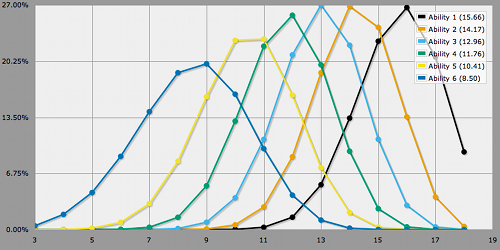
This is accounting for the variance.

When you roll six sets of 4d6k3, there will be a range for what "the highest stat of that set of six" is. That range will be narrower than the range for just any result of 4d6k3, because you're specifically selecting for the largest one. The peak will be further right and narrower than the peak of just any general roll would be. Likewise, the peak for the single lowest stat will be narrower and further left.

Here's the chart, if you want the variance component added in.
6_abilities.png

The chart only explicitly lists the average values. The SDs, in order 1, 2, etc., are 1.43, 1.44, 1.46, 1.53, 1.66, and 1.95.

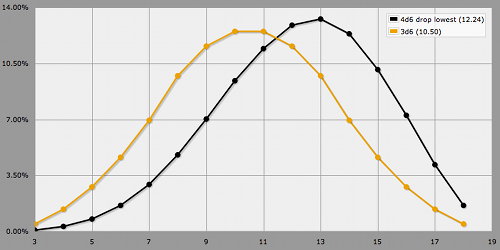
This chart, by comparison, shows the difference between 3d6 and 4d6k3.
4d6dl_vs_3d6.png

The SD for 4d6k3 is 2.85--significantly greater than even the distribution for the worst stat, and almost double that of the highest stat.


What definition would that be? I'm genuinely curious.


My problem is the "of some sort" here. I believe "dump stat" is a fairly strong term. Not like ironclad unequivocal, but for it to be a "dump stat" it has to be more than "I ended up having to choose something for the 7 I rolled to go in".

To me, "dump stat" means that you actively picked something to pull points out of, knowing the cost would be minimal. Merely having some lowest score is insufficient for that. Rolled stats are not totally immune to having a "dump stat", but they have at least a little bit of protection against that simply because you can't pull points out of anything to put into anything else. At least not with current rules. There were, I'm given to understand, ways to massage the old strict rolling method, where you could pull points out of stat X to put into stat Y, but at a 2-for-1 rate.

So...yeah it's the "of some sort" that I'm having issues with here. I see the term as being pretty clear in meaning, requiring some degree of minmaxing to qualify, even if it's just a little bit. Regardless of method, but especially if you roll stats, something is going to have to be the lowest number (possibly multiple somethings). Like if I roll and get {18, 15, 14, 13, 12, 10}, is it really warranted to say that if I put the 10 in Dex that Dex is my "dump stat"? Or Cha or whatever. It just feels...off to refer to something you absolutely have to assign at some point as being a "dump" stat solely because every ordered set of numbers necessarily has a least element (though there may be multiple instances of that least element). The {4, 4, 4, 4, 4, 3} array, or its twin, the {18, 18, 18, 18, 18, 17} array, illustrate what I mean by this--can we honestly call something a "dump stat" if you put a 17 into it?

Could you generate a graph for 15d2-12. Maybe a graph for 16d2k15-12, 17d2k15-12, and 18d2k15-12? 🥺
 

Enchanted Trinkets Complete

Remove ads

Top