Monster Geographica: Marsh & Aquatic
MONSTER GEOGRAPHICA: MARSH & AQUATIC
By Joseph Browning and Suzi Yee
Expeditious Retreat Press product number XRP 3003
208 pages, $20.00
The second book in Expeditious Retreat Press' line of inexpensive d20 monster books,
Monster Geographica: Marsh & Aquatic continues the trend set by the previous book (
Monster Geographica: Underground) by providing 200 monsters for $20.00. They do this by doing away with the illustrations, save for those on the covers.
The cover art, by talented artist Ravindra Rana, is once again done in a reddish-brown monochrome. The front cover depicts a female human ranger fighting what looks to be a shaggy Bigfoot with tusks (this is apparently a bog beast, from page 84). They're standing in water halfway up their calves. Detail is nice, although the bog beast comes across as something you'd find in a low-budget TV show (I'm reminded more than a little of the mugato from the original
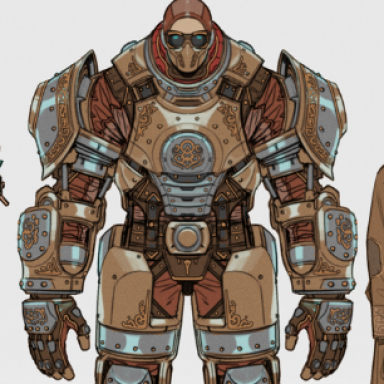
Star Trek series). On the back, we apparently have a portrait of Mr. Toad, complete with Victorian suit, vest, bow tie, and monocle. While well-done, it doesn't seem to correspond to any of the creatures that appear within the book, which is unfortunate - when you're purposely limiting yourself to no interior artwork depicting the monsters in your monster book, it seems like it would make better sense to take what limited illustration space you have and use it to best effect.
This time, there are actually
two interior illustrations: besides the ink sketch on page 1 (this time of two people in a canoe paddling through marshlands), there is also an ink sketch of a heron standing among some swamp trees on page 191. Both are nicely done, but "generic" - they don't really add anything to the book, and if you're buying a monster book with no monster illustrations, you're not really going to be overly concerned about the quality of the two "generic" illustrations that appear in any case. Still, Ravindra does a nice job, and I'm glad to see the same artist being used throughout the series, as it helps give the Monster Geographica books a unified appearance.
Like the first book,
Monster Geographica: Marsh & Aquatic is laid out by Challenge Rating rather than alphabetical (like most monster books). This makes it extremely useful for the DM (the person most likely to be using the book), who can easily flip to the appropriate range of challenges for his adventuring party when designing an adventure (or selecting an appropriate random encounter). Fortunately, there are also alphabetical and creature type listings at the front of the book, so finding any monster is a snap.
The monsters by creature type show some interesting selections again. For those interested in how many of each type appear, here are the numbers:
- Aberration: 22
- (Air): 2
- Animal: 24
- (Aquatic): 84
- (Chaotic): 1
- (Cold): 1
- Construct: 3
- Dragon: 2
- (Earth): 1
- Elemental: 3
- (Evil): 4
- (Extraplanar): 3
- Fey: 4
- (Fire): 2
- Giant: 5
- Hazard: 2
- Humanoid: 6
- (Incorporeal): 8
- Magical Beast: 38
- Monstrous Humanoid: 17
- (Native): 7
- Ooze: 11
- Outsider: 5
- Plant: 20
- (Psionic): 5
- (Reptilian): 4
- (Shapechanger): 2
- (Swarm): 4
- Undead: 25
- Vermin: 11
- (Water): 4
Naturally, if you add those numbers together you get more than 200, but that's because many monsters have multiple subtypes - the devil fish, for example, is counted above as an outsider, (aquatic), (chaotic), and (evil). And while it's not surprising that so many monsters from "marsh and aquatic" regions have the "(aquatic)" subtype, I was a bit surprised at the relatively few that had the "(water)" subtype. Also, I was somewhat surprised to see how many of the 200 monsters in this book didn't actually have an "Environment" stat block mentioning water at all; there are more than a handful that have "Any" listed as their Environment (or worse yet, something like "Any land or underground," which really makes you wonder about their appropriateness). Perhaps one of the best examples here is the skin wraith, an undead formed from the remains of torture victims flayed alive on the rack - what's so inherently "aquatic" about that? Finally, I noticed at least one monster (the blackwater slough) that has so far appeared in both
Monster Geographica: Marsh & Aquatic and
Monster Geographica: Underground. While the XRP guys have already stated that there will be a few creatures that appear in more than one book, I hope that isn't going to be a common trend. Finally, I was a bit surprised to see so many creatures based on the exact same concept, like the three different takes on "uneasy spirits of women who have lost men at sea" - but then, seeing as how this is a collection of monsters from several different game companies, I suppose it's not surprising to see so many different takes on the same basic theme. (Likewise, there are several different "big slug" creatures in here, and several different "undead sailor" creatures as well. Oh well, if nothing else it gives the DM a bit of variety to choose from.)
The proofreading and editing jobs in
Monster Geographica: Marsh & Aquatic were not so bad as to make the material difficult to understand, but there were numerous places where improvements could have been made, especially in the realms of alphabetization ("Blood Golem" and "Blood Naga" should come before "Bloodlust Willow" and "Bloodworms" - you base it on the full first word), italicization of spell names (many were overlooked), capitalization of size categories (although this wasn't as common a problem), several instances where spaces were missing between words or words were either missing or misspelled in a sentence, and a few punctuation errors (usually involving apostrophes). I also noticed several instances where the subject kept changing between the singular and plural forms in a sentence. Also, there were some rather interesting misspellings, like "Arrnor Class" instead of "Armor Class" and "arid" instead of "and" which made me think that perhaps the original text had been "captured" by some "text select" program that had difficulty reading the original fonts. Again, none of this is earth-shatteringly bad, but it does give them quite a bit of room for improvement in future volumes.
Finally, they've still got a ways to go as far as getting their stat blocks correct. In a compilation book like this, where they're selecting monsters from dozens of different sources (and having to update some of them from the 3.0 rules to the 3.5 rules for the first time), I realize that this is going to be a difficult process, and I have no doubt that for every error they missed they caught a half-dozen more, but I still believe that in a monster book, the monster stats should take top priority. (And this is especially true in a monster book like this one, that is essentially monster stats and little else.) With that in mind, I suggest making the following changes:
- p. 6, Lurking Lizard: Shouldn't this lizard also have a land speed? I've never known a lizard to not be able to move about on land.
- p. 8, Drowner Fish: No Treasure is listed; presumably it's "None."
- p. 14, Carp Eater: Initiative should be +0, not +4 (+0 Dex), or else it should have Improved Initiative as a bonus feat.
- p. 14, Cloud Walker: Treasure should be listed before Alignment, not after. (I realize this is extremely picky on my part, but there's a certain order in which the entries go in a monster's stat block, and putting them in a different order runs the risk of fooling a DM into thinking the entry is missing when, in the heat of battle, he references the monster's stats.) There are quite a lot of these particular errors in this book (with these specific two entries), leading me to believe they were probably all taken from the same original source.
- p. 16, Eyeburn Eel: No Treasure is listed; presumably it's "None."
- p. 17, Glowing Frog: Grapple attacks should be at -12, not -11 (+0 BAB, -4 Str, -8 size).
- p. 18, Mantafai: Treasure should be listed before Alignment, not after. Grapple attacks should be at -4, not -5 (+1 BAB, -1 Str, -4 size).
- p. 18, Mire Walker: Initiative should be +1, not +0 (+1 Dex).
- p. 24, Filth Belcher: The Space/Reach entry should mention that the creature has a 30-ft. reach with its tongues.
- p. 34, Poisonous Frog Swarm: With HD 4d8, average hit points should be 18, not 19.
- p. 37, Smoke Dragon: With HD 3d12+3, average hit points should be 22, not 16. Will should be +4, not +3 (+3 as a 3-HD dragon, +1 Wis). The "Listen +?" entry in the Skills isn't particularly informative; doing some quick calculations (which I normally don't do for Skills), it looks like it should be "Listen +9."
- p. 38, Suffocation Jelly: Skills should be listed before Feats, not after. Treasure should be listed before Alignment, not after.
- p. 40, Waterlost: Treasure should be listed before Alignment, not after.
- p. 43, Feasting Fratricide: With HD 5d8+10, average hit points should be 32, not 33. (Fractions get rounded down.) Treasure should be listed before Alignment, not after.
- p. 46, Growler Lizard: No Treasure is listed; presumably it's "None."
- p. 47, Hook Squid: Treasure should be listed before Alignment, not after.
- p. 49, Marsh Babbler: HD should be 6d8+12, not just 6d8 (+2 Con bonus; oddly enough, the average hit points are correct at 39). Grapple attacks should be at +4, not +3 (+6 BAB, +2 Str, -4 size).
- p. 50, Puddle Stalker: Ref should be +8, not +7 (+5 as a 6-HD magical beast, +3 Dex). Treasure should be listed before Alignment, not after.
- p. 51, Quisloi: "Poison" entry says the initial damage of their toxic mucus (upon mere contact) is 1d3 Dex, but the "Spit" entry says only that the mucus blinds the victim (it doesn't say for how long, though), although the secondary effect in both cases is 1d6 hours of paralyzation. Which is correct? (Personally, I'd assume the blinding came from spitting the mucus directly into the victim's eyes, and just add the 1d3 Dex damage to the "Spit" effects.)
- p. 54, Sebrefin: Initiative should be +3, not +2 (+3 Dex). Treasure should be listed before Alignment, not before.
- p. 56, Sloth Viper: For some reason, "Environment" is called "Terrain" here instead.
- p. 58, Spear Fisher: Treasure should be listed before Alignment, not after.
- p. 60, Swamp Troll: Bite damage should be 1d6+2, not 1d6+4 (you only get half of the +4 Str bonus for a secondary attack). "Face/Reach" should be "Space/Reach." Finally, it's kind of odd that this "troll" has no type of regeneration (or even fast healing) at all - isn't that part of what makes a troll a troll?
- p. 62, Whipstriker: No Treasure listed; presumably "None."
- p. 63, Ahlinni (Cackle Bird): 40 feet does not equal 6 squares! Its land speed should be either "40 ft. (8 squares)" or "30 ft. (6 squares)."
- p. 67, Epicurean: Tongue slap attacks should be at +9 melee, not +8 (+6 BAB, -1 size, +3 Str, +1 Weapon Focus).
- p. 68, Fen Vapor: Slam damage should be 1d6-2 plus noxious gas. Special Attacks should refer to "noxious gas" instead of "poison gas," as that's how it's referred to in the creature's description.
- p. 70, Floating Dead: Has 4 HD, yet Advancement is 4-12 HD; that should be 5-12 HD.
- p. 78, Sharkman: In the Attack entry, bite damage should be 1d10+5/19-20, not 1d10+7/19-20 (+5 Str, but bite isn't its sole attack, so it shouldn't get 1.5 times Str bonus).
- p. 80, Stymphalian Bird: 60 feet does not equal 8 squares! Its fly speed should either read "fly 60 ft. (poor) (12 squares)" or "fly 40 ft. (poor) (8 squares)" - my guess is the latter.
- p. 82, Archer Clam: Initiative should be +0, not -1 (-4 Dex, +4 Improved Initiative). AC should be 20, not 19 (-4 Dex, -2 size, +16 natural). Flat-footed AC should be 20, not 19 (-4 Dex, -2 size, +16 natural). Harpoon damage should be 1d8+6, not 1d8+4 (+4 Str bonus, but it gets 1.5 times that since it's its only natural attack form). Ref should be -2, not -3 (+2 as a 6-HD magical beast, -4 Dex).
- p. 85, Bog Spawn: No slam damage is given under "Attack" - it should be 1d4+1.
- p. 90, Diseased Boar: Under Advancement, 18 HD is listed as both Large and Huge.
- p. 91, Fen Witch: "Face/Reach" should be "Space/Reach"
- p. 92, Fukuranbou: Claw attacks (under Full Attack) should be at +0 melee, not +3 (+4 BAB, +1 Str, -5 for secondary attack). Fort save for its Curse of the Rotten Gut should be DC 14, not DC 13 (10 + half its HD + Con modifier = 10 + 4 + 0 = 14).
- p. 94, Kari Dragon: Paralysis Fort save should be DC 15, not 17 (10 + 3 + 2). Worry damage, at 2d10+5, seems an unusual number given its bite damage is 2d8+6.
- p. 97, Sea Walker: Will should be -1, not -2 (+3 as a 9-HD magical beast, -4 Wis).
- p. 99, Sinew Dagger: Mouth tether damage should be 2d6+2, not 2d6+1 (+2 Str).
- p. 106, Blight Belcher: Treasure should be listed before Alignment, not after.
- p. 110, Gloomfog: Ref should be +4, not +1 (+1 as a 4-HD plant, +3 Dex).
- p. 111, Marshwillow: Advancement lists 6-10 HD (Large) and 13-15 HD (Huge), but what about 11-12HD?
- p. 115, Nereid: Under Organization, how many nereids are there in a "troupe?" Is it still 2-4, like a "gang," only with the other creatures listed? This isn't very clear.
- p. 118, Thet: Poison Fort save should be DC 23, not DC 22 (10 + 1 + 0 + 12).
- p. 119, Vine of Decay: 20 ft. does not equal 5 squares! Its land speed should either be "20 ft. (4 squares)" or "25 ft. (5 squares)"
- p. 122, Boggart: HD should be 6d8+18, not 6d8+12 (+3 Con bonus). As a result, average hit points should be 45, not 39.
- p. 123, Brown Pudding: "Face/Reach" should be "Space/Reach"
- p. 124, Dank: Advancement shows 24 HD as being both Large and Huge.
- p. 135, Night-Blooming Lotus: Why does this creature get iterative attacks with its slam? I think under Full Attack that should be "Slam +11 melee" instead of "Slam +11/+6 melee"
- p. 137, Scalewhale: Treasure should be listed before Alignment, not before.
- p. 143, Vendrin: HD should be 7d10+42, not 7d10+30 (+6 Con bonus). Average hit points should be 80, not 68. Under Full Attack, bite attacks should be at +8 melee, not +9 (+7 BAB, +6 Str, -5 for secondary attack). With 7 HD, it should have 3 feats, not just 2. Finally, it has 7 HD, yet Advancement starts at 6-10 HD.
- p. 151, Kelp Devil: "Face/Reach" should be "Space/Reach"
- p. 155, Pumina Snake: "Face/Reach" should be "Space/Reach"
- p. 158, Vampiric Ooze: "Face/Reach" should be "Space/Reach"
- p. 163, Giant Snapping Turtle: "Face/Reach" should be "Space/Reach"
- p. 165, Malamari: Treasure should be listed before Alignment, not after. When in its elemental threshold, touch AC should be 11, not 10 (-2 size, +3 Dex), its incorporeal touch attacks should be at +11 melee, not +18 (+10 BAB, -2 size, +3 Dex), and its saving throws shouldn't be affected (so there's no reason for its Will to bump up from +10 to +12 as listed).
- p. 168, War Whale: When raging, bite attacks should be at +17 melee, not +19 (+9 BAB, +10 Str, -2 size).
- p. 171, Sand Shifter: Tentacle attacks should be at +16 melee, not +17 (+10 BAB, -1 size, +6 Str, +1 Weapon Focus). Bite attacks should be at +14 melee, not +15 (+10 BAB, -1 size, +6 Str, +1 Weapon Focus, -2 for secondary attack with Multiattack).
- p. 175, Crimson Moth: Initiative should be +2, not +1 (+2 Dex).
- p. 177, Marshlight: Advancement shows 13-24 HD (Gargantuan), 19-36 HD (Colossal) - it shouldn't have that overlap of 19-24 HD.
- p. 180, Giant Sea Slug: Grapple attacks should be at +34, not +36 (+11 BAB, +12 size, +11 Str).
- p. 181, Lesser Sea Giant: Attack line shouldn't show iterative attacks with the Gargantuan trident (it should be +24 melee, not +24/+19/+14 melee).
- p. 190, Blackwater Slough: If Improved Initiative is a bonus feat (as indicated), then it should still have one more feat (a 12-HD creature should have 5 feats; this one has 4 feats and a bonus feat).
- p. 192, Sea Giant: In the Attack line, trident attacks should be at +23 ranged, not +20 (+24 BAB, -4 size, +2 Dex, +1 Weapon Focus). Likewise with the net attacks in the Attack line. Also, while this isn't a "mistake," I still find it humorous that the Lesser Sea Giant has more hit points than the Sea Giant (178 vs. 176), even though the Lesser Sea Giant has 17 HD and the Sea Giant has 32 HD! (The difference is in the Constitution bonuses.) I remember chuckling at that when I first noticed them from their respective Mongoose books.
- p. 194, Kalavij: HD should be 20d8+140, not 20d8+144 (+7 Con bonus). Average hit points should be 230, not 234.
- p. 198, War Snail: Will should be +12, not +10 (+17 as a 53-HD vermin, -5 Wis).
Okay, you'll note that in many of the listings above, there is only one thing wrong with the entry, and in many cases it's just something silly like moving where in the stat block the Treasure line goes. I'll grant that again, these aren't really earth-shattering problems. However, I still stand by my stat-block-nitpickiness, and I have to admit that I was disappointed at the sheer numbers of stats in this book that had problems. Unless I've messed something up myself (always a possibility), I count 65 monsters - out of 200 - with stat block problems, or fully 32.5% of the monsters appearing in the book. In a book such as this, where the stat blocks play such an overwhelming role in the contents of the book, I can't help but let their quality affect my rating of the book. As with the first book in the Monster Geographica series, I was wavering between a high "3 (Average)" and a low "4 (Good)," but this time I'm going with the lower of the two scores and giving it just 3 stars. I still like the series, I still like the concept, but I'm just not as happy this time with the results. Hopefully, future books will be better in this regard.
Still, to end on a positive note, I think there have been some areas of improvement. It's definitely worth noting that the XRP folks have taken one of the features of the book most likely to turn off some people - the lack of monster illustrations - and found a way around it: they've teamed up with the folks at Fiery Dragon, who produce monster tokens! While I haven't seen
Counter Collection: Murky Depths & Slimy Shores myself, I understand that it's a storage tin containing a cardstock counter of every single creature that appears in
Monster Geographica: Marsh & Aquatic, plus all of the water-themed monsters from the
Monster Manual. (There's even a full-page ad for it in the back of this book.) I think this is an excellent idea, one that will hopefully prove to be mutually beneficial for both companies, and I commend both Expedition Retreat Press and Fiery Dragon for coming up with such a win-win solution.