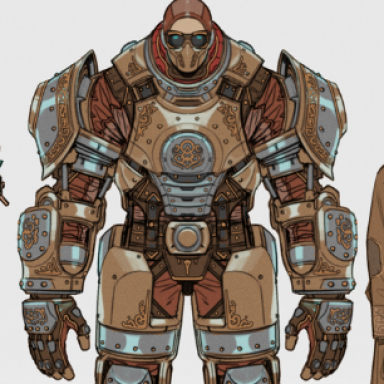
New flavour on magic.

Ferret

Explorer
Whilst creating a new setting I thought I might flesh out how the magic works, so it goes a little something like this.

Magic is like a stream flowing through people, monster, items, buildings etc, with sworls, and eddies creating a distinctive shape. The entire system of streams and flows of magic is called the Source. When spells are cast you change, create or destroy these flows, or the eddies in them. Some magic is an inborn movement and knowing how to twist the streams to your fancy is natural. Other learn about them and effect them with materials, and strange incantations. Other play these flows, or strings, plucking them for different effects. Obvioulsy the last sort lend them selves to music as well.

Other people learn how to do so as part of other training, healing people, hiding well etc. but don't train specifically for it. Without training people may still have some brief, happenstance point where they move in just the right way to cause a disturbence.

Learned scholars also note that whilst normally invisible, the eddies created by people, like water flowing around rocks, can form its own marking on the wold. Laymen sometimes refer to these effects as Ghosts, Poltergeists, Ball lignting or just freak actions of luck; individual but closely related to the people who spawned them, attenuating through time and distance. Sometimes eddies can be created and manifested whole on purpose by experienced weilders of the Source, these 'creatures' take many forms and names but most call Familiars.

The final point about the Source is that peoples 'streams' can be dammed, blocked off, and removed. This creates hollow mindless creatures, influenceable by their creators. Strangley the creatures do not dies immediately, although most fade after a few weeks.

This is in for now, what do you guys think? I have a sinking suspision this has been done before.
 

log in or register to remove this ad

Looks neat, Ferret! I like the idea of magic flowing like a river, and objectifying magic as "the Source" brings the flavor of your idea alive. It should stick in your PCs minds.

I'm a big fan of reenvisioning old D&D tropes to keep the game fresh--in the first 3E game I ran, there was the Will and the Voice. "Will" indicated an arcane spellcaster's ability to alter reality through "force of will"; "Voice" meant that a character channelled the "voice of the gods" into diving spellcasting. My players enjoyed that intepretation of how magic worked in that campaign, even though mechanically it was unchanged.

Anyway, I say keep developing your idea--you're onto something.
 

Very nice and I will "yoink" this for use in my world. I like the idea of expalning things like how deos magic work or what are the gods. However, I always classify things like this under the hedaing of the "unknowable". So in my world you will come across many different schools of thought on how things actually work. All of which may be the truth or clsoe to the truth but its just about as close as you will ever get to the truth.

Thanks for the prose.
 

I also used the idea of the source of magic as an intangible river flowing over the landscape. I called mine "The Flow". I had deeper implications, however, with things such as wild magic and ley lines (rivers of flow).

Rather than retype the whole theory, I'll just recopy the text from another thread:
http://www.enworld.org/showpost.php?p=2370804&postcount=40

I was going to do a quick type up on my rationale behind magic, but its sort of made to answer different questions than your, including some campaign specific ones (see the *)

The basic concept: Magic is, in its passive form, an untapped energy that flows all around the world. In some places these flows become rivers, or "ley lines" which visibly glow. But in most places, this passive magic, or the flow remains invisible and undetected.

1) Why do spellcasters cast spells? Why don't magical effects just happen?

By default, the strength of the flow is too weak and undirected to really accomplish anything. When unidrected, the flow doesn't really do anything. It's just untapped potential.

When spellcasters cast spells, they have gathered the flow energy and -- more importantly -- shaped it to acheive the effect that they desire. Sort of like if a team of horses simply put out to pasture don't do acheive much, but harnessed and put into a team, they can pull a plow or a wagon.

2) Why do wizards prepare spells and sorcerers simply cast any spell that they know? Why do sorcerers know so few spells.

Both wizards and sorcerers must gather energy to use it. This is a major component of the rest period and preparation time.

But wizards are not inhernently magical creatures. The flow is a slippery energy, and if the wizard does not shape the spell when preparing it, it can accoplish nothing. But in some cases, a wizard can leave an alotment of gathered flow energy unshaped and shape it later. The shaping of these spells is a formulaic thing, so they can easily learn whatever spells their mind will bear.

Sorcerers, on the other hand, are inherently magical creatures. They cannot deliberately shape spells; shaping the magic that naturally flows through them in an instinctual thing. When a sorcerer casts a spell, however, they can shape the energy as they cast is, as a reflex. Of course, reflexes take deliberate training. Mere memorization of formulas and principles is not enough.

3) Okay, why do clerics cast spells? Why do they prepare them?

Much like sorcerers and magical creature, gods are magical creatures, perhaps moreso than either of the prior. Immense magical power wells up in divinities.

But divinities are, by nature, aloof from the world, almost operating by different rules of reality than other creatures. Mortals consider philosophy and ethics; gods are in some way actual expressions of these thoughts and concepts.

It is possible for a cleric to tap into this immense power, but it takes deliberate communion with the divine beings. Spells are not simply miracles; they are fragments of the flow energy that the cleric is granted from their deity. Though gods can perform miracles directly, this is almost contrary to their nature, so it is rare.

4) What about psions and other psychic creatures? Why DON'T they cast spells.

In most ways, psions and psionic creatures are similar to sorcerers and magical creatures. They have an innate connection to the flow. However, whereas sorcerers and magical creatures pull flow energy into themselves and then shape it into spells reflexively, psions and psychic creatures reach out to the flow, and shape it as a force of will.

5) Why are sorcerers different from creatures with spell like abilities?

A sorcerer is to a magical creature a bit like a learned monk is to animals that they strive to emulate in the wilderness. An animal has claws, fangs, possibly venom sacks. Similarly magical creatures have organs and glands that do specific jobs. However, like a monk learns to shape his hand into a fang like shape for a strike, or learn the weaving motions of a mongoose, a sorcerer has flexibility and discipline allowing them to shape their magical selves to perform feats similar to magical creatures, similar to the way a monk emulates animals.

6*) Why do ley lines glow? Why do wild surges occur near ley lines. (* this pertains to setting specific stuff in my game)

Normally, when a spell is cast, the flow is so weak and undirected, it is merely pushed aside by the passing spell.

However, when an area becomes saturated in the flow, the little random pertubations of magic begin to express themselves. This is normally simply the soft glow of a ley line. Usually little else occurs, as the flow of ley lines don't naturally allow the flow to accumulate to the level that creates effects much more potent than this (ley line nexuses are a different story.)

However, when you intoduce an active spell to the area, it becomes super-saturated and the flow is often to intense for there to be no magical manifestation. The spell is beat around like an eddy in the current which is often enough to cause the spell to unravel. And when it does, the little magical "directions" that make up the spell interact with the surrounding flow energy in ways that produce unpredictable results.
 

One thing that has always struck me about the 'magic flows across the land' magic systems, is that a logical outgrowth of that thought should be magical architecture. IE: Constructions designed to channel/block/alter these magical flows either to create null/high magic areas or to actually invoke magical effects. This after all is pretty much the same thing as feng shui. And if magic flows like water or air, well we have dams, levees, water mills, wind mills, wind chimes, etc.

Granted DnD, as a system, contributes nothing to the process of figuring out how this stuff works in your world, but it is a new toy to play with.

Some examples might be:

A temple to the god of healing (or a hospital) whose architecture channels magic to generate a room of 'fast healing 1'.

A mage academy with an architecturally generated low magic area used for magical practice without risk of fireball misplacement/accidental summoning etc.

A ley mill. A mill where the stone is turned by the flow of magic.
 
Last edited:

Thanks for the suggestions! This has been a while in the brewing and I'm pleased by what came out :)

Force user, I love the idea of Will and Voice, I might use it in a game some time whilst setting out this system!

BluWolf: Unknowns are a good thing, yes. People in the campaign don't know about gods, or at least aren't sure. They might worship them but its's faith not proof that does this. The gods are actual, like, self-perpetuating consciousness in the Source that favour certain Clasest I will keep in unknowns. Thanks for the ideas!

Some one else has done something like a river of magic flowing over the landscape! Great, now I can look at some of the ideas!

1) I answer mine in the main text, I like how yours store up energies.

2) Similiar ideas here, cool. I had an added thought that directing the Source through the caster would be dangerous, and harmful. So Focuses like books, gems, family, heirlooms could be attuned to change the Source. However the Sorcerers don't need to.

3) My clerics are more like paladins, that encounter magic doing other things. The clericy ones are like cleric-flavoured mages. But I haven't thought so much on this yet.

4) I hadn't thought of psions! Good ideas there!

5) I would suppose mine aren't much different... :) :]

6) Neat idea with the Flow of magic being sort of swished about in the magic-high zone. I also didn't think of ley lines either.... Nice.

Andor, part of the flavour of the campign is very low-profile magic, there will be dead zones of magic, both in the empty, dead way I described my zombies, and the still magic-does-work way.

Thanks for all the ideas!
 

Interesting.

Im especially interested in how you plan to work it into the game. Is it going to be flavour added on top of the spell system, or will it have definite mechanical effects?

For example: can a Wizard "turn" a ghost or poltergeist using Dispel Magic?
 

I can see where the arcane community would come up with laws regarding the flow of magic. In Mythus Magick 3 of the 7 Laws of Magick are concerned with magical energy. They are:

The Law of Emanation: Making use of sources of magical energy.

The Law of Conduction: Directing the flow of magical energy.

The Law of Obstruction: Impeding the flow of magical energy.

For example, one could create a low magic area by either diverting the flow around the location (Conduction), or by blocking magical energy outright (Obstruction). The former used when you don't want all magical energy barred from the area, the latter when you do.


Looks nice, but I've always really disliked the unified field theory of magic, that it's all the same energy for everything. That's just me, though! Any well thought out metaphysical logic for magic in your world is a good thing!
 

Enchanted Trinkets Complete

Recent & Upcoming Releases

Remove ads

Top