
You are using an out of date browser. It may not display this or other websites correctly.
You should upgrade or use an alternative browser.
You should upgrade or use an alternative browser.
D&D 5E (2014) Norse World
- Thread starter Yaarel
- Start date

Yaarel
🇮🇱 🇺🇦 He-Mage
In biblical studies, I primarily deal with archaeology (and archaeologists) as it pertains to the Bronze and Iron Age West Asia, though my own focus is obviously far less historical/archaeological and more literary and ideological.
My own area is Mideast archeology. So I am fond of biblical scholars.
I am academically sensitive to what polytheism is, and what it is not. If your own focus is biblical studies, and you are immersing in Christian (?) biblical texts, I assume you take scientific precautions to avoid unconsciously projecting the Hellenistic anti-polytheistic polemics onto Non-Hellenistic, Non-Christian, non-monotheistic, and non-polytheistic cultures.
The archeological summaries that I present in this Norse World thread come from mainstream Scandinavian archeology and linguistics. Note, the mention of the Nordwest Block material cultures derives from the Dutch archeologists and linguists. The German archeologists and linguists, themselves, emphasize that the socalled ‘Germanic peoples’ are a nonhomogeneous conglomeration of diverse ethnic groups, and that linguistic speculations about Germany before year 750 are uncertain.
The statements in this thread are ordinary enough within scientific communities today.
In general, regions like Scandinavia (and Ireland) tend toward relative remoteness and stability. By contrast, *Continental* Europe is a neverending quixotic flux of ethnographic admixtures and migrations, alternate placenames, shifting territorial borders, and linguistic drifts and replacements. Anyone with even casual familiarity with German ethnography should assume the formative German peoples are responsible for ‘mixing-it-up’.
Personally, I am shocked that there are still (apparently serious) people today who come across as if believing in some kind of ‘racially pure’ monolithic ‘Germanic people’. Scientists today reject that Romantic-Era guess about a homogeneous socalled Germanic ethnicity.
In regards to Norse culture, the archaeological, genetic, and linguistic studies paint a far more complex picture than the one would gather from your posts, which comes across as somewhat monolithic and simplistic.
I am proficient in genetics, and because of archeology, am familiar with yDNA and its evidence for reconstructing premodern ethnographies. I am also familiar with challenges of correlating specific DNA with specific material cultures. But in Scandinavia, there are fewer ‘moving parts’ than in other areas of the world. Easier to track, in comparison.
In regard to Scandinavia (Norway, Sweden, and Denmark), the yDNA modal haplogroups are four: I1, R1a, R1b, and N3. I1 is ubiquitous and is a factor that makes Scandinavian ethnicity distinctive. R1a is somewhat more frequent in central regions. R1b is more prevalent in the south but scarce in the north. Conversely, N3 (one of the modalities that make Sámi ethnicity distinctive) is prevalent in the north but scarce in the south.
All four haplogroups exist in Scandinavia in the Stone Age. N3 is paleolithic, I1 is probably paleolithic. R1a is neolithic, R1b is probably neolithic.
The population of Scandinavia exists before the ‘Proto-Germanic’ language exists. None of these four brought a Germanic language with them. So where does the reconstructed so-called ‘Proto-Germanic’ language come from?
Given the archeological contexts in Scandinavia, Scandinavian archeologists conclude the Nordic language likely evolved internally within Scandinavia. In other words, Grimms Law (a set of linguistic shifts that distinguishes Proto-Germanic from earlier Proto-Indo-European) happens in Scandinavia.
Most archeologists correlate the arrival of the Proto-Indo-European language with Corded Ware material culture. In Scandinavia, this also correlates with the arrival of yDNA R1a. So, if Grimms Law happens in Scandinavia, the explanation is relatively simple.
R1a was a successful culture that integrated peacefully. They were Proto-Indo-European speakers. Also they brought the economic tradition of cattle herding, which is an advantage to the Stone Age Scandinavian hunter-gatherers. A Scandinavian interaction of R1a with the local populations forms Battle-Axe culture.
Later, Grimms Law evolves its linguistic shifts in the context of the languages of I1 and R1b. These shifts transpire a thousand-or-so years. The language consolidates as the dominant language of the Nordic Bronze Age material culture. In other words, the Nordic Bronze Age parent language and the socalled Proto-Germanic language are the same thing.
Likewise, it is easy to explain how a Nordic language spreads southward into continental Europe. The far-flung tribal confederacies of Roman-Period Germania happen to include tribes from near the border of the Nordic parent language speakers. Because of developing political consolidation in the continent, some tribes adopted the languages of other tribes. This happened. Eventually, tribes as far away as the Franks are speaking a language that is non-identical yet related to the Nordic parent language.
This is the prevailing view in Scandinavia. It also is the cleanest explanation for all of the known evidence.
It's also difficult not to detect a Pan-Scandinavian political agenda in your posts that attempts to intentionally separate itself from anything that could be labeled as "Germanic." For example, who are these "Norse" who you claim "are the aborigines of Scandinavia, evidencing distinctive Nordic material cultures since the Stone Age"? Presumably you mean "yDNA I1" here, but that does not make the "Norse" the aboriginies of Scandinavia anymore than the English are the aboriginies of Britain due to the intermingled presence of pre-Anglo-Saxon haplogroups. Though saying "distinctive Nordic material cultures" is about like saying "distinctive American material cultures": it does not say much of substance nor does it imply a continuous or singular culture. And it is not like the Norse Scandinavians have no haplogroup links with substantial overlap with what are commonly regarded as "Germanic peoples" either. But you somehow seem to be treating this yDNA I1 haplogroup in itself as a culture when it is just a genetic marker.
The archaeological and genetic evidence suggests numerous genetic migrations into what we would eventually think of as "Norse Scandinavia." And the development of a proto-Germanic is likely linked to the blending and merging of various peoples in these areas, but it is also linked heavily with Scandinavia as well. So I don't think that one should make sweeping statements about some sort of imagined, unbroken line of "Norse" culture and its associated religious/spiritual worldview. I would recommend using the words "Norse" and "Nordic" with as much caution as you exercise with the words "German" and "Germanic." And I also think that it would be helpful not to pretend that Scaninavia is somehow divorced from genetic, cultural, linguistic, and historical links with the proto-Germanic cultures because, again, you come across as engaging in historical revisionism for the sake of a Pan-Scandinavian agenda.
In the recent past, Pan-Germanism was flagrantly aggressive, even violently. It still is in certain communities. Indeed, if I see someone who seems to imply a "racially pure" homogenous "Germanic people", my first question is, are they some kind of German supremacist?
Even linguistics itself and its nomenclature concerning "Proto-Germanic" is historically inseparable from the most egregious and unscientific expressions of Pan-Germanism.
By contrast, to say, Scandinavians and Germans are different ethnic groups, is sane.
Regarding yDNA genetic evidence. All of it is irrelevant, in the sense that none of it (N3, I1, R1a, R1b) represents ‘Germanic’ speakers during the Stone Age. Grimms Law happens later.
By the way, none of the DNA that is in Scandinavia seems to come thru Germany. N3 comes from northern Eurasia. I1 seems to come thru Poland. R1a comes from Russia via the Baltics or Poland. The specific subclade of R1b that is in Scandinavia appears to come directly from Netherlands by sea (R1b-1a-2a1a-1a). This particular R1b subclade appears to originate from northern Italy.
In any case, all of it Stone Age, and none of it is linguistically ‘Germanic’.
Last edited:
Yaarel
🇮🇱 🇺🇦 He-Mage
I am currently skimming over this particular paper (Ancient DNA Reveals Lack of Continuity between Neolithic Hunter-Gatherers and Contemporary Scandinavians). Its comments are normal enough and, in fact, repeat what this thread is also is saying.
To review the scientific issues, all of this concerns the Stone Age in Scandinavia.
In Scandinavia, Pitted Ware material culture flourishes roughly 3300 to 2300 BCE and Battle-Axe material culture flourishes roughly 2800 to 2300 BCE. In other words, they coexist for about 500 years.
(By the way, on the island of Gotland, the paper says Pitted Ware extends to at least 2000 BCE.)
This paper contributes data correlating Pitted Ware culture to specific matrilineal mtDNA (mitochondrion-chromosomal). But it corroborates similar findings in other papers that identify Pitted Ware culture with patrilineal yDNA I2 (y-chromosomal). Roughly speaking, the patrilineal line helps archeologists figure out where a population group is migrating, while the matrilineal line helps archeologists figure out which other populations have the most interaction.
The yDNA I2 haplogroup still exists in Scandinavia today but in low non-modal frequencies. From other papers, it is known, a few human remains from roughly 7500 to 4000 BCE are also yDNA I2 (arriving and meeting in Scandinavia from different vectors). So, Pitted Ware represents a culture of Stone Age hunter-gatherers who mostly resisted the innovations of Battle-Axe culture. They eventually could not sustain a larger population thus dwindled in relative numbers and merged into the larger population. Hence I2 descendants are still part of Scandinavia today, even if in low frequencies.
Meanwhile, the contemporary Battle-Axe culture in Scandinavia represents significant changes in demographics that occur in the Neolithic Period. This paper suggests, based on mtDNA evidence, a different genepool arrives in the Neolithic Period (or Post-Neolithic as this papers allows) that is responsible for the change in Battle-Axe culture. As I mentioned in this thread, R1a is this neolithic arrival.
(Note, the methodology of the paper has serious limitations. It must extrapolate indirectly because of the scarcity of DNA in good condition. For example, one would like to see DNA samples of Pitted Ware culture, Funnel Beaker culture, and Battle-Axe culture from the same locations where they are coexisting. But these are unavailable. Also the use of mtDNA mutations that are not-yet organized into the detailed subclades is a kind of shotgun approach depending on limited information about the mtDNA. For example, the mtDNA relates to the Baltics, but is this because their mothers are from there, meaning there is admixture with contemporary ethnic groups, or is it because 3000 years earlier, founding populations came from there, meaning there is no admixture with contemporary ethnic groups. When the mtDNA becomes better understood, such answers become clearer. When more and more complete DNA samples become available, answers become clearer. For example, Scandinavian archeologists need to confirm when and how yDNA I1 enters Scandinavia. Even so, the paper considers the limited evidence judiciously and extrapolates useful conclusions.)
So. This paper is fine.
As the Norse World thread mentions, it is Battle-Axe culture (not Pitted Ware culture) that introduces the Proto-Indo-European language, whence the Nordic Bronze Age parent language. The arrival of R1a catalyzes Battle-Axe culture, but the culture itself develops out of a blending with other haplogroups as well.
To review the scientific issues, all of this concerns the Stone Age in Scandinavia.
In Scandinavia, Pitted Ware material culture flourishes roughly 3300 to 2300 BCE and Battle-Axe material culture flourishes roughly 2800 to 2300 BCE. In other words, they coexist for about 500 years.
(By the way, on the island of Gotland, the paper says Pitted Ware extends to at least 2000 BCE.)
This paper contributes data correlating Pitted Ware culture to specific matrilineal mtDNA (mitochondrion-chromosomal). But it corroborates similar findings in other papers that identify Pitted Ware culture with patrilineal yDNA I2 (y-chromosomal). Roughly speaking, the patrilineal line helps archeologists figure out where a population group is migrating, while the matrilineal line helps archeologists figure out which other populations have the most interaction.
The yDNA I2 haplogroup still exists in Scandinavia today but in low non-modal frequencies. From other papers, it is known, a few human remains from roughly 7500 to 4000 BCE are also yDNA I2 (arriving and meeting in Scandinavia from different vectors). So, Pitted Ware represents a culture of Stone Age hunter-gatherers who mostly resisted the innovations of Battle-Axe culture. They eventually could not sustain a larger population thus dwindled in relative numbers and merged into the larger population. Hence I2 descendants are still part of Scandinavia today, even if in low frequencies.
Meanwhile, the contemporary Battle-Axe culture in Scandinavia represents significant changes in demographics that occur in the Neolithic Period. This paper suggests, based on mtDNA evidence, a different genepool arrives in the Neolithic Period (or Post-Neolithic as this papers allows) that is responsible for the change in Battle-Axe culture. As I mentioned in this thread, R1a is this neolithic arrival.
(Note, the methodology of the paper has serious limitations. It must extrapolate indirectly because of the scarcity of DNA in good condition. For example, one would like to see DNA samples of Pitted Ware culture, Funnel Beaker culture, and Battle-Axe culture from the same locations where they are coexisting. But these are unavailable. Also the use of mtDNA mutations that are not-yet organized into the detailed subclades is a kind of shotgun approach depending on limited information about the mtDNA. For example, the mtDNA relates to the Baltics, but is this because their mothers are from there, meaning there is admixture with contemporary ethnic groups, or is it because 3000 years earlier, founding populations came from there, meaning there is no admixture with contemporary ethnic groups. When the mtDNA becomes better understood, such answers become clearer. When more and more complete DNA samples become available, answers become clearer. For example, Scandinavian archeologists need to confirm when and how yDNA I1 enters Scandinavia. Even so, the paper considers the limited evidence judiciously and extrapolates useful conclusions.)
So. This paper is fine.
As the Norse World thread mentions, it is Battle-Axe culture (not Pitted Ware culture) that introduces the Proto-Indo-European language, whence the Nordic Bronze Age parent language. The arrival of R1a catalyzes Battle-Axe culture, but the culture itself develops out of a blending with other haplogroups as well.
Last edited:
Yaarel
🇮🇱 🇺🇦 He-Mage
A cool fact that the paper calls attention to is:
"
Scandinavia holds a unique place in this debate, for it maintained one of the last major hunter-gatherer complexes in Neolithic Europe.
"
The hunter-gatherer Pitted Ware culture coexists for centuries − despite Neolithic traditions inside Scandinavia − before it eventually merges into the more numerous Neolithic population.
Even before that, the hunter-gatherers in Scandinavia coexist despite Neolithic traditions outside Scandinavia, on the southern border.
Hunter-gather cultures went extinct across most of northern Europe by roughly 4700 BCE. Except in Scandinavia, where hunter-gather culture persists to about 2300 BCE. Even then, hunting and gathering and fishing remains vital to sustenance for Scandinavian communities even into modern times in the Industrial Era in Norway and Sweden.
In Norway, only about 3% of Norway is land that is useful for farming. Hunting and gathering in the mountains functioned as a primary way of life.
This extraordinary prolonging of vibrant hunter-gatherer cultures helps explain why Scandinavians are more animistic.
"
Scandinavia holds a unique place in this debate, for it maintained one of the last major hunter-gatherer complexes in Neolithic Europe.
"
The hunter-gatherer Pitted Ware culture coexists for centuries − despite Neolithic traditions inside Scandinavia − before it eventually merges into the more numerous Neolithic population.
Even before that, the hunter-gatherers in Scandinavia coexist despite Neolithic traditions outside Scandinavia, on the southern border.
Hunter-gather cultures went extinct across most of northern Europe by roughly 4700 BCE. Except in Scandinavia, where hunter-gather culture persists to about 2300 BCE. Even then, hunting and gathering and fishing remains vital to sustenance for Scandinavian communities even into modern times in the Industrial Era in Norway and Sweden.
In Norway, only about 3% of Norway is land that is useful for farming. Hunting and gathering in the mountains functioned as a primary way of life.
This extraordinary prolonging of vibrant hunter-gatherer cultures helps explain why Scandinavians are more animistic.
Last edited:

Aldarc
Legend
I immerse my time primarily in the Hebraic (and sometimes Greek and Aramaic) scriptures of the Hebrew Bible/Old Testament/Tanakh and associated apocryphal and other West Asian/North African cultural texts. However, "scientific precautions" largely depends on the focus or approach desired in the study. It's not as if this issue regarding "scientific precautions" regarding polytheism comes up as much when doing cognitive linguistic word studies in some later sapiential texts, for example, even if those are influenced by Hellenism.My own area is Mideast archeology. So I am fond of biblical scholars.
If your own focus is biblical studies, and you are immersing in Christian (?) biblical texts, I assume you take scientific precautions to avoid unconsciously projecting the Hellenistic anti-polytheistic polemics onto Non-Hellenistic, Non-Christian, non-monotheistic, and non-polytheistic cultures.
Which surprises me even more given your aversion to the idea of Norse polytheism given the wealth of evidence that supports this basic idea. This is not to say that animism was not present in Norse and Germanic beliefs, but denying the presence of polytheism or elevating Norse belief veers too closely to the archaeological and historical taboo of exceptionalism. And pushing it on "ze Germans" reeks of the same sort of pan-Germanistic thinking that you claim you seek to avoid but in a manner done in servicing of othering one group while elevating another.I am academically sensitive to what polytheism is, and what it is not.
Some perhaps, but your desire to depict a more monolithic Norse culture while making hard claims about their beliefs as being non-polytheistic seems antithetical for someone otherwise fluent in archaeology.The statements in this thread are ordinary enough within scientific communities today.
But again, genetic markers and ethnographies does not make a singular, monolithic culture. And it also ignores how those various haplogroups (and their subgroups) overlap with continental peoples. Perhaps your study would benefit from more comparative approaches with neighboring cultures. It seems that your fixed focus on Norse culture has blinded you to the similarities with their non-Scandinavian geographic neighbors?I am proficient in genetics, and because of archeology, am familiar with yDNA and its evidence for reconstructing premodern ethnographies. I am also familiar with challenges of correlating specific DNA with specific material cultures. But in Scandinavia, there are fewer ‘moving parts’ than in other areas of the world. Easier to track, in comparison.
In regard to Scandinavia (Norway, Sweden, and Denmark), the yDNA modal haplogroups are four: I1, R1a, R1b, and N3. I1 is ubiquitous and is a factor that makes Scandinavian ethnicity distinctive. R1a is somewhat more frequent in central regions. R1b is more prevalent in the south but scarce in the north. Conversely, N3 (one of the modalities that make Sámi ethnicity distinctive) is prevalent in the north but scarce in the south.
All four haplogroups exist in Scandinavia in the Stone Age. N3 is paleolithic, I1 is probably paleolithic. R1a is neolithic, R1b is probably neolithic.
A population exists in Scandinavia before proto-Germanic, but we encounter numerous ideological problems inherent when asserting that the population of Scandinavia exists before proto-Germanic.The population of Scandinavia exists before the ‘Proto-Germanic’ language exists. None of these four brought a Germanic language with them. So where does the reconstructed so-called ‘Proto-Germanic’ language come from?
Which mostly reaffirms the main ideas that we knew while playing a game of semantics regarding the word "Germanic" while not doing the same for "Nordic," which is where I would cast my own counter criticism. You apply skepticism regarding the validity of one term while following another seemingly unquestionably and uniformly. It seems as if the next wave of criticism would likely address dismantling any notions of the "Norse" label as a false historical construction as well, particularly given the available evidence.Later, Grimms Law evolves its linguistic shifts in the context of the languages of I1 and R1b. These shifts transpire a thousand-or-so years. The language consolidates as the dominant language of the Nordic Bronze Age material culture. In other words, the Nordic Bronze Age parent language and the socalled Proto-Germanic language are the same thing.
Except you are just replacing Pan-Germanism with Pan-Scandinavism - just redrawing the lines of ahistorical pan-nationalism - which strikes me as equally fallacious: trading one false social construction for another. I do not so much think that it is sane to say that Scandinavians and Germans are different ethnic groups, but, instead, that they are composed of the intermingling of different populations throughout history, and that they nevertheless possess close cultural, genetic, linguistic, and historical ties as peoples. Northern Germany, for example, also possesses a number of the same haplogroups that Scandinavia claims. I do not think that we need to engage in strawmen appealing to horrors of Pan-Germanism or Germanic purity to acknowledge that these different populations would later create a highly overlapping set of cultures as part of Nordic Bronze Age culture, which in itself does not somehow erase the existence of that shared culture created that would later be labeled as "Proto-Germanic." We could rename that spade "Proto-Norse" and that spade would still be a spade.By contrast, to say, Scandinavians and Germans are different ethnic groups, is sane.
Exactly, the development of a Proto-Germanic language happens concurrently with the populations of Scandinavia and Northern Germany/Netherlands to the extent that we can still regard these as "Germanic" peoples, as in those are populations that would develop in conjunction with each other in what would would be regarded as an overlapping "culture." Thus attempting to divorce the ideas of Scandinavian cultures from Germanic cultures seems like it is prematurely attempting to throw the baby out with the bath water in service of its own ahistorical political agenda. And by the point that we get to notions of Vikings and Norsemen, we are still dealing with cultures that have been highly interlinked with what we would conventionally think of as "Germanic" peoples, even if the latter have undergone Christianization.Regarding yDNA genetic evidence. All of it is irrelevant, in the sense that none of it (N3, I1, R1a, R1b) represents ‘Germanic’ speakers during the Stone Age. Grimms Law happens later.
Last edited:
Yaarel
🇮🇱 🇺🇦 He-Mage
Wisdom is knowing when to appreciate differences and when to appreciate similarities.
Both are vital. Both are problematic.
Cool. In an other venue, I want to hear more.
My aversion is against the historical German project that tries to force Scandinavians to become Germans. They are not the same. Allow them to be different. Let Scandinavians figure out for themselves who Scandinavians are. And let Germans figure out for themselves who Germans are. Stop trying to turn Scandinavians into Germans.
The same principle applies at a different magnitude. I consider the Sámi an admirable aspect of Scandinavians. The Sámi are distinctive, but I hope the Sámi feel part of the rest of Scandinavians too. (Regarding y-haplogroups, I1 and R1a are also modal, in addition to N3. So at least in this sense they are part of the family of Scandinavia.) At the same time, I must allow Sámi to figure out for themselves who the Sámi are − including who Sámi feel affinity with.
Boundaries are healthy. It is ok to respect differences.
Given the evidence available today, it is scientifically more accurate to call the language ‘Nordic’, a language that was once widely spoken in Scandinavia. At least in the 000s (zero hundreds, first century CE), there is a population in Skáney in Sweden who appear to be speaking a language that seems to resemble what linguists reconstructed as Proto-Germanic. But now it has an identifiable place, and a name. Presumably, at least the southern coastlands of Scandinavia are also speaking this language or something like it.
Nordic has continuity with later Proto-Norse, then Norse, then Scandinavian languages today.
Today Germany includes different regions that derive from different ethnic influences. In the extreme north of Germany, there probably is a population who speak something like Nordic during the 000s. But what the languages are elsewhere is less evident. At least by the 400s, there are tribes in Germany who never spoke Nordic but who adopted a language that has some continuity with the earlier Nordic. But there were also differences. These later tribes never became ‘Nordic’. They borrowed a language but also reinvented it, transforming it in new linguistic environments, and making it a vehicle to express a distinctive ethnic identity.
Compare today England. The English language features some continuity with the Nordic language. But there was never a time when the population in England was speaking Nordic.
Around the 400s, there were influential communities in England that came from the Danish Peninsula and neighboring areas. But the rest of England were speakers of Celtic languages. Eventually, significant numbers adopted this language, but they never became Danish. The English reinvented the language. Made it their own. Today England is a unique (and kinda awesome) ethnic group.
Similarities and differences.
Until the Viking Period, communities in Norway seem less ‘interlinking’. On the other hand, communities in Germany seem more ‘interlinking’.
Today for convenience, archeologists talk about ‘Norwegian vikings’, ‘Swedish vikings’, and ‘Danish vikings’. It seems to me useful to also talk about ‘German vikings’. Was everyone in Germany a viking? Of course, not. But are there parts of Germany participating in Viking Period culture? Yes.
The important Viking Period archeological site, Heiðabýr (German Haithabu, English Hedeby), is in today Germany. Archeologically, it has vibrant continuity with other parts of Germany. For example, the material culture includes clothing styles found elsewhere in Germany, but not in Norway.
To allow ‘Norwegian vikings’ to differ from ‘German vikings’, is more accurate and more respectful. Of course, regions in Norway can also preserve significant differences from each other.
This methodology of respecting differences, has useful implications for other Norse topics, such as the tradition of Óðinn. In Norway, placenames suggest which nature spirits are significant. Óðinn is unimportant in Norway. Hypothetically, there might be parts of Norway where even the name ‘Óðinn’ is unknown. By contrast, in Germany, placenames suggest Óðinn is important in Germany.
It helps to reconstruct precisely the spirituality of the community in Heiðabýr. Do they understand Óðinn to be more like a shamanic nature spirit or more like a Roman god? The evidence in Heiðabýr might answer the question, as long as we are talking about Heiðabýr.
The archeological and textual evidence demonstrates, there are places in Norway that are strictly animistic, even nonpolytheistic. At the same time, there are places in Germany that are strictly polytheistic, even nonanimistic. When discussing thresholds, it is possible to seek descriptions that are precise and accurate.
Compare Native nations in the Americas. It would be absurd to assume that the Inuit and the Aztecs are the same ethnic group. Despite most of Native populations descending from the same ancestors, they evolve diversely. Even within the same area, different tribes can have surprisingly different spiritualities. Even in the same tribe, different family spiritual traditions can vary significantly. As far as I am aware, all Natives in the US and Canada are animistic. But some tribes in the Eastern Woodlands region had developed spiritual traditions that are simultaneously animistic and monotheistic, perceiving a transcendent Great Spirit as originator of all immanent nature spirits. Elsewhere, such as in the Southwest, some tribes developed spiritual traditions that are simultaneously animistic and polytheistic, perceiving a creator who became the sun in the sky, who hierarchically requires obedience and service. By contrast, consider the Thunderbird among Northwest Coast tribes, who despite the perception of great power and the custom of elaborate ceremony is always a nature spirit, never a ‘thunder god’. Notice also various regions where tribes are both agricultural and strictly pure animistic.
This pervasive animism that evolves a network of overlapping local spiritualities, resembles Scandinavia.
It is important to respect differences.
My Dad just visited me. Heh, under the stress of preparing for a stay in Norway, he and his fiance had a fight. My Dad said about it. ‘In this relationship, I try hard to look for common ground. But there are limits!’
Both are vital. Both are problematic.
I immerse my time primarily in the Hebraic (and sometimes Greek and Aramaic) scriptures of the Hebrew Bible/Old Testament/Tanakh and associated apocryphal and other West Asian/North African cultural texts, ... doing cognitive linguistic word studies in some later sapiential texts, for example.
Cool. In an other venue, I want to hear more.
Which surprises me even more given your aversion to the idea of Norse polytheism given the wealth of evidence that supports this basic idea.
My aversion is against the historical German project that tries to force Scandinavians to become Germans. They are not the same. Allow them to be different. Let Scandinavians figure out for themselves who Scandinavians are. And let Germans figure out for themselves who Germans are. Stop trying to turn Scandinavians into Germans.
The same principle applies at a different magnitude. I consider the Sámi an admirable aspect of Scandinavians. The Sámi are distinctive, but I hope the Sámi feel part of the rest of Scandinavians too. (Regarding y-haplogroups, I1 and R1a are also modal, in addition to N3. So at least in this sense they are part of the family of Scandinavia.) At the same time, I must allow Sámi to figure out for themselves who the Sámi are − including who Sámi feel affinity with.
Boundaries are healthy. It is ok to respect differences.
Which mostly reaffirms the main ideas that we knew while playing a game of semantics regarding the word "Germanic" while not doing the same for "Nordic," which is where I would cast my own counter criticism.
Given the evidence available today, it is scientifically more accurate to call the language ‘Nordic’, a language that was once widely spoken in Scandinavia. At least in the 000s (zero hundreds, first century CE), there is a population in Skáney in Sweden who appear to be speaking a language that seems to resemble what linguists reconstructed as Proto-Germanic. But now it has an identifiable place, and a name. Presumably, at least the southern coastlands of Scandinavia are also speaking this language or something like it.
Nordic has continuity with later Proto-Norse, then Norse, then Scandinavian languages today.
Today Germany includes different regions that derive from different ethnic influences. In the extreme north of Germany, there probably is a population who speak something like Nordic during the 000s. But what the languages are elsewhere is less evident. At least by the 400s, there are tribes in Germany who never spoke Nordic but who adopted a language that has some continuity with the earlier Nordic. But there were also differences. These later tribes never became ‘Nordic’. They borrowed a language but also reinvented it, transforming it in new linguistic environments, and making it a vehicle to express a distinctive ethnic identity.
Compare today England. The English language features some continuity with the Nordic language. But there was never a time when the population in England was speaking Nordic.
Around the 400s, there were influential communities in England that came from the Danish Peninsula and neighboring areas. But the rest of England were speakers of Celtic languages. Eventually, significant numbers adopted this language, but they never became Danish. The English reinvented the language. Made it their own. Today England is a unique (and kinda awesome) ethnic group.
Similarities and differences.
We are still dealing with cultures that have been highly interlinked with what we would conventionally think of as "Germanic" peoples, even if the latter have undergone Christianization.
Until the Viking Period, communities in Norway seem less ‘interlinking’. On the other hand, communities in Germany seem more ‘interlinking’.
Today for convenience, archeologists talk about ‘Norwegian vikings’, ‘Swedish vikings’, and ‘Danish vikings’. It seems to me useful to also talk about ‘German vikings’. Was everyone in Germany a viking? Of course, not. But are there parts of Germany participating in Viking Period culture? Yes.
The important Viking Period archeological site, Heiðabýr (German Haithabu, English Hedeby), is in today Germany. Archeologically, it has vibrant continuity with other parts of Germany. For example, the material culture includes clothing styles found elsewhere in Germany, but not in Norway.
To allow ‘Norwegian vikings’ to differ from ‘German vikings’, is more accurate and more respectful. Of course, regions in Norway can also preserve significant differences from each other.
This methodology of respecting differences, has useful implications for other Norse topics, such as the tradition of Óðinn. In Norway, placenames suggest which nature spirits are significant. Óðinn is unimportant in Norway. Hypothetically, there might be parts of Norway where even the name ‘Óðinn’ is unknown. By contrast, in Germany, placenames suggest Óðinn is important in Germany.
It helps to reconstruct precisely the spirituality of the community in Heiðabýr. Do they understand Óðinn to be more like a shamanic nature spirit or more like a Roman god? The evidence in Heiðabýr might answer the question, as long as we are talking about Heiðabýr.
The archeological and textual evidence demonstrates, there are places in Norway that are strictly animistic, even nonpolytheistic. At the same time, there are places in Germany that are strictly polytheistic, even nonanimistic. When discussing thresholds, it is possible to seek descriptions that are precise and accurate.
Compare Native nations in the Americas. It would be absurd to assume that the Inuit and the Aztecs are the same ethnic group. Despite most of Native populations descending from the same ancestors, they evolve diversely. Even within the same area, different tribes can have surprisingly different spiritualities. Even in the same tribe, different family spiritual traditions can vary significantly. As far as I am aware, all Natives in the US and Canada are animistic. But some tribes in the Eastern Woodlands region had developed spiritual traditions that are simultaneously animistic and monotheistic, perceiving a transcendent Great Spirit as originator of all immanent nature spirits. Elsewhere, such as in the Southwest, some tribes developed spiritual traditions that are simultaneously animistic and polytheistic, perceiving a creator who became the sun in the sky, who hierarchically requires obedience and service. By contrast, consider the Thunderbird among Northwest Coast tribes, who despite the perception of great power and the custom of elaborate ceremony is always a nature spirit, never a ‘thunder god’. Notice also various regions where tribes are both agricultural and strictly pure animistic.
This pervasive animism that evolves a network of overlapping local spiritualities, resembles Scandinavia.
It is important to respect differences.
My Dad just visited me. Heh, under the stress of preparing for a stay in Norway, he and his fiance had a fight. My Dad said about it. ‘In this relationship, I try hard to look for common ground. But there are limits!’
Last edited:
Yaarel
🇮🇱 🇺🇦 He-Mage
Snorri characterizes the Norse spiritual heritage before the arrival of Christianity.
Animism is the worldview that natural objects possess desire and intention. Such natural objects can extend to any significant phenomenon, and can include stones, plants, animals, humans, the sun and the moon, even the entire earth and sky.
The desire and intention is usually understood as an aspect of a lifeforce-soul, sometimes a mind-spirit conveying thoughts and feelings, even an aspect of pure consciousness. While animism employs terms such as nature spirits, it helps to keep in mind, these are physical objects ‘who’ possess a conscious spirit. The Old Norse term for a ‘nature spirit’ is a vættr (variant vetr). In the Norse view, there are seven ‘families’ of nature spirits, and humanity is one of those seven. Just like the body of a human has a lifeforce, the body of the earth has a lifeforce too.
For example, in the prologue of the Edda, Snorri describes what nature spirits are. He focuses on the earth spirit (jǫrð) and the sky spirit (himinn).
With regard to the spirit of the earth, earth is literally a lifeform. It is a ‘living being’ (kvikendi). The bird, the mammal, and the earth are given as three examples of different types of species of life. ‘They have the same aspect in some traits, and however are unlike ·in· type’. (hǫfðu saman eðli í sumum hlutum ok þó ólík at hætti.)
‘After these ·clues·, they discerned so, that the earth was alive, and had a life of some type’. (Af þessu skilðu þeir svá, at jörðunni væri kvik ok hefði líf með nökkurum hætti.)
The earth is a living organism. Its cliffs (and bedrock) are a type of bones. The rocks are akin to teeth. Its soil a type of skin and flesh. The equilibrium of water that flows underneath the surface of the earth is the life-bringing blood under the surface of its skin. Where the mammal type of life grows seasonal fur and the bird type of life grows feathers, this earth type of life grows trees and plants from its skin.
The Norse relate to the earth as a living being, in the same way that they relate to other living beings.
The lifespan of the earth is extraordinarily old, even preexisting humanity itself. And the earth ‘feeds all living beings’. The Norse value this lifeform called earth.
With regard to the spirit of the sky, it is ‘of the air’ (loftsins). The Norse term himinn, meaning ‘sky’, especially refers to the cloud level in the sky, understood as the cause and source of weather patterns. The sky covers the land from horizon to horizon. This particular sky spirit interacts with sun and moon above and the winds and weather below, yet is distinct from these smaller objects.
The sun and the moon are themselves living beings, and behave according to their own traits. But the sky ‘advises’ them (ráða), where and when to move. Thus the Norse discern the lifeforce of the sky indirectly, by means of how it coordinates the actions of the other objects of the sky.
The sun orbits the earth each day, evenly. But the moon has a complex ‘uneven’ orbit. Only the phase of the full moon rises and sets during the night. In lunar phases before and after the full moon, part of the journey of the moon occurs during the day, thus its path thru the night is shorter. The new moon happens unseen during the day.
This complex system of solar and lunar cycles forms an astronomical calendar. This calendar organizes the cyclical seasons. The sun is high in the sky in summer and low near the horizon in winter. Meanwhile, a full moon cycles twelve times per solar year. (A thirteenth full moon can periodically complete the solar year in a kind of leap year.) This organization of the astronomical calendar determines the seasonal weather patterns. Thus in the sense of life-giving summer and calm sea opposite life-killing winter and storming sea, the advising of the sky spirit impacts everything in the sky and on the earth.
The Norse perceive this sky spirit as a kind of jarl elected by the other nature spirits, to coordinate their activities. These skyey nature spirits comprise a kind of ‘government’ (ríki). The sky itself serves as their ‘administrator’ (stjórnari), who somehow in some unseen way, regulates the other nature spirits. The Norse observe the sky itself − as distinct from the various other objects in the sky − when the seasons change.
These two nature spirits are vast in size, earth and sky. These two objects are species of living organisms, with desire and intent.
Snorri speaks abstractly, yet describes two specific nature spirits, namely the earthy Jǫtunn spirit called Jǫrð and the skyey Æsir spirit called Óðinn. This specific interaction of earth and sky produces the thunder spirit in its due season. The thunder spirit is prominent in Noregr culture, where the founders of the Ísland communities mainly come from. The thunder spirit is the sheet lightning illuminating clouds, the rumbling, the lightning hammer that transverses sky and earth, the thunder that quakes the earth, all traits of a type of living organism.
Óðinn is the name that the Norse give to the natural phenomenon of changing seasons. It is a ‘fury’, whose advisings keep the seasons cycling, relentlessly. As the astronomical calendar, this spirit of the sky associates two other Æsir sky spirits. One offspring is the hours of enlightening daylight that dies and resurrects at the winter solstice, Baldr. An other is the hours of blinding nightdark that oppositely increases and decreases, Hodr. Probably the good ‘even’ eye and the missing ‘uneven’ eye somehow correspond to the sun and the moon, respectively, as it watches their divergent travels. Óðinn is an ambivalent nature spirit − responsible for making an orderly cosmos yet also collaborating with conflictive forces. Sometimes it is life-giving warmth, sometimes cruel blizard. Sometimes protection (Þórr), sometimes subversion (Loki). The Norse feel this sky will one day cease to exist. But in the meantime, the Norse appreciate the seasonal regularity.
Animism is the worldview that natural objects possess desire and intention. Such natural objects can extend to any significant phenomenon, and can include stones, plants, animals, humans, the sun and the moon, even the entire earth and sky.
The desire and intention is usually understood as an aspect of a lifeforce-soul, sometimes a mind-spirit conveying thoughts and feelings, even an aspect of pure consciousness. While animism employs terms such as nature spirits, it helps to keep in mind, these are physical objects ‘who’ possess a conscious spirit. The Old Norse term for a ‘nature spirit’ is a vættr (variant vetr). In the Norse view, there are seven ‘families’ of nature spirits, and humanity is one of those seven. Just like the body of a human has a lifeforce, the body of the earth has a lifeforce too.
For example, in the prologue of the Edda, Snorri describes what nature spirits are. He focuses on the earth spirit (jǫrð) and the sky spirit (himinn).
With regard to the spirit of the earth, earth is literally a lifeform. It is a ‘living being’ (kvikendi). The bird, the mammal, and the earth are given as three examples of different types of species of life. ‘They have the same aspect in some traits, and however are unlike ·in· type’. (hǫfðu saman eðli í sumum hlutum ok þó ólík at hætti.)
‘After these ·clues·, they discerned so, that the earth was alive, and had a life of some type’. (Af þessu skilðu þeir svá, at jörðunni væri kvik ok hefði líf með nökkurum hætti.)
The earth is a living organism. Its cliffs (and bedrock) are a type of bones. The rocks are akin to teeth. Its soil a type of skin and flesh. The equilibrium of water that flows underneath the surface of the earth is the life-bringing blood under the surface of its skin. Where the mammal type of life grows seasonal fur and the bird type of life grows feathers, this earth type of life grows trees and plants from its skin.
The Norse relate to the earth as a living being, in the same way that they relate to other living beings.
The lifespan of the earth is extraordinarily old, even preexisting humanity itself. And the earth ‘feeds all living beings’. The Norse value this lifeform called earth.
With regard to the spirit of the sky, it is ‘of the air’ (loftsins). The Norse term himinn, meaning ‘sky’, especially refers to the cloud level in the sky, understood as the cause and source of weather patterns. The sky covers the land from horizon to horizon. This particular sky spirit interacts with sun and moon above and the winds and weather below, yet is distinct from these smaller objects.
The sun and the moon are themselves living beings, and behave according to their own traits. But the sky ‘advises’ them (ráða), where and when to move. Thus the Norse discern the lifeforce of the sky indirectly, by means of how it coordinates the actions of the other objects of the sky.
The sun orbits the earth each day, evenly. But the moon has a complex ‘uneven’ orbit. Only the phase of the full moon rises and sets during the night. In lunar phases before and after the full moon, part of the journey of the moon occurs during the day, thus its path thru the night is shorter. The new moon happens unseen during the day.
This complex system of solar and lunar cycles forms an astronomical calendar. This calendar organizes the cyclical seasons. The sun is high in the sky in summer and low near the horizon in winter. Meanwhile, a full moon cycles twelve times per solar year. (A thirteenth full moon can periodically complete the solar year in a kind of leap year.) This organization of the astronomical calendar determines the seasonal weather patterns. Thus in the sense of life-giving summer and calm sea opposite life-killing winter and storming sea, the advising of the sky spirit impacts everything in the sky and on the earth.
The Norse perceive this sky spirit as a kind of jarl elected by the other nature spirits, to coordinate their activities. These skyey nature spirits comprise a kind of ‘government’ (ríki). The sky itself serves as their ‘administrator’ (stjórnari), who somehow in some unseen way, regulates the other nature spirits. The Norse observe the sky itself − as distinct from the various other objects in the sky − when the seasons change.
These two nature spirits are vast in size, earth and sky. These two objects are species of living organisms, with desire and intent.
Snorri speaks abstractly, yet describes two specific nature spirits, namely the earthy Jǫtunn spirit called Jǫrð and the skyey Æsir spirit called Óðinn. This specific interaction of earth and sky produces the thunder spirit in its due season. The thunder spirit is prominent in Noregr culture, where the founders of the Ísland communities mainly come from. The thunder spirit is the sheet lightning illuminating clouds, the rumbling, the lightning hammer that transverses sky and earth, the thunder that quakes the earth, all traits of a type of living organism.
Óðinn is the name that the Norse give to the natural phenomenon of changing seasons. It is a ‘fury’, whose advisings keep the seasons cycling, relentlessly. As the astronomical calendar, this spirit of the sky associates two other Æsir sky spirits. One offspring is the hours of enlightening daylight that dies and resurrects at the winter solstice, Baldr. An other is the hours of blinding nightdark that oppositely increases and decreases, Hodr. Probably the good ‘even’ eye and the missing ‘uneven’ eye somehow correspond to the sun and the moon, respectively, as it watches their divergent travels. Óðinn is an ambivalent nature spirit − responsible for making an orderly cosmos yet also collaborating with conflictive forces. Sometimes it is life-giving warmth, sometimes cruel blizard. Sometimes protection (Þórr), sometimes subversion (Loki). The Norse feel this sky will one day cease to exist. But in the meantime, the Norse appreciate the seasonal regularity.
Last edited:
Yaarel
🇮🇱 🇺🇦 He-Mage
Cool stuff. Personally, I'm more concerned with the mundane than the mythological. I like narrowing down the historical setting from what is - in my view - the ungainly hotch-potch of D&D (rapiers, plate armour and short bows... ugh). I think that gives the game a lot more flavour when compared to the kitchen-sink approach of vanilla D&D.
Yeah, I like having different regions that feel more specialized and distinct from each other. There are so many ways to be human and awesome.
Regarding Norse culture, it helps to relate the Norse ideological structures in light of Scandinavian archeology.
Also the Norse material culture is important for D&D, heh, so players can hit things in distinctive ways.
Yaarel
🇮🇱 🇺🇦 He-Mage
The Viking Period sword-and-shield combat style is more like two-weapon fighting. The viking shield is very light. The combatant wields it actively, rather than passively holding it against the body. The offhand grabs its handle, like a buckler, and it is never strapped to the forearm. The combatant aims the shield boss to punch weapons out of the way (parry) and to attack the opponent.
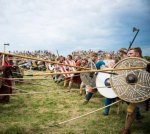
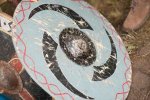
The viking roundshield is roughly 90 cm in diameter − and light. It is made from cut planks of pine wood that are glued together. This wood is very thin, overall about 6 millimeters thick − about 7 millimeters thick around the boss and tapering slightly to about 5 millimeters around the rim. Millimeters! It is probably more useful to consider viking roundshields as a kind of leather shield, rather than wood shield. It uses the wood to hold its shape. The shield maker glues boiled leather across the front and back, and then wraps a strip of boiled leather around the rim of the shield to reinforce it. The shield maker then sews these pieces together around the rim, thru perforations in the wood. The leather can be of cattle, sheep, goat, or pig. The boiled leather shrinks tight and hardens while drying, and also helps to hold the shield together. The result is shield that is solid, tough, light, and highly maneuverable. It deflects oncoming arrows, and so on.
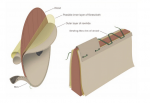
One archeologist, involved in scientifically rigorous combat experiments, noted that failure to wield the viking shield actively tended to result in its wielder becoming ‘dead’. Also the shield incurred damage more quickly when held passively.
Among the remains of viking shields today, usually only the metal bosses survive, and these indicate damage patterns from active wielding.
The viking shield synergizes with the overall combat style that relies on agility. The viking shield requires skill to use properly. The wielder also wields it for offhand attacks.
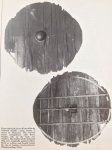
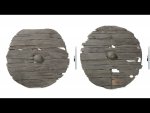
Here are some archeological remains of viking shields. Normally, the shields are painted bold colors, but here the paints have decayed over the centuries.
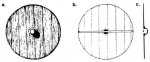
Today, some replicas trim the edge of the shield with metal to reinforce the wood, but this is modern, apparently a misunderstanding of the metal ring that some museums attached to the shield remains as a mount for display.
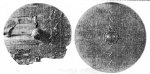
Here are similar shields from around the same time in the Baltics, where some leather covering has survived.
D&D 5e lacks a basic parry action. (The fighter and monk classes have special mechanics to do something like it.) Should a parry mechanism become available in the future, the viking shield is suitable. In current rules, any parrying subsumes into the abstraction of the AC +2 shield proficiency bonus.
One way to represent the viking shield is as an item that can benefit from both shield proficiency and from weapon proficiency. Where 5e makes the whip a martial melee weapon that deals 1d4 damage, this seems comparable to the level of skill necessary to make an effective attack with a viking shield. It exhibits the ‘light’ description for use in the offhand.
Also consider fighter class fighting styles, maneuvers, and feats that synergize with a viking shield for D&D combat, both as an offhand weapon and as a shield. It might be worthwhile to develop new ones here in this thread.
Any fighter character optimizers, please comment on the viking shield stats, to help ensure that it is a good choice and balanced compared to other good choices.
Martial Melee Weapon
viking shield (1d4 bludgeoning; light, special − shield proficiency grants AC +2)
The viking roundshield is roughly 90 cm in diameter − and light. It is made from cut planks of pine wood that are glued together. This wood is very thin, overall about 6 millimeters thick − about 7 millimeters thick around the boss and tapering slightly to about 5 millimeters around the rim. Millimeters! It is probably more useful to consider viking roundshields as a kind of leather shield, rather than wood shield. It uses the wood to hold its shape. The shield maker glues boiled leather across the front and back, and then wraps a strip of boiled leather around the rim of the shield to reinforce it. The shield maker then sews these pieces together around the rim, thru perforations in the wood. The leather can be of cattle, sheep, goat, or pig. The boiled leather shrinks tight and hardens while drying, and also helps to hold the shield together. The result is shield that is solid, tough, light, and highly maneuverable. It deflects oncoming arrows, and so on.
One archeologist, involved in scientifically rigorous combat experiments, noted that failure to wield the viking shield actively tended to result in its wielder becoming ‘dead’. Also the shield incurred damage more quickly when held passively.
Among the remains of viking shields today, usually only the metal bosses survive, and these indicate damage patterns from active wielding.
The viking shield synergizes with the overall combat style that relies on agility. The viking shield requires skill to use properly. The wielder also wields it for offhand attacks.
Here are some archeological remains of viking shields. Normally, the shields are painted bold colors, but here the paints have decayed over the centuries.
Today, some replicas trim the edge of the shield with metal to reinforce the wood, but this is modern, apparently a misunderstanding of the metal ring that some museums attached to the shield remains as a mount for display.
Here are similar shields from around the same time in the Baltics, where some leather covering has survived.
D&D 5e lacks a basic parry action. (The fighter and monk classes have special mechanics to do something like it.) Should a parry mechanism become available in the future, the viking shield is suitable. In current rules, any parrying subsumes into the abstraction of the AC +2 shield proficiency bonus.
One way to represent the viking shield is as an item that can benefit from both shield proficiency and from weapon proficiency. Where 5e makes the whip a martial melee weapon that deals 1d4 damage, this seems comparable to the level of skill necessary to make an effective attack with a viking shield. It exhibits the ‘light’ description for use in the offhand.
Also consider fighter class fighting styles, maneuvers, and feats that synergize with a viking shield for D&D combat, both as an offhand weapon and as a shield. It might be worthwhile to develop new ones here in this thread.
Any fighter character optimizers, please comment on the viking shield stats, to help ensure that it is a good choice and balanced compared to other good choices.
Martial Melee Weapon
viking shield (1d4 bludgeoning; light, special − shield proficiency grants AC +2)
Last edited:
Yaarel
🇮🇱 🇺🇦 He-Mage
Scandinavian archeologists lack consensus about how to periodize the Viking Period. A main difficulty is, the time is defined by things that happen in other lands. But when archeologists look in the lands of Scandinavia itself, there is little difference before or after. Some consider the Viking Period to be part of the Iron Age, some consider it to be part of the Medieval Period, and some consider it to be a separate transition period between Iron and Medieval. The Viking Period is a gradual transitional phase that evidences features of both the Iron Age and the Medieval Period, simultaneously. Here the periods divide by centuries.
500s BCE Nordic Iron Age (Nordic Parent Language, Pre-Roman, Early Iron)
000s CE Early Proto-Norse Period (Roman Period, Early Iron)
400s CE Late Proto-Norse Period (Elder Fuþark Runes, Migration Period, Middle Iron)
500s Pre-Viking Period (Late Proto-Norse, Transition Runes, Vendel, Merovingian, Early Medieval, Middle Iron)
800s Early Viking Period (Old Norse, Younger Fuþãrk Runes, Twig/Branch, Carolingian, Early Medieval, Late Iron)
900s Middle Viking Period (Old Norse, Norwegian Younger Runes, Early Medieval, Late Iron)
1000s Late Viking Period (Old Norse, Fuþork Runes, High Medieval, Late Iron)
1100s Post-Viking Period (Old Norwegian/Swedish/Danish/Icelandic, Eddas, Sagas, High Medieval)
1300s Late Medieval Period (Middle Norw/Swed/Dan/Icel, Late Sagas, Black Death, Kaimar Union, Decline of Runes)
1500s Early Modern Period (Modern Norw/Swed/Dan/Icel, Renaissance, Protestant Reformation)
500s BCE Nordic Iron Age (Nordic Parent Language, Pre-Roman, Early Iron)
000s CE Early Proto-Norse Period (Roman Period, Early Iron)
400s CE Late Proto-Norse Period (Elder Fuþark Runes, Migration Period, Middle Iron)
500s Pre-Viking Period (Late Proto-Norse, Transition Runes, Vendel, Merovingian, Early Medieval, Middle Iron)
800s Early Viking Period (Old Norse, Younger Fuþãrk Runes, Twig/Branch, Carolingian, Early Medieval, Late Iron)
900s Middle Viking Period (Old Norse, Norwegian Younger Runes, Early Medieval, Late Iron)
1000s Late Viking Period (Old Norse, Fuþork Runes, High Medieval, Late Iron)
1100s Post-Viking Period (Old Norwegian/Swedish/Danish/Icelandic, Eddas, Sagas, High Medieval)
1300s Late Medieval Period (Middle Norw/Swed/Dan/Icel, Late Sagas, Black Death, Kaimar Union, Decline of Runes)
1500s Early Modern Period (Modern Norw/Swed/Dan/Icel, Renaissance, Protestant Reformation)
Last edited:
Similar Threads
- Replies
- 3
- Views
- 914

- Replies
- 12
- Views
- 2K

- Replies
- 0
- Views
- 268

- Replies
- 7
- Views
- 2K


- Replies
- 26
- Views
- 5K
Recent & Upcoming Releases
-
June 16 2026 -
June 16 2026 -
September 16 2026 
Arcana Unleashed(Dungeons & Dragons)
Rulebook featuring "high magic" options, including a host of new spells.
Replies (250) -
September 16 2026 -
October 1 2026 -
October 6 2026 -
January 1 2027 -
January 1 2027






