
D&D General Revisiting the Red Box.

Every so often, I look at the Red Box and wonder whether its approach could be replicated today—not as a one-and-done product, but as a way to introduce someone to their own heartbreaker in deliberate increments. And whether that’s even necessary.

Many modern discussions center on structure without acknowledging what the Red Box actually did. It didn’t just explain rules—it taught you how to play by experience.

You could start with a story.
Then a single roll.
Then introduce a few concepts.
Then a solo quest.
Then a choose-your-own-adventure.
Then, a fully prepped level.
Then an empty level.
And finally, a “do it yourself” with hints instead of answers.

Because Bargle still causes a visceral response to this day. <shakes fist>
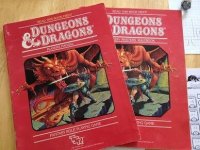
 

Attachments

  • red box books.jpg
    red box books.jpg
    38.7 KB · Views: 17

log in or register to remove this ad

I personally would say the format of the Red Box is probably not necessary, due to the fact that the odds of someone being handed the box on their own under the expectation to learn and enjoy the game on their own is much, much less than it would have been 40+ years ago.

40 years ago gaming culture was much different, much smaller, much more niche, and much more looked down upon. Thus those kids and young adults who might have been curious about it would not often have a circle of other gamers who were all open about their gaming that they could turn to. Thus the need and the ability to "try D&D out on their own" (because they had no other choice) was more of a necessity. And the Red Box served that need (it certainly did for me). But these days? That sort of solo experience is exceedingly rare I feel-- rare enough that I do not think any sort of in-road nor money-earning potential could really be gained by making products focused towards those kids and young adults.

Today's youth are all a part of a wider, world-wide gaming culture, and the knowledge of what a "role-playing game" is permeates said gaming culture. So if there are youths who want to get out from behind their computer, tablet, and phone screens to "play tabletop games"... trying to do it on their own is for the most part unnecessary. There will always be others of experience (friends, family, stores, conventions, internet connections) who can bring those youths in to learn how to play... or they can gather their own gamer friends together and all work as a group to learn these games. Learning D&D in the 21st century is not a solo experience really... so making a product like the Red Box that does that is not really the best use of resources. Other styles of "starter" products I think would probably be more useful today.
 
Last edited:

I see a lot more solo games, methods to play solo, people posting their solo experiences than ever.

I thought solo was having a moment but it might just be the internet bubble I live in.

There is also a lot of campagin in a box board games that can be played now which seems like it might be a better way to go, but I’ve never played either type of game solo so I don’t really know.


How is this much different than the new box set? I have not played it, but is looks like it spoon-feeds things to the players and the DM to start playing. Is there the offramp to go off and create your own stuff to add or create a whole new campaign?
Yes, the Expert Set that followed. BE is the most complete version of the game that also has the best guidance on what to do with the game. No older brother or mean high schoolers needed: ten year olds could have these things in hand and learn to be awesome players and GMs (if I do say so myself).


Every so often, I look at the Red Box and wonder whether its approach could be replicated today—not as a one-and-done product, but as a way to introduce someone to their own heartbreaker in deliberate increments. And whether that’s even necessary.

Many modern discussions center on structure without acknowledging what the Red Box actually did. It didn’t just explain rules—it taught you how to play by experience.

You could start with a story.
Then a single roll.
Then introduce a few concepts.
Then a solo quest.
Then a choose-your-own-adventure.
Then, a fully prepped level.
Then an empty level.
And finally, a “do it yourself” with hints instead of answers.

Because Bargle still causes a visceral response to this day. <shakes fist>
I believe Chaosium and Free League offer their own take on this approach with their boxed sets. So yes, it would work. ;)
 

How is this much different than the new box set? I have not played it, but is looks like it spoon-feeds things to the players and the DM to start playing. Is there the offramp to go off and create your own stuff to add or create a whole new campaign?
It's wildly different than Heroes of the Borderlands, which is designed around having a DM and 1-4 players, and no solo content. Adventure content is put out in small chunks, usually a page or less at a time, and there are a ton of simple quests available from talking to pretty much everyone in the Keep.
 

Enchanted Trinkets Complete

Recent & Upcoming Releases

Remove ads

Top





