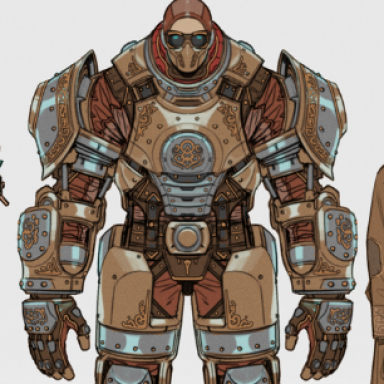
Minigame Magazine is published by Valent Games. The current issue of this monthly PDF release is the August 2004 issue, the fourth Minigame Magazine to date. It is also the longest, at 57 pages, and has four pieces of black and white interior artwork (which includes the cover illustration). Bookmarks included in the PDF make it easy to jump to whatever section you need to reference, and include bookmarks to the art, and the sidebars scattered throughout. The file, downloaded zipped, is a manageable 2.4 megabytes and is downloadable from RPGnow.com for $6.
The first and most important thing to note about “The Undying Lands” is that it is an original roleplaying game. The mechanics, stats, task resolution system, etc. are all new to this product, meaning that no other books are needed (references for campaign flavor notwithstanding of course).
The theme of this issue of Minigame Magazine is the fey. More specifically, it’s about normal people from the real world displaced into the fey world. Something of a reverse of White Wolf’s Changeling: The Dreaming (which the author himself notes in the Inspiration section). Though the only possible overarching goal for the campaign isn’t “How do we get home?” it’s certainly the most prevalent throughout the issue.
Following the three pages for the ubiquitous cover, introduction, and table of contents, there is an Inspiration section, something we first saw in the previous issue. Unlike that one, however, this is a short section, barely half-a-page of noting works that the author found helpful for the theme of this issue, and that he feels GMs for the setting might also. Following this is almost a glossary of common terms and what they mean in the context of this game.
The next short section (two-and-a-half pages) lays out the basics. Refreshingly, this doesn’t include a section on what a roleplaying game is and how exactly you play it. Given the space limitations on the product, and that it’s describing a new campaign setting and game system, this is certainly understandable. Likewise, having read such introductions to roleplaying over and over in many books, I’m just as happy not to see it again here. What we do see instead is a basic idea of what the main characters should be like, supporting characters, getting to the Undying Lands, and returning.
I found the section here on main characters to be amusing, since a fair amount of space is devoted to driving home the idea that the player-characters are supposed to be normal people from the real world; a far cry from the idea in many RPG’s that the PCs are supposed to, even at their outset, be somehow better than the NPC’s. Correspondingly, there is also a small warning to the Game Master that the game does need to be tailored to the PC’s, since a group of larcenous-minded characters won’t be motivated by altruism’s sake.
The part talking about travel to the Undying Lands goes out of its way to emphasize that getting to the Undying Lands is a feat so rare that it’s almost unknown in the fey world. What’s more, it’s virtually always an accident, and since magic is unique and unrepeatable (more on this later), the characters can’t use the way they got there to go back home. A sidebar even explains that if a two-way gate were found, overuse would quickly make it collapse. A sort section then explains the differences in time between the real world and the Undying Lands.
Page eight is where we begin to come to the meat of the issue. This section, “The World of Dreams and Nightmares” describes the fey world that is the Undying Lands. Seven-and-a-half pages describe forests, mountain ranges, cities, an ocean, and more, with sidebars explaining the seasons (or lack thereof), and how hard science works in a fundamentally magical world. While this section doesn’t lack in colorful descriptions, painting the various areas in broad strokes that seem perfect for a world of magical beings, my major complaint from issue #2 returns here: there is no map. The good news is that this isn’t as big a deal as it was for issue #2. That issue described a singular island, so it was more important to have an exact picture in your mind of what the setting was like. When describing an entire world, it’s easier to be inexact, since you’re just describing vast regions with a few paragraphs; hence, no map is more forgivable here. Still, it’s something most Game Masters will probably miss.
The next section describes the new game system used to play the game. “Game Mechanics” takes up twenty-and-one-half pages, which makes it the single largest section in the entire product, though still barely over a third of the entire issue.
In the Undying Lands game system, characters are measured in three respects: their attributes, their skills, and their magic. PC’s, however, only start out with the first two, as no human from the real world (which is what the PC’s are) begins with any sort of magical knowledge or ability. The measure of ability is ranged from 1 to 10. However, this is where it begins to become markedly different from most RPG’s. The numbers used for attributes et al isn’t just a single number. Rather, you use a range of numbers. For example, your Fitness attribute might be rated 1-5. The higher your maximum number, the better your ability in the relevant attribute, skill, or spell. It’s interesting that, when assigning attributes for your character, you do need to keep your numbers consecutive, but do not need to start at 1.
When making dice checks, the game system always has you rolling under two listings simultaneously. Any check you make will always be under both an attribute and a skill (or, for casting spells, an attribute and a magic type). For example, a PC trying to make his horse jump across a ravine might have to make his roll under the Command attribute (to convince the horse) and the Riding skill (to correctly have the horse perform the maneuver). One problem I noted here was that there didn’t seem to be guidelines for linking which attributes to which skills when outside of combat or spellcasting. While fighting or using magic clearly lays out what skills (or magic types) you use in conjunction with which attributes, there are no guidelines for what to use when, for example, trying to jump off a cliff into a river without getting killed. While the obvious implication here is that GM’s should use common sense, players are known to demand consistency from their Game Masters, so it could be something of a headache for GM’s that they need to make a notation of what every action type entails in terms of the relevant skill/attribute combination.
The dice that are actually rolled for action checks are 3d10 (three ten-sided dice), with the 0 always being understood to be 10. The results are not added, but are individually compared to the two relevant listings you’re making the check under. The results are calculated two ways; the number of matches you get (“matches” here meaning if a rolled number falls under the range of scores in either of the listings you’re rolling under), and the single highest match, which is called “quality”. The quality of your roll determines the rate of your success, and the number of matches determines how well your success holds up under opposition. So, for example, if you were rolling under Grace (attribute) and Athletics (skill), with your respective point ranges in them being 1-5 and 1-6, and your 3d10 roll was 2, 6, and 8, you would have three matches, because the 2 falls within both ranges for two matches, and the 6 falls in your Athletics range for another match there, with the 8 not matching at all. Likewise, your quality would be 6, since the 6 you rolled is your highest match. So, your roll has a high success rate (since a 6 is a high quality), and is a fairly substantial victory (since it has three matches backing it up). For ordinary tasks, a single match is enough, but opposed actions or difficult tasks can require a minimum number of matches and/or quality.
The various attributes, skills, and magic break down like as such: the attributes for your character are Command, Creativity, Fitness, Grace, Persistence, Reasoning, Savvy, and Senses. Skills are Academia, Animal Ken, Armed Combat, Art, Athletics, Bargaining, Carousing, Computers, Crafts, Etiquette, Fae Lore, Firearms, Larceny, Medicine, Motor Vehicles, Paperwork, Ranged Combat, Repair, Riding, Sailing, Stealth, Unarmed Combat, and Wilderness Survival. The types of magic are Household Magic, Illusion, Compulsion, Blessings and Curses, and High Ritual. Starting characters have 60 points for attributes, and 70 points for skills (starting characters are not allowed to have magic). Buying a number under the relevant attribute or skill costs an amount of points equal to the number. Hence, buying 1-3 in a skill costs 6 points. Experience is 7 points at the end of a game session that may be used for anything, even magic. However, while skills bought with experience points follow the usual paradigm (a number of points equal to the number bought), magic costs that amount plus 2, and attributes cost a number of points equal to the number, doubled – this is to reflect that its easier for humans to improve on what they already know, but learning magic is harder, and changing yourself is even more difficult.
Combat is a relatively small sub-section here, not quite three whole pages, since real characters don’t often fight, something that holds true in the fey world as much as it does here. When a fight breaks out, characters roll Fitness and Grace, with the best results going first. While the attribute/skill used by ranged fighters and defenders are fairly standardized, melee combatants will have to choose a style of combat, those being Aggressive, Opportunistic, Defensive, Flashy, and Intimidating. Each uses a particular attribute/skill combination, and have the defenders use one of two possible attribute/skill combinations to defend (though, for all of these, the skill portion of the attribute/skill rolls is always either Armed Combat or Unarmed combat, whichever you’re using). If the defender can match the quality and number of matches of the attacker, the defender takes no damage. Otherwise, he loses the highest digit from his combat skill or attribute that he was using to defend with. When that falls below 1, the combatant is helpless, and at the mercy of their opponent.
Magic is, as noted above, divided into five disciplines, and is rolled as skills or combat rolls are. However, where magic differs is that spells never truly fail. Rather, if a target roll fails, the magic simply drains some of the caster’s life force (Fitness attribute) to power itself to completion. However, if the roll is a spectacular failure (all the d10’s are 1) or it drains the last of the caster’s Fitness (which doesn’t kill the caster), then the magic still works, but by backlashing in a horrible effect.
Following the “Game Mechanics” section is the “Faeries” section, which is six pages of describing the groupings of fey that inhabit the Undying Lands. These fey are the most numerous and influential dwellers of the fey world, though they are not the only ones, nor the most powerful. The basic five groups of fey are Nobles, Goblins, Pixies, Wee Folk, and Niskies. While these (usually) just have one set of stats laid out per entry, the flavor text makes it clear that these entries are themselves just broad categorizations. Niskies, for example, groups together mermaids, nerids, undines, tritons, and more.
Another six pages composes the “Creatures” section. These are the creatures besides the faeries that live in the Undying Lands, from unicorns to dragons to beings from the Netherworld, the place of demons and death that lies beyond the real world and the Undying Lands. An interesting exception is that this section also contains the statistics for King Oberon and Queen Titania, rulers of the fey.
The last section (a page for the OGL and for plugs for other Valent Games products notwithstanding) is “Plot Hooks”. Here are a hundred ideas for adventure in the Undying Lands, broken down into groups, such as People to Visit, Sidetreks, and Ways to Leave. There is more than enough material here for an entire campaign.
It’s worth mentioning that the Open Game License section declares that the “Game Mechanics”, “Faeries” and “Creatures” section are all Open Game Content, meaning that enterprising writers can use the new system presented here, as well as even possibly make their own supplements for the Undying Lands.
All in all, this innovative product offers quite a change of pace. The campaign setting itself is fleshed out well, but leaves most of the finer details open for GM’s to fill in the rest of the world on their own. Likewise, the game engine is something of a refreshing change from some of the more combat-oriented systems in other RPG’s. With its intricate way of measuring degrees of success, it lends itself perfectly to an adventurous game. Players and GM’s looking for a change of scenery would do well to visit the Undying Lands.