Ryan Dancey & AEG Part Ways Following AI Comments

COO says that AI could make any of the company's games.
Alderac_brandpage_BS_1200x600_crop_center.webp


Ryan Dancey, the Chief Operating Officer of boardgame publisher Alderac Entertainment Group, no longer works for the company, following statements on social media where he claimed that AI could make most of the company's board games, and that D&D and Magic: the Gathering were the only new forms of gameplay in his lifetime. After another poster on LinkedIn claimed that "AI wouldn't come up with Tiny Towns or Flip Seven or Cubitos because it doesn't understand the human element of fun", Dancey responded that he had zero reason to believe that AI could not do such a thing.

"I have zero reason to believe that an Al couldn't come up with Tiny Towns or Flip Seven or Cubitos. I can prompt any of several Als RIGHT NOW and get ideas for games as good as those. The gaming industry doesn't exist because humans create otherwise unobtainable ideas. It exists because many many previous games exist, feed into the minds of designers, who produce new variants on those themes. People then apply risk capital against those ideas to see if there's a product market fit. Sometimes there is, and sometimes there is not. (In fact, much more often than not).

Extremely occasionally (twice in my lifetime: D&D and Magic: the Gathering) a human has produced an all new form of gaming entertainment. Those moments are so rare and incandescent that they echo across decades.

Game publishing isn't an industry of unique special ideas. It's an industry about execution, marketing, and attention to detail. All things Als are great at."
- Ryan Dancey​

The Cardboard Herald, a boardgame reviews channel, responded yesterday on BlueSky that "As you may have seen, [AEG] CEO Ryan Dancey stated that AI can make games “just as good as Tiny Towns or Flip 7 or Cubitos”, completely missing the inexorable humanity involved.We’ve spent 10 years celebrating creatives in the industry. Until he’s gone we will not work with AEG."

Today, AEG's CEO John Zinser stated "Today I want to share that Ryan Dancey and AEG have parted ways.This is not an easy post to write. Ryan has been a significant part of AEG’s story, and I am personally grateful for the years of work, passion, and intensity he brought to the company. We have built a lot together. As AEG moves into its next chapter, leadership alignment and clarity matter more than ever. This transition reflects that reality.Our commitment to our designers, partners, retailers, and players remains unchanged. We will continue building great games through collaboration, creativity, and trust."

Dancey himself posted "This morning [John Zinser] and I talked about the aftermath of my post yesterday about the ability of AI to create ideas for games. He's decided that it's time for me to move on to new adventures. Sorry to have things end like this. I've enjoyed my 10 years at AEG. I wish the team there the best in their future endeavors.

I believe we're at a civilizational turning point. That who we are and how we are is going to change on the order of what happened during the Agricultural and Industrial Revolutions; and it's past time we started talking about it and not being afraid to discuss the topic. Talking about AI, being honest about what it can and cannot do, and thinking about the implications is something we have to begin to do in a widespread way. Humans have a unique creative spark that differentiates us and makes us special and we should celebrate that specialness as we experience this epic change.

For the record: I do not believe that AI will replace the work talented game designer/developers do, nor do I think it is appropriate to use AI to replace the role of designer/developers in the publication of tabletop games. During my time at AEG I developed and implemented polices and contracts that reflect those views. It's important to me that you know what I believe and what I don't believe on this particular topic, despite what you may have read elsewhere."

Whatever your position on generative LLMs and the like, when the COO of your company announces publicly that all of the company’s games could have been made by AI, it’s a problem. UK readers may recall when major jewelry chain Ratners’ CEO Gerald Ratner famously announced that the products sold in his stores were “trash”, instantly wiping half a billion pounds from the company’s value back in the early 1990s. The company was forced to close stores and rebrand to Signet Group. At the time the Ratners Group was the world's biggest jewelry retailer. Ratner himself was forced to resign in 1992. The act of making a damaging statement about the quality of your own company’s products became known as “doing a Ratner”.

Dancey was VP of Wizards of the Coast when the company acquired TSR, the then-owner of Dungeons & Dragons. He is also known for being the architect of the Open Game License. Dancey has worked as Chief Operating Officer for AEG for 10 years, and was responsible for the day-to-day operations of the company, second-in-command after the CEO, John Zinser.

 

log in or register to remove this ad

Considering we're talking about people like professional painters having their careers eliminated via AI right now, it seems unlikely that cameras eliminated that career 150 years ago...
not every painter is a portrait painter… if anything cameras freed painters from the goal of replicating reality accurately and allowed them to do all kinds of other styles. No idea about numbers though
 

log in or register to remove this ad

I can't actually find any numbers on how many Americans identify as capitalists; seems most polls just ask if you like capitalism... not surprisingly the number of people especially among the youth that feel capitalism is working out is headed downwards.

The only number I could actually find was 1 in 5 aged 18-29 identify as such.

"So we started by examining a troubling 2016 Harvard University survey that found that 51 per cent of American youth aged 18 to 29 no longer support capitalism. Only 42 per cent said they back it, while just 19 per cent were willing to call themselves “capitalists.”

So I will concede it's probably not the majority, but if it's at 19% amount the disaffected youth, I'd say it has to be significant portion of the population. But I have no idea what that portion is.

Even then, are they responding to a technical definition of capitalism, or the version of they may hold in their minds?

Kind of like asking conservative voters what they think of "liberalism". Any who know the definition are more likely to be in favor of it.
 

Ah, I see. We are talking about careers. Jobs. And you seem to be including hobbyists. My uncle Jim who played the fiddle at family events was never a professional--his job was never at risk and didn't "lose a career" as a fiddler because of recorded music (he was a truck driver by career). None of those people playing the fiddle at family gatherings lost their career; that wasn't their career in the first place. I'm still waiting for any sort of data that shows professional musicians declined sharply after recorded music.
I wasn’t… I said

Technology has definitely limited the number of artists we have/need over time.

Every family used to have someone that could play an instrument, it was an important part of filling time and providing entertainment. Recorded music and players basically wiped that out.”

I was talking about artist being taken out by tech. Not just people who got paid to make art.

Again, the printing press did not end the professional careers of people who wrote books and other written works. It actually expanded the careers. Print media took off. People who wanted to write and illustrate books had more career opportunities. That is literally the opposite of what we're talking about here.
Again I specifically said people who make illuminated manuscripts. A specific type of art. Much different than being a writer.

You keep taking something I said and making it into something else.
Apples to oranges again. I ask you again, show me data that showed professional painters losing their careers after cameras were invented. Considering we're talking about people like professional painters having their careers eliminated via AI right now, it seems unlikely that cameras eliminated that career 150 years ago...
Again portraits painters… it was a whole profession. Not just painters… how many straw men are we building here?
 

I wasn’t… I said

Technology has definitely limited the number of artists we have/need over time.

Every family used to have someone that could play an instrument, it was an important part of filling time and providing entertainment. Recorded music and players basically wiped that out.”

I was talking about artist being taken out by tech. Not just people who got paid to make art.


Again I specifically said people who make illuminated manuscripts. A specific type of art. Much different than being a writer.

You keep taking something I said and making it into something else.

Again portraits painters… it was a whole profession. Not just painters… how many straw men are we building here?
The whole point of this thread is AI replacing careers. Jobs. Not hobbies. No amount of AI is going to stop me from drawing myself, because I like it. Recorded music never stopped anyone from playing an instrument for fun. And we're not talking about corner cases. "Well, AI did replace artists who paint in a particular style that is very small compared to the whole...." We're talking about the entire industry. So....apples and oranges.

Which again, you have yet to provide any actual data to back up the claims you made. Which is moot, really, because again, we're talking about lost jobs here. Eliminated career paths.
 

I ask you again, show me data that showed professional painters losing their careers after cameras were invented.


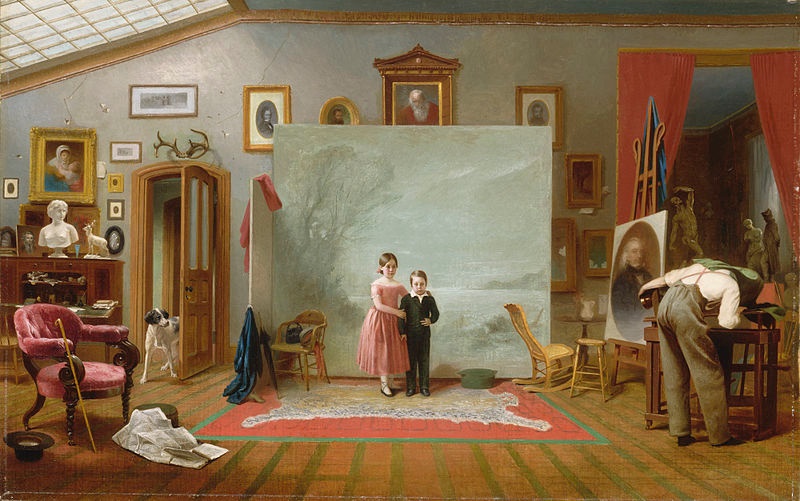
Here's an interesting paper on photography and painting in the 19th century. There were professional careers that were wiped out. Portrait miniaturists, for example. Many painters took up photography or coloring photos in order to adapt.


“many [painters] turned their steps towards photography and businesses connected therewith, and thus found a much more tranquil career and oft-times ampler fortune” [24]

Photography had particularly dramatic effects on the livelihoods of painters who operated on the fringe of the mainstream. This included the portrait miniaturists, whose markets fell drastically, particularly after the introduction of the multi-pose and cheap cartes de visite in the mid-1850s. Many gave up, while others turned to colouring photos [25].

The advent of relatively quick, cheap and accurate photography also contributed to the eventual disappearance of the itinerant or journeying artist who travelled round the countryside, materials in a haversack, ready to decorate a farm wagon, paint an inn sign or execute on-demand portraits of people and pets, wedding scenes, and the staff in stately homes.


Here's an interesting paper on photography and painting in the 19th century. There were professional careers that were wiped out. Portrait miniaturists, for example. Many painters took up photography or coloring photos in order to adapt.

Landscape painters like Frederick Edwin Church (1826-1900) were wildly popular...there would be lines outside his exhibitions...because before color photography their paintings were the only way that people could experience far off, exotic places without traveling there.


This mixture of outward disdain and inner dread meant that many painters would often be reluctant to admit to actually using photography in their work.

Found this bit interesting...and familiar.

This paper is from over a decade ago and not recent, in case anyone is wondering.
 
Last edited:

What was the last new genre of music that was not easily described as being a derivative of another pre-existing one?

I’m honestly curious because I can think of any. We’ve had new genres but it’s always been fairly clear (or so I thought) about what they came from.
Just because one genre evolves out of another doesn’t necessarily make it derivative.

Punk was reactionary to prior genres, especially things like prog. While it shares some superficial characteristics with Metal, they have different musical foundations. And notably, punk is usually ascribed to have a social ethos outside of the music itself.

Like Punk, most early New Wave was largely a reaction to and rejection of prior musical conventions.

Rap has some of the oldest constituent elements in music, and it borrows musical elements freely from most other genres. But it’s not really based in the conventions of modern popular music. The introduction of sampling via turntables was musically and technologically innovative.

Arguably, none of the fusion genres should be considered derivative because there’s no unbroken musicological lineage between them and the genres they meld. They’re chimeras that can combine extremely different, unrelated elements. So things like Prog Punk, Nü Metal, Shoegaze, Reggae Metal, Country Rap, and so forth don’t come into being naturally, like different rivers flowing into a larger body of water. They are consciously crammed together, sometimes in anticipation of creating mental dissonance.
 

I predict that most normies will consume AI stuff without a second thought. Human-made products will only be appreciated by hobbyists, collectors as a luxury item. Like organic produce.

"Unlike store-bought board games, THIS one was entire designed by human writers, editors, artists and designers, hence the premium collector's price and value."

If big corpos love AI and use it to increase profits, it's here to stay. Films made with real people will be a rare, film-buff type of thing, like going to modern art galleries.

I can see it now "how pretentious; that gallery only features human-slop, not a shred of AI in there, buncha elitists".

To add, I've already seen pro-AI groups co-opting Inclusivity and Accessibility language, eg "AI can let disabled or neuro-divergent people create art themselves, at last? Are you against inclusivity?". yeah I'm sure that's what the silicon valley dude bro oligarchs are thinking of.
 

Related Articles

Remove ads

Remove ads

Top