D&D General When Was it Decided Fighters Should Suck at Everything but Combat?

That's fine, but in practice it still means with someone with a decent understanding of probability its functionally equivelent to "X times per encounter".
So long as you're coming at it from a representational perspective, that what you've got in practice. Seeing it "math first" is a choice, one that has little to do with why I suggested the idea.
 

log in or register to remove this ad

I think it's worth noting that nearly every person you mentioned up there was a multi or dual classed NPC in D&D. When you have a handful of classes, you can't mirror every archetype. So rather than bloat up every class you do have, you just multi-classed into another class to get the skills represented in fiction.

No they aren't! That's tautological. 'We've made fighter dumb jocks so now all the interesting fighter paragons are suddenly now a complex multi-class chimera'.

That’s not what happened. They didn’t suddenly make fighters dumb jocks. Multiclassing to capture fictional archetypes has been there since day one. Just open deities and demigods, or read any of the dragon magazines. Also, I’ll repeat what I said above: most of those traits of fictional heroes are captured by high stats in abilities like INT or CHA, you didn’t need a specific power to do something smart or persuasive. Also, DnD was never built or meant to replicate fictional figures in a game statblock. It can’t. No rpg can do that as fictional characters are all over the board with abilities that don’t carry over into the game well.

I also disagree with your premise that a fighter paragon can’t be interesting unless it’s multiclassed. That’s just simply not true.
I think this is illustrative of Soviet's point.

Fictional heroes from the literature which inspired D&D have traditionally had many skills and been broadly competent. D&D siloed skills to create roles with niches, but in the process, once skills started creeping in with expanded classes (Thief, Ranger, Paladin) in 1975, the Fighter, which could in 1974 have been judged to be broadly skilled and able to, say, sneak or track as well as anyone, started having those abilities removed by implication, since such skills were explicitly given to others.

When Gary (and others) started writing up fictional mythic heroes in Dragon Magazine (and later places like Deities & Demigods) they felt like they needed to give those heroes of fiction abilities from multiple classes to replicate their skills & abilities.

This has, basically until WotC opened up a la carte multiclassing with 3.0, exemplified a tension between the pre-3E D&D rules on classes and skills and every player who's ever wanted to simulate a fictional hero (or make their own character modeled off one), who wasn't allowed to do what Gary chose to do in his articles writing up the stats of heroes from fiction.

Second, I used to love the book-based game "Ace of Aces" (and really wish I still had my original copy). And I've long wished for an RPG combat system based on the same concept: you and your opponent simultaneously declare your next move, and the two actions are resolved concurrently. It would be awesome! (And maybe not achievable for anything except duels. Using specific weapons.)

There actuallly used to be a collection of game-book combat rules that were somewhat in that direction; I probably still have mine buried somewhere. I can't remember what they were called any more though, and since they were designed for standalone play, would probably be too in-depth for use in an RPG anyway (you'd need to factor character skill in in some way too, which they didn't do).
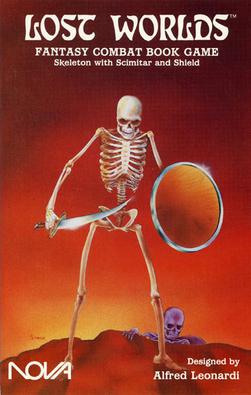
Lost Worlds, from Nova games. I've still got all of mine. As I recall SCA fighters were originally consultants on the system, and it shows. The system was also licensed out for some Battletech game booklets in the 80s, and some Warhammer 40k ones in the 2000s, among others.

Lost Worlds does actually have an experience/progression system, but basically it just gradually adds damage bonuses to different maneuvers, and can IIRC eventually add an additional attack, which is primarily useful to let a combatant fight multiple enemies at once.


I’m not going to respond point by point, but I have been generally thinking of something similar to this for a while, possibly with the added complexity of something like speed factors, not to the granularity of 1e, but in the “Immediate actions go first, then some system for things that take movement (or otherwise eat up time).” Initiative boils down to an instant: you might get the jump on the goblin archer, but if you’re trying to run across the field to hit him with a sword before he puts an arrow in you, it won’t work.

It’s tied into a houserule I’m tinkering with to make initiative “side-based” (d6, high side acts first) but staggered. What do I mean by “staggered?” PC(s), monster they attack, PC(s), monster, and so on.

Basically, if two or more on either side tag-team someone, the initiative winning side goes first, then we resolve their opponent’s turn, then move to the next group.

That sparked the questions: “Shouldn’t archers who are ready get to shoot before people can move? How long should spells take to cast, etc.” And that’s why the houserule is still in development.

Side note on your d6 thing is you could get big dice that could be seen from across the table. I might think about having people roll a d6, but using a large d12 to represent your turn - if I add my speed idea to it (“You want to run over to that goblin? Okay, moving across the room takes 3 segments, so increase your die by 3 and we’ll resolve your attack then. Next person.”)

Clearly still a work in progress.

I was toying around with some ideas around this last summer.


More recently I've been using individual initiative in Shadowdark, but I've been representing weapon reach by stealing a simple rule from The Nightmares Underneath - if you are aware of the attacker and are attacked before your initiative by someone whose weapon has shorter reach than a weapon you have in hand and ready, you may forego your turn later that round to attack them first. So spears, missile weapons, swords against enemies with daggers or claws or whatever, get that reach advantage for first strike.
 

I’m not going to respond point by point, but I have been generally thinking of something similar to this for a while, possibly with the added complexity of something like speed factors, not to the granularity of 1e, but in the “Immediate actions go first, then some system for things that take movement (or otherwise eat up time).” Initiative boils down to an instant: you might get the jump on the goblin archer, but if you’re trying to run across the field to hit him with a sword before he puts an arrow in you, it won’t work.

It’s tied into a houserule I’m tinkering with to make initiative “side-based” (d6, high side acts first) but staggered. What do I mean by “staggered?” PC(s), monster they attack, PC(s), monster, and so on.

Basically, if two or more on either side tag-team someone, the initiative winning side goes first, then we resolve their opponent’s turn, then move to the next group.

That sparked the questions: “Shouldn’t archers who are ready get to shoot before people can move? How long should spells take to cast, etc.” And that’s why the houserule is still in development.
The bolded could (and, I think, would) get messy the moment anyone in the combat has the potential to affect more than one "group" or can easily move from group to group. It'd probably end up in play as entire-side initiative a la 1e, which itself has a bunch of inherent problems not least of which is that the side that wins initiative has a massive advantage.

Having done side-based init. in the past, I'm for individual initiative all the way.
Side note on your d6 thing is you could get big dice that could be seen from across the table. I might think about having people roll a d6, but using a large d12 to represent your turn - if I add my speed idea to it (“You want to run over to that goblin? Okay, moving across the room takes 3 segments, so increase your die by 3 and we’ll resolve your attack then. Next person.”)
Took me a minute to parse this, then I realized you're counting up from 1 as the fastest where I count down from 6 as the fastest. :)

What I do instead is if someone has to move and rolls low init. it's assumed their init. is low because they spent that time getting there. If the rolled init. is too high for the character to have covered the distance, I knock it down appropriately.

For spells, if a caster starts on a 1 and the spell has a 2-segment casting time, it resolves on 5 of next round.
 

I skipped 4e, but I understand the AEDU concept (if I got those letters right) and it's exactly what I don't like. It feels very video-gamey to me. It's possible to find an in-fiction interpretation ("No...no...I only Cleaved once during the fight simply because there was only one good opportunity, it had nothing to do with a metagame restriction!") but it's a kind of gamism I don't like. At least in my RPGs. If an ability must be limited artificially I'd rather have it on a recharge die, which is easier to fluff as opportunity. IMO.
Which is almost ironic because I was thinking of 4E as well while you were talking about wanting to focus on in-encounter priorities, not per-day resources.

4E has primarily At-Wills and Encounter attack powers, so you can just focus on the needs of the current fight, although there are also Dailies and your limited number of Healing Surges (like Hit Dice but a fixed number) per day for longer term exhaustion and resource management.

I get what you mean about being able to wrap your head around random recharge abilities better. Didn't 13th Age or something include a mechanic that you'd roll an even/odd die each round and only be able to use certain abilities on the right roll, representing opportunities? Similarly, Dungeon Crawl Classics has the Mighty Deed Die, which increases in size as Warriors level up and thus makes special maneuvers easier/more likely as you get higher level.
 

This points to a trend across the editions that I'm not fond of: the emergence and allowance of jack-of-all-trades characters who can, in a pinch, do everything.

In the early (as in, pre-2e) editions each class had a clear niche and multiclassing was difficult, thus soft-forcing a certain amount of inderdependence among the party as one character's strengths cancelled out another's weaknesses. Your F-MU-T, while versatile, still couldn't heal itself and needed someone else to cover off that weakness.

2e allowed much more by way of multiclassing, and since then niche protection has been steadily and drastically eroded through various design choices. Now, it's possible to build a character who really can do enough of everything to in effect be a one-person adventuring party, which while fine for that specific character is not IMO at all good for promoting interdependent group play.
The problem with niche protection is that it enforces fairly rigid party structures. You gotta have a fighter, a cleric, a wizard, and a thiefrogue because that's how you cover all the niches. The ranger need not apply unless all the niches are covered because they can't fight as good as a fighter and they can't sneak as good as a rogue (not to mention they can't deal with traps and stuff). It's even worse when expanded to secondary areas ("Tracking is a ranger thing so everyone else has to suck at it").

4e tried managing this by codifying the defender, leader, striker, and controller roles, thus ensuring you could have a number of different classes fulfilling each role. I think this was a good start but it could use some work and could expand to non-combat applications as well. I'm thinking something along the lines of:
  • Each class has a primary and a secondary combat role. For example, both the fighter and the paladin are primary defenders, but the fighter is a secondary controller (by limiting the options of nearby opponents) while the paladin is a secondary leader (because of healing/buffing abilities).
  • In some cases, the secondary role can depend on subclass. Clerics are primarily leaders, but some mix it up in melee with heavy armor and are secondary defenders, while others stay in the back laying down holy AOEs and thus become secondary controllers.
  • In addition to primary and secondary combat roles, characters also fill a number of non-combat niches, e.g. worldly lore, natural lore, arcane lore, infiltration, stealth, subterfuge, charming, leadership, etc. Some of these could be class-based, some background-based, and some optional. These should ideally be wider competencies than current skills, and should have a focus on allowing the whole group to overcome challenges in that area. For example, an Athlete shouldn't just be able to get themselves to the top of a wall, but help the whole group get there.
 

The problem with niche protection is that it enforces fairly rigid party structures. You gotta have a fighter, a cleric, a wizard, and a thiefrogue because that's how you cover all the niches.
Sure. To me this is something of a feature rather than a bug, and people are always free to play differently-structured parties just like they're always free to play less-than-perfectly-optimized characters.

There's also a lot to be said for parties of more than four characters, including that having more allows expansion into the not-core-four types such as Ranger, Druid, etc.
The ranger need not apply unless all the niches are covered because they can't fight as good as a fighter and they can't sneak as good as a rogue (not to mention they can't deal with traps and stuff). It's even worse when expanded to secondary areas ("Tracking is a ranger thing so everyone else has to suck at it").
I'm also fine with the idea of "specialist" characters, that really shine in some situations but aren't as front-and-centre in others. Ranger is a good example: sometimes you really need one and other times you don't.
4e tried managing this by codifying the defender, leader, striker, and controller roles, thus ensuring you could have a number of different classes fulfilling each role. I think this was a good start but it could use some work and could expand to non-combat applications as well. I'm thinking something along the lines of:
  • Each class has a primary and a secondary combat role. For example, both the fighter and the paladin are primary defenders, but the fighter is a secondary controller (by limiting the options of nearby opponents) while the paladin is a secondary leader (because of healing/buffing abilities).
  • In some cases, the secondary role can depend on subclass. Clerics are primarily leaders, but some mix it up in melee with heavy armor and are secondary defenders, while others stay in the back laying down holy AOEs and thus become secondary controllers.
  • In addition to primary and secondary combat roles, characters also fill a number of non-combat niches, e.g. worldly lore, natural lore, arcane lore, infiltration, stealth, subterfuge, charming, leadership, etc. Some of these could be class-based, some background-based, and some optional. These should ideally be wider competencies than current skills, and should have a focus on allowing the whole group to overcome challenges in that area. For example, an Athlete shouldn't just be able to get themselves to the top of a wall, but help the whole group get there.
This leads straight back to jack-of-all-trades characters, though. 4e codified the roles but then made them too wishy-washy (and got some of them outright wrong: the Fighter should be both a striker AND a defender) instead of doubling down and niche-protecting those roles.
 

I get what you mean about being able to wrap your head around random recharge abilities better. Didn't 13th Age or something include a mechanic that you'd roll an even/odd die each round and only be able to use certain abilities on the right roll, representing opportunities? Similarly, Dungeon Crawl Classics has the Mighty Deed Die, which increases in size as Warriors level up and thus makes special maneuvers easier/more likely as you get higher level.

Flexible attacks for some PC classes, and a lot of the way NPCs/monsters trigger attack riders work like that in 13th Age (well, 1e, I haven't internalized 2e enough to know how common it still is).


4e codified the roles but then made them too wishy-washy (and got some of them outright wrong: the Fighter should be both a striker AND a defender) instead of doubling down and niche-protecting those roles.
Nah, it did a pretty darn good job. Every class got a primary role, though you could choose powers and feats to emphasize as secondary. And with the Essentials expansion Fighter got the Slayer class which was Fighter-as-primary-Striker. There were enough customization options to let a player specialize a character or generalize a bit and fill multiple roles not quite as well.
 

Remove ads

Top