In the books? He's mentioned as having one, but it rarely comes up.And is shield that iconic for Boromir? I literally do not recall him having it at all.
More of a movie thing, where it's very visible on him.
In the books? He's mentioned as having one, but it rarely comes up.And is shield that iconic for Boromir? I literally do not recall him having it at all.
Any RL Anglo-Saxon warrior would have carried a shield, as the shield wall was their standard tactic. The idea that you didn’t have one would have seemed very strange to them. (NB longbowmen came later).What anglo-saxon heroes you mean? And is shield that iconic for Boromir? I literally do not recall him having it at all.
What anglo-saxon heroes you mean?
The idea of Lich is a combination of many different elements from many different folklores, especially the Koshei the Deathless, with Jewish term phylacery thrown in, and we can see its influences in modern media, especially after The Lich being the main villain of Adventure Time, we can see influences of D&D-style Lich on many villains like the Beast from over the Garden Wall or Emperor Belos from the Owl House, and even somewhat retroactively modern interpretations of Skeletor (even though Mumm-Ra is argurably more lichy of the two 80's villains)
The concept of a "Simple Sword & Board Fighter", which people annyoingly demand even unrelated games like Draw Steel to adhere to, which to be perfectly honest, I have hard time actually finding in fiction from before D&D, where most archetypical knights or warriors either fight with a two-handed weapon, or use shield exclusively on a horse, with a lance. And some characters who do use shield, like Captain America, are not what I'd call simple.
This one may be more going off the vibes. The thing I see sometimes in media is when the story introduces a group that seems to lack any sort of initial cohesion and just gives a feeling of a misplaced D&D adventuring party - people of all professions, walks of life and aesthetics vaguelly filling typical d&d archetypes and giving a feel of fantasy characters, often feeling very out of place in the setting, whose members are of different species or, in humans-only stories, at least different ethnicities. Sometimes its done on purpose like monster hunters in Perdido Street Station. I'm not sure whenever it was intentional with other examples, like mercenaries in Netflix Yasuke, which include a muscular Russian werebear woman, an African Shaman, a scantily-clad assassin, a catholic priest and a freaking robot. The show takes place in Japan soon after death of Oda Nobunanga, btw.
First time I have gotten this "mispalced D&D party" feeling from a group of characters, however, was Marvel Comics' the Black Order, who barely seem to have anything in common aside serving Thanos and even then sometimes they do mercenary jobs.

And most regular Saxons would have used axe and shield, but the shield is the unifying factor. You could argue that sword and board was uncommon because swords were uncommon (Roman gladius being something of an exception), but everyone had a board.The Greeks at Troy used Spear and Shield but I think that still counts.
Here's a very specific 3e one: creatures other than wolves being called "dire". Every so often I'll catch reference to a "dire crow" or "dire capybara".
Funny thing I hardly remember him having a shield in the movie. I do not think he would be good source for inspriation of all the demands for "sword and board fighter".In the books? He's mentioned as having one, but it rarely comes up.
More of a movie thing, where it's very visible on him.
I am not a film buff so a gif from a movie without a title is not very informative to me
Would you consider either of them iconic for the hero so much they cannot be imagined without them? Roland I can agree, but didn't Beowulf had that one CGI movie where I do nto remember him using a shield?Der Bremer Roland Statue with his sword and shield![]()
Beowulf had an Iron shield specially made so that he could face the dragon and not have his wooden shield burn up.
There is a lich in Gardner Fox's Sword of the Sorcerer (1969). Clark Aston Smith also used that term in reference to corpses and undead in 1930's. But the modern image of a lich was, in fact, codified by d&d. I may even go further and say that a lot of modern divides and classifications between various types of monsters come from d&d. Most of people would and likely still use terms like Ghost, Wraith or Spectre interchangeably, same for say ghoul, zombie, wraith, living dead. Hell, a lot of time there are beings in folklore that completely defy modern classifications derived from D&D, and I do not think it's a surprise they see much less use - Rusalka, Banshee, Dulallalah are are blurring lines between our modern definitions of undead and Fae creatures because these lines once did nto exist.Anyway The Lich is an interesting case, it was certainly standardized and fully defined by DnD, but it predates DnD via such examples as Vathek (1786) and RE Howards "Horror from the Mound" (as well as the Sorcerer Xaltotun who Conan faces).
He doesn't really act that much like a Mummy, he fits much closer modern image of a lich.Oh and Mumm-ra is a Mummy!! its right there in his name!
I must disagree here because, well, SUPERHEROES do not have this problem. There is very little to no cohesion betwen an average incarnation of Justice League or Avengers or Teen Titans or X-Men, and yet it is extremely rare for me to look at them and say "they look like someone's d&d party". Exception is when the superhero book is doing a fantasy thing (that time Champions went to Weirdworld, done intentionally by a writer Jim Zub, who is a huge D&D buff, or entire Demon Knights, where all d&d-isms were accidental because writer Paul Cornell doesn't play rpgs). This is why Black Order stands out so much, because they evoke that feeling.3 and back in the ancient Col_Pladoh Q&A thread I asked about the DnD random Party composition being a reflection of the Fellowship of the Rings mixed party of elfs, men, dwarfs, halflings and a semi-divine wizard. He dismissed the direct link claiming that any time a group of diverse species and skills gets together, without spotlighting a central hero, its going to look like that. So DnD didnt invent the mixed party, but neither did Tolkien.
indeed the Argonauts could be cited as an ancient example of the mixed group of champion, scout, seer and priest travelling from place to place solving problems. Jason was the main character but with Hercules, Orpheus, Atalanta and Medea on board he was far from being the central hero.
Any RL Anglo-Saxon warrior would have carried a shield, as the shield wall was their standard tactic. The idea that you didn’t have one would have seemed very strange to them. (NB longbowmen came later).
The Greeks at Troy used Spear and Shield but I think that still counts. Ajax was renown for his massive Tower Shield and Spear thrusts.
I am very specific here about it being a "sword and board fighter", because I can think of archetypes using shield that predate d&d, but pretty much none of them use it with a sword, even Captain America literally uses FIST and board over a sword. Sword in general isn't even a good weapon to pair with a shield, it is inferior to an axe or spear, hence why I feel this archetype shows up mostly in d&d and influenced works and even then, like in Dragon Age Absolution, for every fighter using a sword and a shield there, there is one using shield and a hammer. And Absolution, like all of Dragon Age, wears its d&d influences on its sleeve anyway.And most regular Saxons would have used axe and shield, but the shield is the unifying factor. You could argue that sword and board was uncommon because swords were uncommon (Roman gladius being something of an exception), but everyone had a board.
There actually is a Fighter archetype in Level Up that was modeled IMO after Captain America. The Charging Shield FighterI am very specific here about it being a "sword and board fighter", because I can think of archetypes using shield that predate d&d, but pretty much none of them use it with a sword, even Captain America literally uses FIST and board over a sword.
a5e.tools
I am very specific here about it being a "sword and board fighter", because I can think of archetypes using shield that predate d&d, but pretty much none of them use it with a sword, even Captain America literally uses FIST and board over a sword. Sword in general isn't even a good weapon to pair with a shield, it is inferior to an axe or spear, hence why I feel this archetype shows up mostly in d&d and influenced works and even then, like in Dragon Age Absolution, for every fighter using a sword and a shield there, there is one using shield and a hammer. And Absolution, like all of Dragon Age, wears its d&d influences on its sleeve anyway.
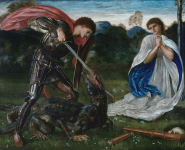
Or, you know, every crusader.I think we can blame the British and Armenian iconography of St. George fighting the dragon for popularizing "sword and board" fighting in a fantasy context, particularly against dragons (even though he used a lance to fight the dragon and only used his sword to execute the wounded beast). We can also see it in, for example, Prince Phillip fighting Maleficent in Sleeping Beauty.View attachment 429181