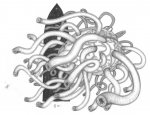
Ah, I wondered how long this thread would hide from U_K.

Upper_Krust said:
This was the problem I initially faced. However, I chose to reflect its power rather than size. The original was roughly in and around the power of Intermediate Deities/Greater Deities, so I sort of made it akin to a relatively weak Greater Deity.
Fair choice. In my case, I had rules for expanded sizes before your Bestiary came out, and among the higher adjectives was "Cyclopean" which corresponds (after I made the changes to convert to your system) to between 25 and 49 miles in size. That's Macro-Titanic, to use the Bestiary definitions (note that the mileage I gave above doesn't precisely match yours, because I opted to refigure the table based feet and on powers of 2, and then round off to the nearest mile for each).
My reasoning was this: I was on a Cthulhu kick at the time I completed the first version of the table, and as a result I simply had to have a Cyclopean monster somewhere.

When I thought about beasts that could possibly match such an enormous size, I made the connection to the original Draeden, and started thinking. My version is actually about twice the size of the original, but given the general changes 3E made over OD&D, I didn't feel that was inappropriate- nor was its power level going up by many orders of magnitude.
Upper_Krust said:
I think if you were to give it 55,000 Hit Dice then you are probably looking at a bare minimum of CR 20,000. Which means you are only going to be able to use it against Ridiculous(TM)-level PCs.
Of course- like I said, it's not something I really think I'll ever use, though it might be cool to stage a fight between one and en entire pantheon of deities and overgods someday.
But I will note that this precise problem meant I left the statting project in limbo for a couple of years, and only recently picked it up again- my original main difficulties were figuring out its skills, feats, and CR. The IH Bestiary showed me the Omnicompetent ability (which neatly cuts out the skill problem); when Fieari statted up Lavos, I saw how the feat problem could be circumvented by using stackables like Armor Skin and Damage Reduction to just inflate abilities to ridiculous levels; and when Fieari called for help to estimate the CR for A'Tuin the Star Turtle, and I took up the challenge, I discovered that it actually is possible to arrive at reasonable values for uber-monsters.
So in the last month or two I started again, and this time am plowing forward. I haven't gone ahead with a CR estimate yet, because I'm currently thinking about what special abilities to give it exactly (besides its basic stats and spellcasting ability of course). It's an interesting conundrum, and one I likely will end up using the Dvine and Cosmic powers in IH Ascension for in the end.
Upper_Krust said:
Apsu from the Pantheons of the Megaverse book could be a Shadow-Draeden?
Well, the wikipedia entry on
Apsu suggests that it might be more appropriate to call it a Water Draeden, but that's probably quibbling.
Certainly, a Draeden vaguely resembles a beast that evolved in water, so postulating that an ancient, never-described (except by being a creature made of water) entity is in fact a Draeden probably isn't far off the mark.