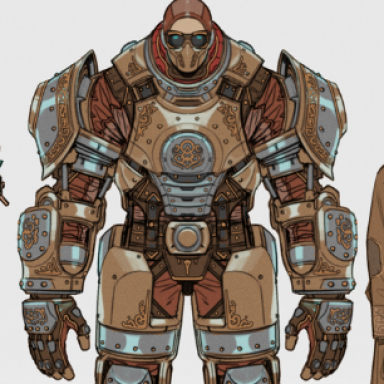
HellHound
ENnies winner and NOT Scrappy Doo
(there won't be a game-a-day tomorrow, as we are heading out to see Fusangite this afternoon and won't be home until Sunday)
StormBringer (and Elric!, which was basically somewhere between StormBringer 4e and StormBringer 5e) were games written based on the Elric saga by Michael Moorcock and set in the Young Kingdoms series, using Chaosium’s BRP system with slight modifications.
The Elric saga is the series of fantasy novels that really got me into non-juvenile oriented fantasy storytelling. Between Chalker and Moorcock, I found my fantasy worlds, not within the stories of Tolkein. Moorcock’s writings have affected my reading and gaming styles as long as I can remember, so of course I was excited by this RPG. The Elric saga is the opposite of so many other fantasy stereotypes – featuring a weakling who relies on drugs and the stolen souls of his enemies in order to even carry his sword, stories where the main character starts out in a high position (emperor of a nation) and then sacks his own country, kills his lovers and friends, and works to further the cause of Chaos until the final battles where he turns to the side of Law (or at least, turns against Chaos) in order to retain the balance of law and chaos in the world.
Although I first heard about the game through a review (where it was described as overly complex) in Dragon magazine, I didn’t get exposed to it properly until University. My radio co-host, Stephane, had a copy of StormBringer which I borrowed and fell in love with.
For those not familiar with BRP (the system for StormBringer, RuneQuest and Call of Cthulhu), it is very similar to D&D on some levels (3-18 stats, generally speaking, and a familiar stats group, although a few new stats are added), but implements a percentile skill system that handles everything including combat.
For a fan of the Young Kingdoms and the Elric Saga, this game is pretty packed with (albeit somewhat superficial) information about the various nations that comprise the Young Kingdoms, the characters from the stories, and the creatures and planes described.
The only major problem with the game, however, is that it tries to stick very closely to the source material in ways that are counter-intuitive to running an RPG. In the stories, the main character is always Elric of Melnibone, and he is a pretty “epic” character with his artifact sword, StormBringer, and his access to the ancient magical pacts of his race. He is usually accompanied by the companion in one form or another, who is a much less capable character in most circumstances. In the game, this translates to a system where you can create the equivalent of an epic character during character creation, or maybe just a ‘typical’ adventurer. On average, a party of 3-5 players will have one epic character amongst them, in my experience.
And that’s where the trouble is. Things that threaten the epic character squish the other characters flat. In our first game, four of us fought one monster while the warrior priest of Pan-Tang in the party killed the other 12 monsters and finally dispatched ours for us, without him ever taking a scratch, and with the rest of us beaten to within inches of our lives. All without summoning the massive power of his elemental allies or his chaos magic.
While some people claim that game balance is artificial and unrealistic, a complete lack of balance within a party like this ends up being frustrating to those who always have the short end of the stick. In fact, among the four of us, only one had a single skill at a level higher than the warrior priest. He was our match in all things – exploration, fighting, magic, politics…
But besides that one (major) flaw, the game was a LOT of fun. The game includes rules for summoning (and creating) demons of all shapes and sizes, as well as a large collection of sample demons from the stories. The storyline of Law vs Chaos is one I prefer immensely over Good vs Evil – because neither side of Law vs Chaos should ever actually win, because neither is supportive to human life as we understand it. Further, the adventures included in the core book are fairly well written (especially for sample adventures) and set a nice tone for a GM to follow from.
This is also one of the games I think of when I think of gaming with Dextra. Shortly before the birth of Chrystine, we spent a significant amount of time playing a short campaign using all the sample adventures in the book as well as a few of my own drawn from the world of the Young Kingdoms. I fondly remember a few long spring days spent lying around on the bed with Dextra surrounded by the book and a plethora of maps and character sheets while simultaneously trying to entertain Gelfling #1.
---
About three months ago a very close friend and one of the core team of the original Ambient d20 team committed suicide. This really struck deeply into me, and I haven't been able to concentrate on anything RPG-related since then - I haven't prepped a game, written a supplement, edited anything, or even put anything through layout. I even dropped off the RPG message boards I love, especially ENWorld.
So, I've started to think back over all the games I've played over the years and what makes gaming fun for me. And I'm collecting them into roughly 1,000 word posts about the various games, with the intent to write and post one every weekday that I'm not on the road, and then re-invest this energy into running games and writing again.
StormBringer (and Elric!, which was basically somewhere between StormBringer 4e and StormBringer 5e) were games written based on the Elric saga by Michael Moorcock and set in the Young Kingdoms series, using Chaosium’s BRP system with slight modifications.
The Elric saga is the series of fantasy novels that really got me into non-juvenile oriented fantasy storytelling. Between Chalker and Moorcock, I found my fantasy worlds, not within the stories of Tolkein. Moorcock’s writings have affected my reading and gaming styles as long as I can remember, so of course I was excited by this RPG. The Elric saga is the opposite of so many other fantasy stereotypes – featuring a weakling who relies on drugs and the stolen souls of his enemies in order to even carry his sword, stories where the main character starts out in a high position (emperor of a nation) and then sacks his own country, kills his lovers and friends, and works to further the cause of Chaos until the final battles where he turns to the side of Law (or at least, turns against Chaos) in order to retain the balance of law and chaos in the world.
Although I first heard about the game through a review (where it was described as overly complex) in Dragon magazine, I didn’t get exposed to it properly until University. My radio co-host, Stephane, had a copy of StormBringer which I borrowed and fell in love with.
For those not familiar with BRP (the system for StormBringer, RuneQuest and Call of Cthulhu), it is very similar to D&D on some levels (3-18 stats, generally speaking, and a familiar stats group, although a few new stats are added), but implements a percentile skill system that handles everything including combat.
For a fan of the Young Kingdoms and the Elric Saga, this game is pretty packed with (albeit somewhat superficial) information about the various nations that comprise the Young Kingdoms, the characters from the stories, and the creatures and planes described.
The only major problem with the game, however, is that it tries to stick very closely to the source material in ways that are counter-intuitive to running an RPG. In the stories, the main character is always Elric of Melnibone, and he is a pretty “epic” character with his artifact sword, StormBringer, and his access to the ancient magical pacts of his race. He is usually accompanied by the companion in one form or another, who is a much less capable character in most circumstances. In the game, this translates to a system where you can create the equivalent of an epic character during character creation, or maybe just a ‘typical’ adventurer. On average, a party of 3-5 players will have one epic character amongst them, in my experience.
And that’s where the trouble is. Things that threaten the epic character squish the other characters flat. In our first game, four of us fought one monster while the warrior priest of Pan-Tang in the party killed the other 12 monsters and finally dispatched ours for us, without him ever taking a scratch, and with the rest of us beaten to within inches of our lives. All without summoning the massive power of his elemental allies or his chaos magic.
While some people claim that game balance is artificial and unrealistic, a complete lack of balance within a party like this ends up being frustrating to those who always have the short end of the stick. In fact, among the four of us, only one had a single skill at a level higher than the warrior priest. He was our match in all things – exploration, fighting, magic, politics…
But besides that one (major) flaw, the game was a LOT of fun. The game includes rules for summoning (and creating) demons of all shapes and sizes, as well as a large collection of sample demons from the stories. The storyline of Law vs Chaos is one I prefer immensely over Good vs Evil – because neither side of Law vs Chaos should ever actually win, because neither is supportive to human life as we understand it. Further, the adventures included in the core book are fairly well written (especially for sample adventures) and set a nice tone for a GM to follow from.
This is also one of the games I think of when I think of gaming with Dextra. Shortly before the birth of Chrystine, we spent a significant amount of time playing a short campaign using all the sample adventures in the book as well as a few of my own drawn from the world of the Young Kingdoms. I fondly remember a few long spring days spent lying around on the bed with Dextra surrounded by the book and a plethora of maps and character sheets while simultaneously trying to entertain Gelfling #1.
---
About three months ago a very close friend and one of the core team of the original Ambient d20 team committed suicide. This really struck deeply into me, and I haven't been able to concentrate on anything RPG-related since then - I haven't prepped a game, written a supplement, edited anything, or even put anything through layout. I even dropped off the RPG message boards I love, especially ENWorld.
So, I've started to think back over all the games I've played over the years and what makes gaming fun for me. And I'm collecting them into roughly 1,000 word posts about the various games, with the intent to write and post one every weekday that I'm not on the road, and then re-invest this energy into running games and writing again.