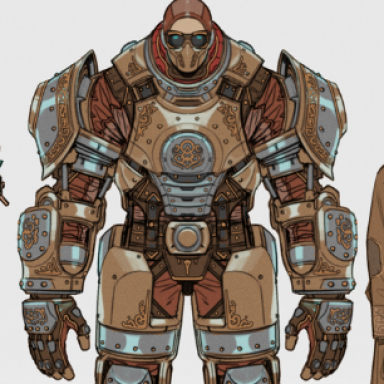
Haldendreeva

Edena_of_Neith said:
And yet ... my first experience with elves - my very first of all - in literature was with elves who were very much indeed flighty and frivolous, noble and lofty, merry and loving, gentle and kindly. No, I do not refer to Santa Elves (lol) I refer to Tolkien's High Elves in The Hobbit. That made a deep impression on me that has lasted ever since that 4th grade day.

How to duplicate that, and make it even half believable, given the context of a fantasy setting? Logic inevitably leads the other way, down the path towards those paranoid wood elves who vanished in a poof of smoke whenever the dwarves or Bilbo stepped into their midst.

Funny that you say that. For me, those paranoid wood elves with their cruel streak made the longer lasting impression. As far as high elves go, the "flighty and frivolous" from the "Hobbit" has been very much supplanted by the tragic component that gets to the front in the LotR. I guess I'm not alone with this.

Thus the jaw dropping drivel given in my first post above.
And you look at that, and say: that is absurd. Elves are not like that. Elves could never be like that. In fact, nobody could be like that! (at least, no civilized, non-evil culture could be like that, certainly.)
Why not. I don't have a problem with your concept. The D&D elves, as they are now, are in a limbo. They are a mix of mechanical traits and flavor text that doesn't really fit. As a result, most elves that I see played don't have any flavor at all. The only thing elvish about them is the entry on the character sheet. Your concept is a nice foray into new territory.

Btw., my quote from above wasn't meant to derail the thread; I just wanted to point out that I'm used to elves that have a hivemind and eat their foes. And don't be fooled by the tenor of that propaganda text from war times that I quoted above; those elves are generally depicted as friendly and flighty, too.

If you are interested in how I took normal elves and turned them into such monstrosities, and then had the gall and audacity to still call them 'normal' elves, I will relate the tale of Haldendreeva.
Sure I am :).
 

log in or register to remove this ad

Ok, bear with me. I fear I say too little with far too many words, and right now I feel sickish as well. Adopting to Florida has it's rewards, but it has it's prices.

For my purposes I used some of the D&D rules for support. Some of my logic is questionable at best. And I don't pretend to be a great writer or the most imaginative guy around, for I'm not. Also, I used cliches in my logic, so if you see one and grit your teeth, my apologies.

Haldendreevan was a city originally called Haldendrea, and Haldendrea was an unimportant but large elven city of 100,000 in the elven nation of Delrune, population 3,000,000 (95% high elven, 4% grey elven, 1% wood elven.)
The Fluff on Delrune: The elves were Highfolkish, cosmopolitan, used magical roads to get around quickly in their country, enjoyed the company of humans and demihumans, tended towards neutral good, had a King, had a sizeable standing army of nearly entirely males, protected their females as humans would, and most of their energy was spent on growing food, building beautiful homes, and creating works of art and treasures. These elves mostly lived in cities, travelling via their magical roads to their fields to tend them. Delrune itself was hilly and heavily forested, temperate in climate, and similar to the Ohio River Valley from Pittsburgh to Paducah.
The Crunch on Delrune: These were 1st edition elves, most were 0 level (in 3rd edition, most would have been 5th level or less, with very few in adventuring classes), the country was magic poor (a lot of 1st and 2nd level spells known, some 3rd, a scattering of 4th, and a very few 5th, and only a few hundred wizards in the nation), the standing army consisted primarily of green recruits led by officers of 1st through 3rd level, the women of the nation were virtually defenseless since their society kept them so, and Delrune had only one fortified border (the fortress city of Archendrea in the north.) Delrune relied on isolationism and the protection of friendly neighbors to keep the peace, and this had worked for many centuries. Elven political infighting and entrenched ways led to stagnation, internal rot, and an inclination of the heroic minded to leave the country.

What happened at the beginning:

An Enemy came and attempted to destroy all the countries in the region Delrune was within. (The enemy was known as the Solistarim, but this is not relevant: what is relevant is that there was an Enemy.)
This Enemy, as is common in many fantasy stories (cliche, I know) desired the extinction of the elves (and the drow ... all elves were elves, to them.)
The Enemy did not intend to attack Delrune first, but it was in the way on their path towards greater targets, so they destroyed half of it to clear the way. They killed half of the elves, and destroyed their capital city, their magical roads, their crops, their meager stores of magical items, their King, their standing army, most of the rest of their leaders, and most of the heroic minded in the country.
They accomplished this easily. Sometimes life is not fair. The Enemy consisted of CR 10 creatures and up, and had planned the war for a century. The elves were primarily CR 1 or 2 beings, with no experience in war. The result was equivalent to machine gunners attacking defending swordsmen.
The war ended in a stalemate, and the Enemy fell back, leaving what remained of Delrune in peace (another cliche, but there it is.)

What happened next:

The elves suffered severe hardship due to ruined infrastructure, crops, lack of leadership to pull their country back up, and lack of help from devastated neighboring countries.
The elves suffered psychological devastation.
Many elves committed suicide by choosing to prematurely go to Arvandor. Many more fled the country. All suffered an extensive period of starvation, disease, and anarchy.
During this period of travail, the elves turned their backs on the Seldarine Pantheon, claiming they had been abandoned (ala, Krynn after the Cataclysm.) Elven clerics were chased away or lost their powers. (A reasonable argument could be made that the Seldarine did abandon the elves, really.) This reaction to suffering, greatly intensified the suffering as plagues swept the country, and wounds could not be healed.
A secondary reaction begin, in which all those who remained loyal to the Seldarine were driven out of the country, attacked, or even killed. The idea that it was ok for elves to kill or harm elves, a very rare event previously, became accepted and normal in Delrune. This, despite the fact that the elves of Delrune had an inherent nature to love living, life, and to treasure life in general. This innate tendency was whelmed and submerged under dark emotions, and remained submerged as Delrune became corrupted into evil.

Seeking power, the elves now turned to the evil deities, such as Lolth, who were overjoyed to have them. Elven wizards began intensive research into Vile spells, since evil magic is better at killing. (all of this clichish, I know.) They took the 'drow approach', thinking they too could become feared and powerful like the drow. All elven females in Delrune, and all civilian males, were pressed into military service.
To compensate for the loss of manpower in the fields, the elves instituted slavery, first for outsiders, then for elves accused of wrongs real or imagined. A convenient way to overcome the labor shortage: the cost was to their souls. But the elves were about survival at any cost, and they embraced the cliched evil principals eagerly, and they did indeed reap great power and short term reward for it. Lolth, among others, was eager to reward them, and all that military training and magical research begin to pay off.

This sorry state of affairs was confounded by a new problem. The massacre of so much life, the drenching of the land with so much blood, the psychological pain of the survivors, and the taint of evil, sank into the Delrunian Highlands and withered them. The entire country rapidly eroded into badlands, and the level of the land sank, creating extensive swamplands.
The elven reaction to this new hardship was to become more violent, more aggressive, and more evil. Food could be procured in war, taken from neighbors. Disease and starvation became accepted and tolerated norms. Swamps made great breeding places for monsters, suitable for experimentation and increasing elven power.
Those elven druids who had survived up til now, tolerated by the new leadership of Delrune, worshipping the land and not the Seldarine, fled the country or were driven out.

And then ...

The elves were comparable, sadly, to children who had lost their parents, and had become psychologically ill because of it. Unfortunately, there was no comfort to be had. The elves had turned their back on the only comfort that could have helped them, the Primordial Light, choosing Darkness instead. (Another cliche, I know.)
This attitude did not change the reality of the world around them. And that reality was: there were Powers out there quite capable of defeating and destroying the elves, no matter what they did or what attitude - light or dark - they took.
After decades of building their country into a fortress empire, the corrupted elves believed themselves invincible to the kind of slaughter that had occurred previously. Reality didn't particularly care what they thought, and a new slaughter was unleashed.

A Great Enemy (Vecna, but what is important is that it was a Great Enemy) came and conquered the entire world. All the nations of the world were conquered, either destroyed or made to serve in slavery, or serving as terrified, obedient 'allies.'
The Great Enemy desired the extermination of all elves, drow included, and said Great Enemy did just that. Every last elf and drow in the world was killed. Every last one. Except for the 30,000 elves in the city of Haldendrea.
The Great Enemy made a mistake people commonly make in real life when they are intensively involved in a project and paying great attention to detail: they overlook something glaringly obvious. An example would be someone who mowed the grass studiously throughout the entire yard, but missed an entire section of grass (and blinked in amazement when this was pointed out to him, after he came inside to rest.) Or, to cite another real world example, a computer meticulously maintained and cared for, vital to the company's security, but it isn't working for some reason: they forgot to plug it in to the wall (I cite this one from a professional engineer.) Or a person who is very careful about maintaining his car, who forgets to change the oil (the basic oil change every 3 months.) Or even the person who prepares for a trip and readies an exhaustive list of everything to take, and compiles that list, only to forget something obvious like the dogfood, the soda pop, the kid's reading books, the portable CD player, or (grimaces) the tylenol and/or anti-diarrhea medication.
So, the Great Enemy made this mistake, Haldendreeva escaped unscathed when all the rest of Delrune was utterly destroyed, and afterwards the Great Enemy overlooked his mistake for several decades, having other enemies to fight and great goals to achieve (his servants, of course, copied his error.)

The destruction of Delrune by the Great Enemy completed it's physical destruction as well, leaving it a poisoned swamp with shattered hills sticking out of the muck.
To the west, the mountains thence exploded into seas of lava, sending volcanic smog over Delrune, poisoning and heating the air, creating tropical conditions and an eternally darkened sky and fiery glows.
To the east, fell magic in use by allies of the Great Enemy created an icecap in the temperate region, and blasts of arctic air struck into Delrune from that direction.
The two airmasses collided, producing constant storms of acid rain and black snow, windstorms and tornadoes and hail, huge swings of temperature from below 0 to 125 degrees and back, the year around, across Delrune.
The faerie peoples of Delrune, decimated in the first war, then assaulted by their previous elven friends, then decimated again by the Great Enemy, were unable to halt the downward spiral and fled the region, taking with them the last vestiges of health and most of the remaining inherent good magic of the region.

Assaulted by volcanic smog, poisoned air and water, violent heat and cold in mad succession, and a land increasingly laced with evil magic, the natural flora and fauna of Delrune perished, leaving ten thousand square miles of deadwood, rot, and cesspools.
It would take years before new vegetation, mutated and freakish, magically adapted to the extreme conditions, would take root and refill Delrune. It would take 20 years before a new silvan forest emerged ... forest is not the word really, when you are refering to a Mirkwood/Old Forest situation gone berserl, filled with hangman trees, strangleweed, undead treants, ropers, banshees, and other niceties of this sort (think of Degobah, from the Empire Strikes Back, then fill it with monsters strong with the Dark Side of the Force.)

Also, the elves who had survived now discovered that evil, apparently, doesn't pay. Lolth and the other deities disappeared and granted no new spells, and they withdrew all their favors from the elves (Ghanadaur stuck around, of course ... he most certainly enjoyed the situation! ... and he refused in any way to help the elves. He did help infest the swamp with his assorted puddings, molds, jellies, and slimes, though, and took great delight when yet another elf was eaten, even elves who had once venerated him.)
And last and not least, the elves found that only their low level wizards remained, with spells of 2nd level and below (had Haldendrea had wizards of higher level, the Great Enemy WOULD have noticed this and prematurely ended this nutty story of mine.) Thus, the elves could not teleport out or magically escape by any means. Physical escape was out of the question, since all the lands around the swamp were filled with the Great Enemy's servants, or terrified peoples (such as the illithid) eager to carry out the edicts of the Great Enemy (edicts such as: kill any and all elves you find, or you will share their fate.)

The food ran out in days. Then the fresh water stored in caskets ran out (all the wells were poisoned, obviously.) Then Haldendrea itself sank halfway into the murky, poisoned waters and slime, and remained that way. No new place existed that was suitable for building anything substantial, so the elves were required to live out in the open, helpless before the onslaught of arctic cold and volcanic heat, poisoned air and pummeling rain, blizzards of snow and huge black hailstones.

And this was The End.

Well, shouldn't it be?

In most stories, this would be the end. The elves would have all died, of course. There is no plausible way they could have survived that I can think of (barring Divine Intervention, or the sudden discovery of a Mass Teleport spell to get them out of there!)
What plausible story plot could save these people? Do you know of any? Can you think of any?
I tried to create a situation, with this history, where the elves of Haldendrea - in their darkest hour - could not have survived by any plausible, believable, sane, rationale.
Yes, some tried to run away, as is common in many stories (in Tolkien, where the surviving elves fled Beleriand; or in Dragonlance, where the Qualinesti fled and became homeless; or in the Forgotten Realms, where the Retreat was called after Myth Drannor was destroyed.) Those that ran away, may have survived and may not, but they are not of consequence to the story.
Yes, they tried to find that Mass Teleport spell. Yes, they tried Divine Intervention. Neither effort produced results.
Yes, they tried various extreme, ridiculous things you would escape people in EXTREMIS to do. I won't go into the gory details. Suffice it to say, none of these tactics worked, except to kill more elves.

This is where I came in, and used the travail of Haldendrea to take the elves down the Strange Road, which led to Haldendreeva and the odd traits of elves today.

I will continue, if someone is interested.
 
Last edited:


The gnomes will tell you, if you ask them, that the phrase Hakuna Matata refers to a legendary gnomish city of long ago known as Hakuna Matata.

The gnomes will also tell you that Hakuna Matata refers to the quintessential nature of what and who they are: Hakuna Matata means "no worries," the Heart of Gnomishness, the Soul of Gnomedom, the Bubble Butt of the Gnomish Derriere, as it were.

Indeed, gnomes will lament that kobolds are not Hakuna Matata, but instead follow the Dark Trickster.

Finally, gnomes will tell you that humans, dwarves, and elves cannot be Hakuna Matata. Some kender and halflings can, but otherwise no non-gnome can ever possess the innate Hakuna Matata that makes a gnome, a gnome. This is a thing strictly gnomish, a part of their core history, a fundamental thing passed down through the millennia to all gnomes today.

;)


Elvish anthropophagy (and demi-anthropophagy) has nothing to do with curses or like malarky. Elves as a group suffer from a genetic condition in which the victim cannot manufacture vitamin D, unlike the other races. In addition they cannot process vitamin D from other sources (such as milk) unless it is the specific form produced by humans and non-elven demi-humans. Without a source of vitamin D elves quickly start to suffer the effects of rickets.

Were that not bad enough, elves were originally the final result of the transformative event recounted in Land of the Dead in which the 'zombies' were changed into something much different. The restoration to life profoundly changed the creatures, rendering them effectively immortal. But they unfortunately retained their pathological obsession with the ingestion of living human flesh. It's a treatable condition, but the number of people who know how to treat it is small indeed.

Keep in mind that even if an elf is successfully treated for 'the hunger' he'll still need to eat people etc. in order to get his daily vitamin D requirement.

BTW, humans with elvish blood sometimes suffer from either or both conditions. If the latter is the case such are often known as ghouls.
 

Ok, back. (takes a deep breath and dives into the water again.)

The elves of Haldendrea, now the last elves of their world or Crystal Sphere, had no way of surviving in the Post-Apocolypse world they faced. That has to be understood. Extinction should have happened. In any plausible, believable storyline, they were all dead.
This is where my story stops being plausible, and goes off into the bizarre. For I'm saying the elves did survive.

Because they had become evil after the first war, and they looked to dark deities, the elves could not cooperate in any sense of the world to survive in their Post-Apocolyptic mess. Initial attempts failed in bloodbaths, elves turned on each other and committed unspeakable acts in their desperation, and finally all semblance of civilization collapsed.
Within a few weeks of the Apocolypse (that is, the annihilation of Delrune by the Great Enemy) the elves were reduced to an each-elf-for-himself situation (sorta like an each-drow-for-herself in the passages of the Underdark.)
For the next several years, each and every surviving elf spent his or her entire time trying to figure out how to survive for a few more hours, and then a few more hours after that, and then a few more hours after that, and so on. They became primordial savages bent on just one thing: surviving to see the next day.
This was a time of purgatory. Most of the elves did not survive it. None of the 'evil' ways learned after the first war survived it.

How do I put this? Elves are ... special. They are a 'good' people. What does that mean?
One of the facets of the 'goodness' of Haldendrea elves was that they cherished life, their own and others, and all life around them. They very greatly enjoyed being alive, just being alive, and derived immense pleasure from seeing others alive and enjoying being alive. This was not a learned or cultural affair; this was basic instinct for these people.
It had been supressed during the time of the 'evil fortress empire' but now this instinct - unhindered by civilized notions and learned behavior - broke free and waxed supreme.
Also, the elves were innately magical. Unlike humans, they could subconsciously call upon that magic to save themselves in extremis. And this was extremis.
Think of the film Conan the Barbarian, and the Wheel of Pain. Conan marches around and around, pushing the grist mill. All around him, people are dying of overwork and disease. In the end, he alone survives, but instead of being weakened, he is made stronger (a most questionable thought, but there it is.)
Well, the elves had their own Wheel of Pain, and it also went on for years. And most of the elves perished pushing this 'Wheel of Pain.' But those who wanted to live the most - those who cherished life the most, actually - and those strongest in innate magic, were the survivors, and they became stronger.

Remember the Agnakok from the Complete Book of Wizards? An Agnakok was a wizard who came from one of the most extreme environments in the world, such as a torrid or frigid climate, or the inside of an active volcano.
All elves had innate magic. All the elves were potential wizards. So, all the elves were potential Agnakoks, and certainly what they existed in qualified as 'one of the world's most extreme environments.'
So, the elves became Agnakoks!
After years of starvation, they physically adapted to eating leaves (their stomach acids became magical), insects, arachnids, roaches, and other unpleasantries of that sort. They discovered they could obtain additional sustenance from gnawing on wood, and it made their teeth stronger.
The elves discovered that devouring foes alive, or just killed and still hot, gave them great sustenance, magical sustenance, out of all proportion to the effects of eating mere meat.
Considering that leaves and bugs, and foes (plenty of foes came into the swamp to kill whatever remained there, or just to inhabit the place) were all the elves had to eat, period, such an adaptation was necessary for survival.

The elves also acquired immunity to all natural poisons, natural parasites and biting insects, natural diseases, extreme cold and extreme heat, burning sunlight and finally the volcanic fumes stopped asphixiating them.
The elves learned to exist underwater for long periods of 30 minutes to an hour, and to branchalate through any sort of brush and trees. They learned to walk on quicksand and reedy waters as well as people walk on dry land. They became physically hardy against storms, wind, hail, and the occasional tornado (the elves of Athas come to mind here ...)
Eventually, the elves became as comfortable with their environment as we would be in our own homes. Now, remember, most of them perished before this happened, and the remainder suffered extraordinarily to achieve their Agnakok stasis. Nothing came for free. But when purgatory was decreed for the elves, some rose to the challenge and triumphed over all the physical obstacles. Their instinctive love of life, and their innate magic, made it possible. (Humans, could never have done this, being non-magical, and having a much lesser love of life. Humans would have tried, and humans would have died. But perhaps other magical races of inherently 'good' alignment could have achieved, what the elves accomplished.)

So much for the mundane physical adaptation. Now, for the mental adaptation.
The elves lived in an insane world, where life simply wasn't worth living from any sane perspective. Even after they conquered the physical challenge of the swamp, endless foes came to drag them into a war eternal, a pointless war without end, without hope of there ever being an end, short of the death of all the elves. The Great Enemy had endless forces to deploy, and was willing to send them all to extinguish the elves.

In an insane world, the elves psychologically adapted by going insane themselves. Because of certain things they did, their insanity proved a better insanity, and it enabled them to come to flourish and triumph over their evil (and demented, insane themselves) enemies, and to throughly enjoy themselves in the process.
 
Last edited:


THE INSANE ELVES

One thing should be made clear: the mechanics of D&D, as they existed in 1st and 2nd edition, were ruthlessly used by the elves, in their insanity, to survive. Think of a munchkin game gone truly berserk. Think of using the rules, and abusing the rules, and ultimately bending the rules into mobius strips. In game terms, this is what happened.

The first thing that happened is the elves 'woke up' from their obsession with survival, and began to realize they had once been civilized people. They now had time to consider such things, since immediate survival for the next few minutes was not filling all their thoughts.
That 'love of life' thing helped here. But another 'good' trait of the elves manifested: their innate joy with being around each other (that's right, elves are touchy-feely beings, communal beings, in a way that might occasionally make even an illithid vomit. But, paradoxically, they are fiercely independent critters. So go figure. What's the answer to this impossibility? Think of the phaerimm, a race of superwizards who live alone, each pursuing it's own goals and sustained by magic, but still needing the company of other phaerimm for communal survival. That's a rough, and partially inaccurate, analogy.)
The elves appreciated they could not return to the old 'evil' ways, but also they could not return to the old 'good' ways either. Something more drastic, something cataclysmic, perhaps some Great Spell of some sort, was needed. They began searching for that Great Spell.

The elves made a massive breakthrough when they finally learned they could cast clerical magic simply by drawing upon themselves. This discovery occurred decades after the Apocalypse, and initially was slow to be expounded on.
The Mystics of Krynn, from the Age of Mortals, is a poor analogy to what the elves discovered. A better analogy would be that the elves discovered that each being had his or her own private Heaven and Hell, and the true Gods were not only without, but also within. The door to the Afterlife was not some Astral Gate, but the mere, mundane (not so mundane!) elven heart. A scientific analogy might be that elves were made of matter, and matter is full of energy: there is enough energy in a typical person to blow half the Earth away, in Real Life (anti-matter, anyone?)
But whatever analogy you prefer, the end was that elves started becoming clerics again, without deities in the normal sense. And, since the hearts of elves are inherently bright, noble affairs (why else are they such 'good' people, if not?) these 'clerics' were 'good aligned' per se. The elven instinct to help other elves, to cherish life, sorta helped out in this respect, too.

But, from a normal elven perspective, this awakening of power was to go horribly awry. Not that these elven 'clerics' could have overcome the Great Enemy anyways, so perhaps it is better that they went insane.

The elven mages were making better progress, long before elven 'clerics' returned to the scene.

((Yours Truly grumbles, still being sick, fumbling with the words, muttering to himself.))

The elven mages wanted to learn all the 'forbidden' lore. You know, Things Man Was Not Meant to Know, Vile Spells, and the like? And, simultaneously, they wanted to learn Good spells, and 'noble' magic. Now, they never succeeded in doing this (because it is not possible to do this, not even for insane Haldendrean elves) but the thought was what counted.
The elves appreciated, from bitter experience, that many paths of magic had this bad tendency to destroy the caster, or worse, to turn the caster into a ravening monster who slaughtered his fellow elves. This was particularly true of Vile magic, but it applied to many other types of magic also.
The elves determined that in their Great Spell, they would stop this threat. They would render themselves immune to the harmful effects of magical research, and then be able to learn magic as they pleased with no consequences (talk about delusions of glory!)
This shows the elves had learned from their flirtation with evil, but they had not truly learned wisdom. And why was this?
Well, their mad obsession with survival was one reason, and they knew magic was the supreme force, the supreme way to get out of their predicament. And they also suffered from the inherent 'elvish' fascination with magic, like moths drawn to the flame. They deluded themselves into believing they could 'somehow get it right this time' after so many mistakes in the past. And 'this' time, they would not turn on each other because of any evil knowledge gained, would not be perverted into monsters by meddling with evil forces.
Total tom-foolery. But that's how they thought.

After they had all become Agnakoks, after their new 'clerics' had appeared, and after they had relearned a considerable amount of magical lore (but not enough lore yet to teleport themselves out of their sorry predicament), they - all 3,000 survivors - got together and threw the Great Spell. This was the Haldendrea Mythal, as it were.
The idea was that the combined strength of 3,000 elves would create a magic so powerful no 'evil' could corrupt the individual minds of spellcasters dabbling with Vile or evil arts (or other dangerous paths of magic.)
Also, the elves set other conditions, conditions they thought would protect them, and free them up for research and other efforts at survival: their Great Spell put a permanent prohibition on elves killing elves, elves harming elves, or elves even thinking about doing either. It granted them an Epic capacity to recognize each other, regardless of disguise or magic or whatever, so this prohibition could not be circumvented.
The Great Spell required that all participants, from then on, spend their lives working for the greater good of their 3,000 fellow participants, to the exclusion of all else.
The Great Spell granted the elves telepathy, communal and individual, which allowed for ultra high speed communication 10 times faster than humans could verbally relate things, and with images and pictures sent that negated the need for mere verbal descriptions.

And it worked.
It worked. Completely! It granted the elves ALL of the above!
The Great Spell was a smashing success, with no apparent side effects whatsoever. It was so successful that afterwards one of it's participants might have been able to study Cthuluesh lore, and be protected and remain normal and sane in the process!
And in honor of their Great Spell, the elves renamed their city Haldendreeva, the City of Unity, the City of Elvendom Triumphant.

The Great Spell didn't need side effects. The consequences of this spell were better (worse) than any mere side effects.

-

Now free to research as they pleased, the Elves of Haldendreeva began to swiftly rise in power as both wizards and clerics.
This, in turn, made them better at making war against their enemies in the Great Grungy Swamp around Haldendreeva.
And this, in turn, made them more powerful, since the basic premise of D&D is that killing pays, killing grants experience and levels, and certainly the elves were doing enough killing.

The elves also branched out into other studies, all of them related to war, since war was the main reality of their existence. They relearned the basics of physical combat and martial combat, how to smelt metal and make iron, and then steel (although magic was used to speed the process, later on.) They relearned endless things, in writing, bookmaking, building, crafting, sculping, their history, assorted undead and faerie and monster lore ... and they put it all to making better and better war, always and sincerely in the name of 'altruistically aiding their fellow elves' and 'upholding the value of life.'
Perhaps the elves could have returned to being a civilized people, in a civilized city, but instead they became a collection of individuals obsessed with survival (the elven 'love of life' perverted), war (another perversion of their 'love of life'), and study (their 'elvish' fascination with magic perverted beyond hope.)
The Great Spell allowed all this and more. Freed of having to worry about each other, they could turn all their efforts outward. Freed of the dangers of magical research, freed of the consequences, they could obtain great power without the wisdom and caution that comes from such learning. Their 'clerics' could frivolously cast great magic without being beholden to, or constrained by, any deity, answering only to themselves (and, of course, the Great Spell required them to be endlessly obsessed with 'the good of the community', which meant war and more war and yet more war.)

The elves regained the clerical ability to create food and water, but never used it since they had murky, slimy water aplenty and to spare (a sea of water to drink!) and plenty of food (leaves, bugs, and devoured foes) which were ever so much more tasty than their former 'normal' food.
Elven mages gained the teleport spell. By the time they did, all though of fleeing the area was past. They were enjoying their cesspool, their endless war, far too much to abandon it for safety on some other mundane world.
Likewise, elven psionicists emerged, with a similar attitude.

As I said above, the elves were required to make war, to survive. As they made war, they got stronger, which made them better able to make war, which made them stronger, and this sorry spiral continued until the elves were all over 10th level in their assorted classes.
Fortunately for them, the Great Enemy had not yet discovered them. The elves at least had the sense to fight only the creatures of the Swamp, and not to go beyond it into lands held by that Great Enemy.
Even now, the elves could have evolved into a civilized people, noble and lofty, had the Great Spell not freed them of all consequences. Freed of consequences, free to gain power without wisdom or price, they de-evolved mentally instead.

-

At first war was a grim necessity. Then it was a mere necessity. Then it was routine. Then it became exciting and fun. Finally, it became ecstatic fun, the kind of thing life wouldn't be worth living without. And in the end, it became the sole purpose of life.
Elven clerics regained the use of Raise Dead, then Resurrection. When they did, they prompty resurrected all those who had fallen, and anyone who fell henceforth. The old elven thinking, that the Afterlife was sacred, was discarded as rubbish. LIFE was what mattered, and those who were forcibly returned to said life heartily agreed with the clerics.
As war became fun, it became unthinkable that an elf would not be resurrected. Leaving him dead, would mean he'd miss out on the fun! And obviously, he'd want to return to rejoin in the fun, no?
As the elves grew very powerful, producing High Priests and Archmages, their capacity to return their dead to life multiplied exponentially, until resurrection became a certain thing, and death was only a temporary thing, a part of the greater 'fun.'
At first, the Constitution loss of Resurrection (1st and 2nd edition rules, experience loss in 3rd edition) hindered this process. But freed of consequences, able to research whatever dreadful avenues of magic they pleased, the elves soon found ways around such paltry problems, and then there were no consequences at all.
Death became just another part of life, temporary and meaningless. All the horror and angst of dying was gone. And with it went all the horror and angst of a constant war situation.

So now we had a society of 3,000 maniacs, all of them 18th level or higher, for whom war was 'fun', death was a part of that 'fun', and 'loving life' meant endlessly, insanely, researching ever more ghastly, monty-haulish, broken munchkinish, ways of making war and obtaining power.
And because the hostile world obliged these elves by making constant war on them, it feed that appetite, increased it, made it into an insatiable and eternal hunger.
Meanwhile, the maturity level of the elves dwindled until they were like kender. But no kender, not even the most nutty kender who ever lived on Krynn, was as remarkably frightful as these elves became.
They had all gone insane. In an insane world, they had answered with insanity, and out-insaned everyone else. The Great Spell, which freed them of Consequences, had made it possible. The harsh world around, fed their insanity with endless gluttony.

The insanity intensified.

Now the elves did not dream of leaving their beloved Swamp. They certainly called for no allies (it has to be wondered what the reaction of other elves on other worlds would have been, had their help been asked for.) They used their magic to obtain every item and monstrous magic they could, gleefully wallowing in death and madness, war and slaughter, but they did not make allies or friends. From their point of view, they didn't NEED allies or friends.
The love of war turned into a savage game of torture and be tortured. Some enemies had certainly tortured the elves before killing them, so now the elves returned the favor to all their foes. At first, torture was inflicted with glee, but later on it became mundane and standard, with the elves lecturing their screaming prisoners on their stupidity and on consequences of daring to fight them (lol) in a most calm matter, while they practiced torture on a level that would have made the drow proud.
The enemies of the elves became more brutal also, torturing back, hunting the elves with ferocity and hatred, but the elves merely came to expect torture upon defeat as a routine thing. It wasn't pleasant, of course, and they never learned (like the clergy of Loviatar have done) to enjoy pain, but they accepted it as proper etiquette on the part of their foes. Eventually, they became greatly disappointed in foes who did not inflict torture, considering them amateurs in the 'game.'

As I said, in an insane world, the elves had out-insaned everyone else. After they started acquiring Epic Spells (or, in 1st and 2nd edition terms, 10th level spells) all game mechanical limits to the madness were transcended.
One could not say the elves were 'evil.' They weren't. They would have laughed Ghaunadaur, Lolth, and other evil deities and their offers of help out of town (they did laugh Ghaunadaur out, actually ...) It wasn't about good or evil, it was about life and living and helping my fellow elves and the great good fun of war! (just imagine the kender of Krynn all gone utterly demented, with 9th level and even 10th level spells at their command, and unfortunately the discipline and strength to concentrate on getting things done, and you can't go wrong here.)
Eventually, the foes of the elves in the Swamp learned utter terror of these elven maniacs and fled, and then the Great Enemy finally got word that some of the elves, the hated elves, long though exterminated, were still there, living right in the heart of his Empire.

The Great Enemy moved swifty to destroy these elves. He was not concerned with their sanity or insanity, merely with whether they were dead or not dead.
He came with his armies and destroyed Haldendreeva and killed most of the elves, sending the survivors fleeing, then returned to his capital, leaving his servants to hunt down the remaining elves.
It didn't work. Even before he returned to the capital, he found Haldendreeva had been fully restored, all the elves returned, and all of them stronger than ever.

In D&D, there are just too many ways for high level wizards to escape death. Stasis Clone, Clone, Contingency, and Simulacrum are only some of the ways a wizard can escape being killed. Consider some of the notorious wizards of the Forgotten Realms, like Manshoon, or the notorious Acererak of Greyhawk. You keep killing that wizard, and he keeps coming back. Worse, sometimes he comes back in multiples! (the Manshoon Wars.)
And clerics are the same way. Even Shandril Shessair, Spellfire Wielder Extraordinare, Bane of the Zhentarim, could not by herself defeat Fzoul Chembral, and Fzoul escaped her in the end. And when you have Resurrection, and everyone wants it, and there are no penalties or consequences of casting it, then ... well ... you have a mess.

Everyone who was killed, was Wished back, Resurrected, or never died in the first place. Restoring Haldendreeva was easy using 9th level magic. This happened within a matter of hours after the Great Enemy destroyed Haldendreeva.
And because of their insanity, the elves were not psychologically harmed or intimidated by the Great Enemy and his legions. This was a new foe, which meant ... new fun! Bigger and better fun! The ULTIMATE fun!

The Great Enemy levelled Haldendreeva many times before he realized that, unless he somehow killed all of the Haldendreevan elves, ALL of them would return within the hour to plague him once more. Perhaps he was not accustomed to maniacs who loved war even more than he did, who were utterly fearless, who expected and even DEMANDED punishments and tortures to make the Endless Death seem nice in comparison. Whatever the case, before he figured out that he had to do something new and different, his warmongering had raised Haldendreeva into a community of 30th level characters.
Armed with Epic might (or, in 2nd edition terms, an entire city of Simbul-powered beings) the elves of Haldendreeva hid copies of themselves throughout the multiverse, stashed their magical items and books in strange realities, created multiple duplicates of themselves, and worked up Contingencies, Chain Contingencies, and Chain Chain Chain Contingencies that would leave a world renown lawyer beating his head in frustration against the wall, trying to decipher them.

The Great Enemy gathered his great magic, the soul killing magic, the Spheres of Annihilation, summoning creatures that ate enemies soul and all, summoning Fiends who would drag the souls of the elves screaming into the Lower Planes.
Then he attacked. And this time, he had more success. He managed to permanently kill some of the elves. Although they regrouped immediately, he knew that repeated attacks of this sort would whittle them down and finally see them eradicated.
However, the Elves of Haldendreeva had an answer to this attack. Since they could not, even with their magic, return their dead, they ... started turning their foes into new Haldendreevan elves.

They could do this because a spell exists that specifically causes such conversions. It is an 8th level spell from Dragon Magazine, which requires three Wishes to halt and reverse (and once completed, cannot be reversed), and which creates a new being of equal power to the old being, of the caster's choice.
The elves discovered this nifty spell, and after they started taking permanent losses, used it to convert high powered servants of the Great Enemy into ... high powered Haldendreevan elves. And these new elves were as bound to the Great Spell and it's effects as all the original elves had been.
So, the Great Enemy found that because of his new methods, instead of 3,000 elves, he suddenly had 30,000, then 300,000, elves to deal with!

Needless to say, at this point, by the standards of any campaign that Yours Truly can imagine, the situation was FUBARed.
It would remain that way for the next century.
For the next century, the Elves of Haldendreeva and the Great Enemy endlessly plotted and schemed, and warred, and thought up new and ever more impossible and insane ways of making war, more ultimately munchkinized answers to unsolvable and ridiculous situations, and generally had a great time.
They could not destroy each other, although both sides tried their best. They trashed the planet they were on trying. They trashed the whole Crystal Sphere trying. The sucked in other hapless worlds and Crystal Spheres into their wargames, involved creatures from other planes and dimensions to the ends of the multiverse, and created magical contingency situations so byzantine that no DM in existence could comprehend his way through the mess (imagine sorting through the petabyte legions of information stored by a large company, to find a single item ... the travesty made even the plotting in the book Dune seem mild in comparison.) But they could not destroy each other. In the end, neither side wanted to destroy the other. The war had become life, had become the meaning of life. Without that war, the elves believed they would lose all reason for existence.

In an insane world, they had become supremely insane and lost, and yet supremely triumphant. They were supremely powerful, but supremely innocent and naive. They had become the incarnation of all the horrors of their world embodied in flesh itself, and yet they were supremely noble, altruistic, caring, and they gave everything of themselves for their fellow elves.
They had become supremely Haldendreevish.

 
Last edited:

Cool :cool:

I must admit, though, that it seems less useful now...I'll have to separate the idea from the backstory, but I'm going to use the Haldendreevans or explode, or something :)
 

Enchanted Trinkets Complete

Recent & Upcoming Releases

Remove ads

Top