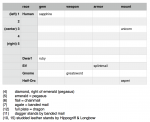
You are on the right path, and yes everything after those straight forward are related to each other, but also some of the clues are actually directly associated with each other, and that is a conclusion that has to be drawn.
For example: Clues 4 and 5 are referring to the same two heros. So are 7 and 11, and 10 and 15.
I totally am into puzzles, so I was able to pick up what you were aiming for pretty quickly. However, I've never seen a group of players with enough presence of mind and interest during play to actually craft a logic grid.
And, really, unless you're gaming with serious geniuses, you NEED a logic grid to solve this puzzle.
So unless you have exceptional, astute, and very committed players, I don't see anyone actually bothering to make a logic grid in play. Unless, of course, you explicitly tell them "You need to make a logic grid, and hey! I've started this handy handout for you guys!" YMMV.
Now my question is, does replacing the confusing riddle with something that actually makes sense help?
Before you are the tombs of five great heros.
Each one stands upon a different gemstone pedestal.
Each one rides a different animal.
Each one wears a different armor and wields a different weapon.
Determine who wields the staff to receive their bounty.
Fail and you shall face their wrath.
Yep, that's what was needed

To clarify...what do the players ACTUALLY SEE in the niches? Are they completely empty? Are there statues in each niche already? For example, the center niche (position #3) has a unicorn mount there. Do the players need to move some kinda statue there? Do they need to verbally say out loud "unicorn in the center"? Or what? How does the puzzle interaction actually WORK?
From the way you describe it above, it seems like everything is present in the niches already EXCEPT for the weapons. Though I don't think that's what you mean.
Still unclear, still too many assumptions.
Think "boxed text." What do the players PERCEIVE in the room? in the niches?
I definately see that, and I was hoping that I could make it less tedious by having them get attacked by a rather harmless attack and giving them an opportunity to see where they made a mistake.
You've got the
stick, that's great. But put some thought into the
carrot...for example, clues you can drop on a successful Intelligence check or divination spell at the bare minimum.
I envision this as a several hour long scenario. At least an 1 hour for players to "hit stride" and figure out how to solve it, at least 1 hour to work together to solve it, and then extra time for whatever fights/traps you have in store for them (and whatever hijinx they have in store for you).
As I stated in my previous reply, there are five challenges before this relating to the five heros that should provide additional information regarding this.
That's great that there are five challenges before this which will provide the players with clues. It's really important to spread clues out. ALSO, it's important for each necessary clue to have multiple ways to reach the PCs. For example, say they need to get the clue that
The Elf wears Splintmail.
You would want to come up with three vectors for them to get that clue, for example:
- Lord Erundil of the elves passed down his white steel splintmail thru his family line, but it was lost when orcs toppled the elven kingdom. Rumors of the magic splintmail have intrigued various adventurers over the years.
- The dwarven library the PCs visited had several stone tablets depicting fighting against elven commandos wearing stylized splintmail.
- A group of elven assassins the PCs faced wore Japanese-style splint armor blackened with pitch.
Not the greatest clues, but I don't know the particulars of your scenario and setting.
Including positioning, for example, a human archer gives the first challenge, a half-orc rogue the second, a dwarven cleric the third, an elven wizard the fourth, and a gnomish paladin the fifth.
That's pretty abstract. WHY should players assume that the order they face the challenge-givers has ANYTHING to do with the order in which the ancient heroes are laid in their tombs? And if there IS a convincing reason, then you need to make sure the players are aware of this (and don't be coy about).
If the players have paid attention then realisitcally this should be easy; however, if they didn't , then its a different story.
If I had a nickel for every time a DM said "well, if the players paid attention..."

Basically, from the DM's perspective, ALWAYS assume the players won't have paid the same kind of attention you have to the story, NPCs, riddles, etc. They'll miss things either because (a) they're goofing off or just tired that day, (b) your exposition goes over their heads or isn't as clear as you imagined it to be, (c) they're completely distracted/interested in something else in your game.
That's why Justin Alexander came up with his
Three Clue Rule. Definitely worth a read if you're not already familiar with it.
EDIT: Oh! A final thought! This is the kind of puzzle that is GREATLY enhanced by props, even if it's something as simple as treasure cards that the players arrange and rearrange. It helps a lot of players to have visual cues to visualize this sort of puzzle.