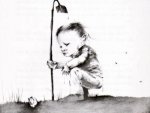
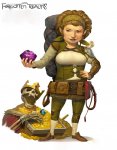
What's a little frustrating, is that if you hunt down the articles where the art director talks about Halflings, the concept art isn't so bad.
Sorry, the implementation in the PHB may be worse but the concept art was already awful (enormous heads and ridiculously tiny feet) and many people said as much in the comments at the time. Why WotC kept going with it remains a mystery.
They had a stated goal of designing the races so that one could identify a member of said race in a given picture very easily, which they succeeded in doing. A Gnome is clearly a Gnome, and a Halfling is clearly a Halfling, without any size referents needed.
If that was the goal, they failed because on several pictures the only sure way to tell the gnomes from the halflings is the pointy ears. There was no need to make either race hideous for that.
They're not my favorites but trying to draw a halfling without needing another object to create scale is scale when you can't go heavy on the big or hairy hands and feet thing. Escaping the hobbit or small human chasms could not have been easy.
Not sure why they had to "escape the hobbit chasm" (after so many years of shameless imitation, especially now that there are immensely popular movies far more likely to attract new halfling players than the pictures in the PHB).
If it's some brand identity or copyright issue (again, why now?), covering the iconic hairy feet should be more than enough to differentiate them visually. Slightly larger extremities are just a common cue for fantasy little people in illustration, independently of Tolkien.
If you're going with a big head, also having larger hands and feet simply looks more balanced and is less reminiscent of some creepy toddler.
As for "small humans", they aren't my preference but I don't see why a fantasy race couldn't look exactly like a small, well-proportioned human (and thus require another object as a size reference) either. It's a perfectly valid concept in itself.