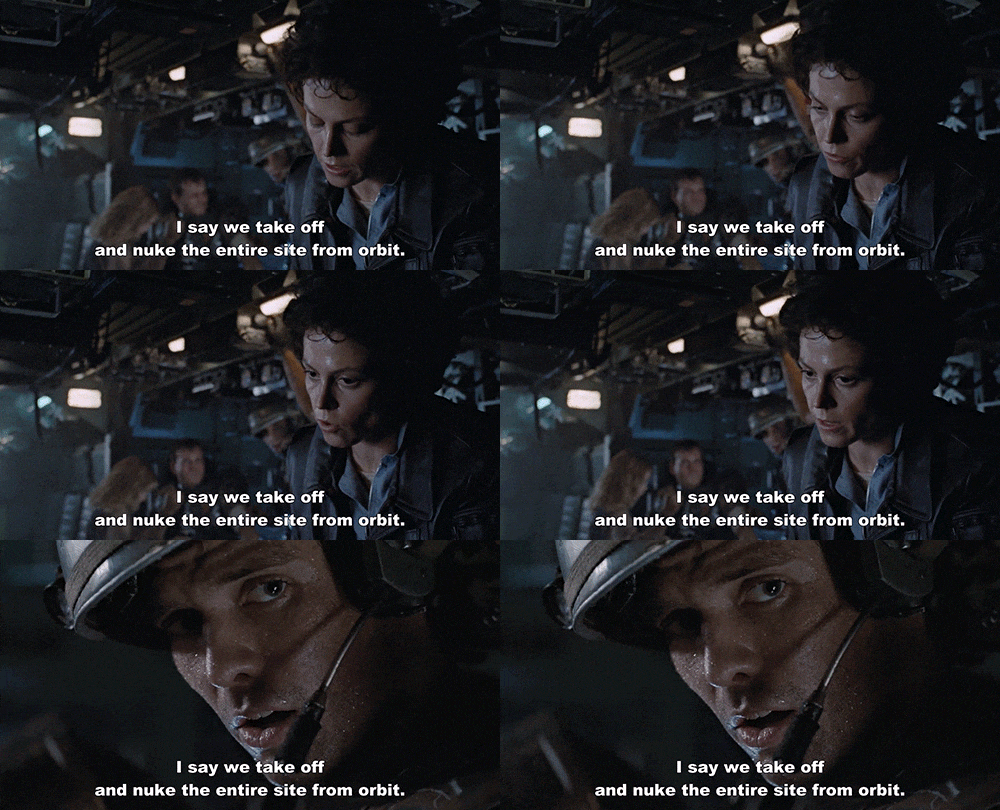
Me neither. But if the reason is really interesting or fun, I'd be okay with it. I guess there's a compromise: if the GM says in session zero that there's "always a chance" that the whole party dies, that would be fair warning without ruining a surprise.Yeesh, I dont like running stuff like this. If there is gonna be some "everybody died but the story continues..." contrivance id make that the beginning of the campaign and known. This isnt the type of surprise I like sprung on me. YMMV.
This is fun: rewards for TPK. The bigger you go out, the better your reward.A campaign titled "Raging to Valhalla"? Expect your fallen heros to be rewarded with feasting and recreational violence in their afterlife.
Cool idea. I guess there are a lot of possibilities, and like @payn said, there's also "enjoy the show." It's probably important just to have options, because enjoying the show depends a lot on the game. For example, I would not want to just watch a D&D battle while PCs slowly died off. It's hard enough watching a D&D battle while I'm still alive. Let me start rolling another character . . . that would keep me busy for a while.Having a PC 'ghost' that sticks around and can possess others can be fun. The player can leap from body to body and try to do things.
Agreed...its different for every group and every campaign....
Not all surprises are good.
Some people hate negative "surprises" like this.
In my opinion: a plotted TPK shouldn't be a surprise to the players. If there was no in game foreshadowing, I'm of the opinion that the plot is faulty. If there are no exit points for the characters along the way, it's a railroad to oblivion. If that's the genre, and the players like it, enjoy the ride.
...
I'll amplify this a bit. Not only is it not a requirement, but it can also be a simplistic or even lazy way to end a story. I feel that the best form of horror is when you could have succeeded, but failed to. Or you survive at a cost that is so high that death would have been preferable. I have had one CoC campaign end with nearly all the characters surviving, and realizing that to save the world, they would have to supply victims to be sacrificed to ward of the ancient evil continuously for the rest of their lives, and to recruit others to do so in the future. The player whose character died just before this felt they had the better outcome ...
So what can non-horror games use/learn from horror games regarding TPKs? I'm finding it weird that horror games reportedly have less threat of death than non-horror games.Investigative horror games in particular have risk but they don't tend to assume a particularly high level of PC mortality.
1. It's up to them. I've had players leave the session, others have hung around and gave advice from the grave (which I'm fine with)I've been reading the thread about avoiding encounters that are too easy or that result in a Total Party Kill (TPK), and I just gave some XP for a poster pointing out that horror games are supposed to end in TPK. So now I'm wondering about the middle ground: when a TPK is expected to happen in a non-horror game.
And no, this isn't about making encounters difficult enough to defeat all the PCs. I think that subject was covered back in GMing 101.
I want to know things like:
- What do players of dead PCs do while waiting for the rest of the party to die?
- If your plot calls for TPK, do you ask permission first and ruin the surprise?
- WWMD (Matt Merville)?