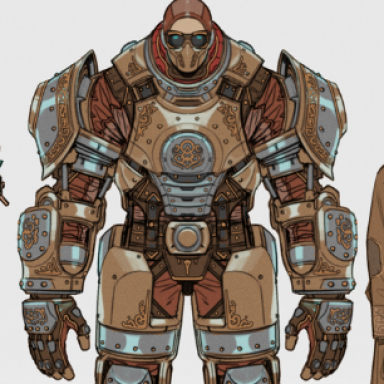
Myth20 Fantasy: Introduction

mythusmage

Banned
Banned
Some people were not pleased with my suggestions re D&D4e, so I'm taking a new tack and starting a new thread. The subject is Myth20 Fantasy: Introduction. Your job, should you choose to accept the assignment, is to comment on it. That said ...

Myth20 Fantasy: Introduction

This is a game of adventure. It is a game of mystery and intrigue. A game of daring, heroism, and dark villainy. In this game you play a person who lives in an imaginary world, and gets caught up in events either by accident, or deliberately. Someone who must use his abilities and skills as best he can to prevail against sometimes overwhelming odds.

There are exotic lands and exotic peoples in this game. Monsters out of nightmare, and creatures from dream. in Myth20 Fantasy you can negotiate with immortal queens and feast with goblin kings. In Myth20 Fantasy paths can run between worlds, and doorways can open on fields far from the ken of Man. Or the door may simply open to reveal a peddler with an old copper broach to sell. A broach you just know the wife would love to have.

This is a game of life in an imaginary realm, and what could happen to ordinary people who experience extraordinary things. How will you fare?
 

log in or register to remove this ad

Is this for real

It sounds a lot like some stories I have written
I love it and if it is not a game in development I will scarf this bad boy up for myself and do something for it, with it, etcetcetc

Tad


Patryn of Elvenshae said:
It sounds pretty generic, so far. There's nothing in what you've written at this point that distunguishes it from any of a hundred other fantasy RPGs.

I agree it is generic. Nonetheless if this were the blurb on the back of a book I'd get the notion that it might be a low fantasy approach with a strong 'fairytale theme' (which combined with evocative artwork would get me interested in reading more)


tadk said:
cough up more of what you are thinking

It is fairly generic. Since people rarely read introductions, why waste their time with long-winded bloviation? :) Keep it short, simple, and to the point. I'm not trying to cover everything in Myth20 Fantasy: Introduction, that's what the rest of the book is for.

BTW, it's been awhile since I had an attack of bronchitis, so ... :D
 

Myth20 Fantasy: Core Mechanic

Yes, the Myth20: Fantasy core mechanic is a variant of the d20 core mechanic. I took the active defense variant and expanded it to non-combat situations. The change in language came about because I'm not all that hot at technical writing.

That said ...

Myth20 Fantasy: Core Mechanic

To find out if an action succeeded or failed roll a d20 and add any bonus or subtract any penalty. Compare the modified die roll to the action's difficulty. If the modified roll is equal to or better than the difficulty the action succeeds. If the modified roll is less than the difficulty than the action fails. But see opposed actions for an exception.

There are two types of rolls, opposed and unopposed. Each is explained below.

In opposed rolls two parties are involved. Sometimes two players, more often a player and the GM. One is the "attacker", the other is the "defender". (Why the quote marks? Sometimes opposed rolls don't involve combat.) Both parties roll a d20 as normal and add or subtract bonuses or penalties as appropriate. If the attacker's modified roll is better than the defenders, the attacker wins. If the defender's modified roll is equal to or better than the attacker, the defender wins. This is an exception to the standard mechanic.

An unopposed roll works according to the standard mechanic against a pre-set difficulty. Unopposed rolls are used for such things as picking locks, opening doors, appraising items, casting spells, and the like.

In the case of an unopposed action the difficulty is set by the GM according to the circumstances. The more difficult the situation, the more difficult the attempted action. Guidelines to setting difficulty for unopposed actions is presented in the skills chapter.
 
Last edited:

Myth20 Fantasy: Characteristics

Yes, I went and changed the most sacred cow of d20 sacred cows. :p

Myth20 Fantasy: Characteristics

Myth20 has six characteristics; Strength, Dexterity, Constitution, Intelligence, Wisdom, and Charisma. For humans each is determined by rolling 2d6 and adding 4 to the result. This give a range from 6 to 16. Non-humans use this method for most of their characteristics, with one or two exceptions. (For example, dwarfs are known for their strength and endurance, but they are not the most scintillating conversationalists. So for dwarfs Strength and Constitution are determined by rolling 2d6 and adding 6 to the roll. But Charisma is found by rolling 2d6 and adding 2.)

High and low characteristics modify d20 rolls. Which characteristic applies depends on the action attempted. For every two points above 11 the modifier is +1. For every two points below 11 the modifier is -1. Or consult the table below.

16: +3
15: +2
14: +2
13: +1
12: +1
11: 0
10: -1
09: -1
08: -2
07: -2
06: -3

(At this point I must fess up to being flummoxed on how to describe what each characteristic stands for and is used for. I could use the SRD's boiler plate, but I'd much rather put it into my own words. so expect this posting to get (repeatedly) edited.)

Spell Use: Maximum spell level for a caster is determined by the appropriate characteristic. Intelligence for Wizards; Wisdom for Clerics, Druids, Paladins, and Rangers; and Charisma for Bards, and Sorcerers. The minimum characteristic for using spells of a certain level is 10 plus spell level. Which means the typical human wizard is limited to 6th level spells at best. 7th level or higher spells are restricted to extraordinary individuals.

(Special Note: For Myth20 Fantasy I bumped spells up one level. So instead of 0 to 9th level spells M20F has 1st to 10th level spells. The magic chapter will have more on this.)
 

One thing I like to consider for stats is that Cha is external force of personality and Wis is you internal force of personality.

High Cha people exert peer pressure.
Low Wis people succumb to peer pressure.
It is quite possible to have somebody that exerts the peer pressure they feel (High Cha, low Wis). It is also possible to have somebody that is socially unremarkable, but not vulnerable to peer pressure (Low Cha, high Wis).

I would encourage you to avoid the stereotypes of High Cha people are all beautiful and so easy to get along with. There are unpleasant people that can also be very diplomatic, convincing, persuassive, intimidating, etc.
 

Myth20 Fantasy: Races (Humans)

Before I present what information I have on races in Myth20 Fantasy I must inform the reader that I don't balance the races mechanically. If everybody wants to play a dwarf or elf, then can all play dwarfs or elves. In a world dominated by humans they might be recent elven university graduates out on the Grand Tour. Or staff for a dwarven ambassador to a human kingdom. As to why people should play humans etc in a game where one or two races are simply better, I should hope I present a varied enough world that most any character of any race could have a role in a party. And that the players are encouraged to create characters that are well rounded instead of focused on one aspect of the game or another. That said ...

Myth20Fantasy: Races (Humans)

In Myth20 Fantasy there are 8 races; humans, elves, half elves, dwarfs, orcs, half orcs, gnomes, and hobs.

Humans predominate. They are not the smartest or the strongest, or the toughtest, they are simply more adaptable. At this moment in time they share the world of Myth20 Fantasy with other sapients, but in time - say a millenium or two - the others may fade away into extinction. Or become such as spirtes and fairies in the Fey Realms.

Humans gain no special benefits or penalties for being human. But unless dealing with an extremely xenophobic culture they are more likely to gain assistance from other humans than non-humans are. And humans are more plentiful.

Coloration ranges from very dark to very light, height from short to tall. Human builds are about average, with only a slight variation. Human weight on the contrary can vary widely, but the extremes indicate an unhealthy condition.

Of all the races humans have the greatest variation in environment, culture, and language. Indeed, it is the orc that comes closest. And orcs are the most likely to interbreed with humans. But any story one might hear about orcs doing this deliberately, so as to ensure survival of their race in some form or another, ignores the well known faults and failings inherent in all orcs.

Bonuses and penalties to skills and any special traits vary according to region and culture. But unlike the other races humans are fairly comfortable in other cultures. Whereas dwarfs rarely come to live in a foreign land, humans will actually seek out a new place to live should they find one that appeals to them. Human cultures are also unique in that they will welcome immigrants and seek to make them a part of their home. Maybe not in the first generation, but by the second the newcomers are usually part of everyday life.

(More to be written about humans, but that's what I've got for now. Next up, elves.)
 

Enchanted Trinkets Complete

Recent & Upcoming Releases

Remove ads

Top