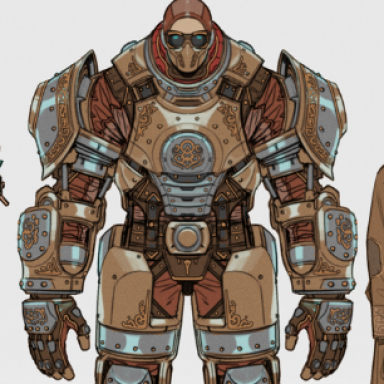
HellHound
ENnies winner and NOT Scrappy Doo
Shape Memory Polymers
By the turn of the millennium, engineers at Brunel University had finalized the design and implementation of a family of ‘shape memory polymers’. These polymers retain a given shape after heating and remoulding. This means that they could be moulded into one shape, and then would change to the ‘memory’ shape when heated to a certain temperature. Advanced polymers could have two or more different shapes that would be reached at different target temperatures.
First introduced in Japan and then the United States 1984, shape memory polymers are polymers whose qualities have been altered to give them dynamic shape "memory" properties. Using thermal stimuli, shape memory polymers can exhibit a radical change from a rigid polymer to a very elastic state, then return back to a rigid state again. In the elastic state, a shape memory polymer will recover its “memory” shape if left unrestrained. However, while in this pliable state it can be stretched, folded or otherwise conformed to other shapes, tolerating up to 500% elongation. While manipulated, the shape memory polymer can be cooled and therefore returned to a rigid state, maintaining its manipulated shape indefinitely. This manipulation process can be repeated many times without degradation. Unlike shape memory alloys, SMP exhibits a radical change from a normal rigid polymer to a very stretchy elastic and back on command, a change which can be repeated without degradation of the material. The "memory," or recovery, quality comes from the stored mechanical energy attained during the reconfiguration and cooling of the material. The secret behind these clever materials lies in their molecular network structure, which contains meltable "switching segments".
Modern variations on the classic turn-of-the millennium shape memory polymers react to other stimuli than heat – one of the most important is a photonic reaction which allowed for the creation of quick and affordable fibre-optic switching units. Other developments include exposure (or lack of exposure) to oxygen – these polymers are now in use in many orbital applications where they can instantly seal small breaches in vehicle and station hulls as well as personal protective equipment. Finally, piezo-stimulus shape memory polymers react to different electrical currents by taking on different shapes. Some become pliable under a specific current, others remain pliable until a current is established, and the more elaborate designs have multiple states, and can switch from one hardened state to another through the intermediary pliable state simply by changing the current applied to the plastic. Some other varieties include magnetic field-triggered polymers and acid-base reaction polymers used in some scientific applications.
To date, the most common usage for shape memory polymers is in the production of other plastics. SMP (Shape Memory Polymer) moulds can be made of a hard and high-temperature material for high precision injection moulding, and then with the application of electrical current, the moulds seem to melt away from the final product, then reform into the mould format again when the current is turned off. In addition, modern SMP foamed polystyrene allows for convenient shipping of products in large polystyrene shipping units to protect against jostling and abuse, then the polystyrene packing containers can be compressed, releasing the air within the structure and reducing the container down to a plastic block less than 3% of the normal volume of the polystyrene. These are shipped back to the original sender where they are heated and ‘fluffed’ to be returned to their normal size and shape.
By the late 2020’s, SMP characteristics can be engineered into almost all polymers, allowing for automobile fenders to be bent back into shape with the application of the right amount of heat, the creation of multiform solid-state furniture that shifts to accommodate different users with the press of a button, and a million other household uses. Some low-rent apartment buildings even use piezo-activated SMPs for the doors on their units so the door can be quickly ‘melted’ with the application of a simple stun-gun-like device.
The tools, weapons and equipment in this article / thread assume that SMP technologies achieve this level of sophistication, but do not exceed it by much over coming years. This works well for a campaign set with technology in Progress Level 6. The technology remains somewhat stagnant during Progress Level 7 (so the tools and weapons are still available) and evolves into Shape Memory Metallic Alloys and Ceramics at Progress Levels 8 and 9.
(all works posted by myself in this thread are copyright 1997-2005, M Jason Parent)
By the turn of the millennium, engineers at Brunel University had finalized the design and implementation of a family of ‘shape memory polymers’. These polymers retain a given shape after heating and remoulding. This means that they could be moulded into one shape, and then would change to the ‘memory’ shape when heated to a certain temperature. Advanced polymers could have two or more different shapes that would be reached at different target temperatures.
First introduced in Japan and then the United States 1984, shape memory polymers are polymers whose qualities have been altered to give them dynamic shape "memory" properties. Using thermal stimuli, shape memory polymers can exhibit a radical change from a rigid polymer to a very elastic state, then return back to a rigid state again. In the elastic state, a shape memory polymer will recover its “memory” shape if left unrestrained. However, while in this pliable state it can be stretched, folded or otherwise conformed to other shapes, tolerating up to 500% elongation. While manipulated, the shape memory polymer can be cooled and therefore returned to a rigid state, maintaining its manipulated shape indefinitely. This manipulation process can be repeated many times without degradation. Unlike shape memory alloys, SMP exhibits a radical change from a normal rigid polymer to a very stretchy elastic and back on command, a change which can be repeated without degradation of the material. The "memory," or recovery, quality comes from the stored mechanical energy attained during the reconfiguration and cooling of the material. The secret behind these clever materials lies in their molecular network structure, which contains meltable "switching segments".
Modern variations on the classic turn-of-the millennium shape memory polymers react to other stimuli than heat – one of the most important is a photonic reaction which allowed for the creation of quick and affordable fibre-optic switching units. Other developments include exposure (or lack of exposure) to oxygen – these polymers are now in use in many orbital applications where they can instantly seal small breaches in vehicle and station hulls as well as personal protective equipment. Finally, piezo-stimulus shape memory polymers react to different electrical currents by taking on different shapes. Some become pliable under a specific current, others remain pliable until a current is established, and the more elaborate designs have multiple states, and can switch from one hardened state to another through the intermediary pliable state simply by changing the current applied to the plastic. Some other varieties include magnetic field-triggered polymers and acid-base reaction polymers used in some scientific applications.
To date, the most common usage for shape memory polymers is in the production of other plastics. SMP (Shape Memory Polymer) moulds can be made of a hard and high-temperature material for high precision injection moulding, and then with the application of electrical current, the moulds seem to melt away from the final product, then reform into the mould format again when the current is turned off. In addition, modern SMP foamed polystyrene allows for convenient shipping of products in large polystyrene shipping units to protect against jostling and abuse, then the polystyrene packing containers can be compressed, releasing the air within the structure and reducing the container down to a plastic block less than 3% of the normal volume of the polystyrene. These are shipped back to the original sender where they are heated and ‘fluffed’ to be returned to their normal size and shape.
By the late 2020’s, SMP characteristics can be engineered into almost all polymers, allowing for automobile fenders to be bent back into shape with the application of the right amount of heat, the creation of multiform solid-state furniture that shifts to accommodate different users with the press of a button, and a million other household uses. Some low-rent apartment buildings even use piezo-activated SMPs for the doors on their units so the door can be quickly ‘melted’ with the application of a simple stun-gun-like device.
The tools, weapons and equipment in this article / thread assume that SMP technologies achieve this level of sophistication, but do not exceed it by much over coming years. This works well for a campaign set with technology in Progress Level 6. The technology remains somewhat stagnant during Progress Level 7 (so the tools and weapons are still available) and evolves into Shape Memory Metallic Alloys and Ceramics at Progress Levels 8 and 9.
(all works posted by myself in this thread are copyright 1997-2005, M Jason Parent)