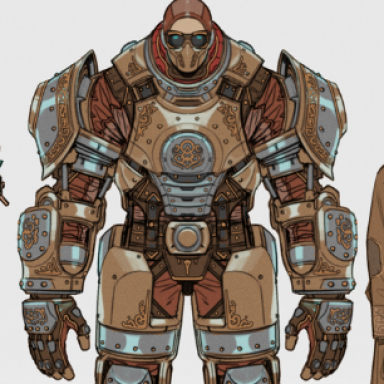
Brasswatchman
First Post
So I'm currently working on... hrm... let's not call it a low magic campaign setting. Maybe a better term for it would be lower magic - no wizards, sorcerers or clerics, and we use the variant ranger without spells in Complete Warrior - but bards and paladins are allowed, and are kind of the center of the setting.
On the other hand, I also realized that there was room for a priest-type class, but I thought the cleric was too powerful for what I had in mind for this setting. So I took the Adept NPC class in the DMG, and tried to pump it up so that it might be - if not a complete match for a bard or paladin - at least somewhat decent to play.
What do you think? Did I succeed? Could this, concievably, be balanced? What if I took the cure and summon monster spells off the Bard list? Would it work then? And finally - please, God - can someone come up with a better name for the special ability called aura of divine favor or wrath? Bit long on the tongue, that one, but it was the best I've been able to come up with so far.
Anyway, here's what I've got so far. Tell me what you think:
NOTE: 9/6/06 - updated to version two. Got rid of that annoying "aura of divine whatsits" name, and have a new ability called imbue familiar. Changes in bold. Tell me what you think.
NOTE: 9/11/06 - replaced Divine Harbinger with Heal Self, new ability based off of divine wholeness, pg. 32, Complete Divine. Disallowed medium armor. Changes in bold.
PRIEST
HD: d6
Skills: Concentration (Con), Craft (Int), Decipher Script (Int), Diplomacy (Cha), Handle Animal (Cha), Heal (Wis), Knowledge (arcana) (Int), Knowledge (nobility and royalty) (Int), Knowledge (religion) (Int), Listen (Wis), Profession (Wis), Sense Motive (Wis), Spellcraft (Int).
Skill Points: 4 + Int
Starting Equipment: 5d4 * 10 gp (125 gp average)
Base Attack Bonus: Average
Good Saves: Fort, Will
Spells: See below for progression.
Spells per Day –
Level: 0 / 1 / 2 / 3 / 4 / 5
1: 3 / 1
2: 4 / 1+1
3: 4 / 2+1
4: 5 / 2+2 / 0
5: 5 / 2+2 / 1
6: 5 / 2+2 / 1+1
7: 6 / 2+2 / 2+1
8: 6 / 2+2 / 2+2 / 0
9: 6 / 2+2 / 2+2 / 1
10: 6 / 2+2 / 2+2 / 1+1
11: 6 / 2+2 / 2+2 / 2+1
12: 6 / 2+2 / 2+2 / 2+2 / 0
13: 6 / 2+2 / 2+2 / 2+2 / 1
14: 6 / 2+2 / 2+2 / 2+2 / 1+1
15: 6 / 2+2 / 2+2 / 2+2 / 2+1
16: 6 / 2+2 / 2+2 / 2+2 / 2+2 / 0
17: 6 / 2+2 / 2+2 / 2+2 / 2+2 / 1
18: 6 / 2+2 / 2+2 / 2+2 / 2+2 / 1+1
19: 6 / 2+2 / 2+2 / 2+2 / 2+2 / 2+1
20: 6 / 2+2 / 2+2 / 2+2 / 2+2 / 2+2
Special:
Level 1: Imbue relic.
Level 5:Aura of divine favor or wrath Divine harbinger Heal self (level)
Level 10: Extra domain, heal self (2 x level)
Level 15: Heal self (3 x level)
Level 20: Heal self (4 x level)
Weapon and Armor Proficiency: Priests are proficient with all simple weapons, with light and medium armor, and with shields (except tower shields).
Deity, Domains, and Domain Spells: The priest’s primary spellcasting ability is Wisdom. A priest must have a Wisdom score equal to or higher than 10 + spell level in order to prepare a spell. He receives bonus spells if he has a high Wisdom score (see pg. 8, PHB). The Difficulty Class for a saving throw against a priest’s spell is equal to 10 + the spell level + the priest’s Wisdom modifier.
Priests receive domain spells, just as clerics do. However, unlike clerics, priests eventually receive two domain slots per spell level. The priest may fill their domain slots with the spells from both domains, or fill both domain slots with the spell from only one of his domains, as he chooses.
In addition, a priest gains an extra domain at level 10. See below for details.
Imbue Relic: At 1st level, a priest chooses a certain object to serve as his relic. A relic is a container of holy energy, linked to the spiritual power of the priest’s soul, which serves various purposes to him as he goes about his duties. In game terms, a priest’s relic is his item familiar.
What this object may or may not be is ultimately the decision of the DM. That having been said, the following objects may serve well as a relic: any simple weapon, the favored weapon of the priest’s deity, all light or medium-sized armor, any shield (except tower shields), a pair of gloves, a ring, a pair of boots or shoes, a cloak, a cape, a bracelet, or a necklace. In general, a relic must be either a weapon, armor, or must be capable of being worn on the priest’s body like a standard magic item (see pg. 214, DMG). Once the priest chooses an object as his relic, it immediately becomes a masterwork item, regardless of its appearance, make, material or craftsmanship. If the priest’s relic is a weapon, it gains the benefits of a masterwork weapon; if the priest’s relic is a suit of armor, it gains the benefits of masterwork armor.
At 3rd level, a priest’s relic gains a +1 enhancement bonus. If the relic is a weapon, it becomes a +1 weapon; if it is a suit of armor, it becomes +1 armor. At the DM’s discretion, the relic may adopt a separate power – for example, become a particular wondrous item – equivalent in cost to a +1 weapon.
The various abilities a relic gains as a priest increases in experience are otherwise described on pages 170-174, Unearthed Arcana (or here - or you can just click here ).
Level: Special Ability
1-2: Masterwork
3-4: +1 enhancement bonus (or equivalent).
5-6: Invest skill ranks.
7-8: Sapience; senses; communication.
9-10: Invest spell slots.
11-12: Special Ability
13-14: Scry on relic.
15-16: Special Ability
17-18: Special Ability
21st or higher: One additional special ability per three character levels above 20th.
Spontaneous Casting: As per the cleric ability (pg. 32-33 PHB), except that a priest can convert prepared spells into either cure spells or inflict spells regardless of alignment. A Lawful Good priest can spontaneously convert a prepared 1st-level spell into either an inflict light wounds spell or a cure light wounds as he chooses, just as a Chaotic Evil priest can choose to convert the same spell into either a cure light wounds or an inflict light wounds spell. Priests of any god can heal or harm as necessary.
Heal Self (Su): Beginning at 5th level, a priest has the ability to draw extraordinary amounts of vitality from his devotion to his god. A priest with the heal self ability can heal his own wounds, in addition to any other healing abilities he might have. At 5th level, he can heal up to his priest level in hit points each day; at 10th level, he can heal up to twice his priest level; 15th level, three times his priest level; and at 20th level, four times his priest level. The priest can spread this healing out among several uses. Using the heal self ability counts as a swift action. A priest can only use heal self when wearing light or no armor.
Extra Domain: At 10th level, a priest gains access to a third domain in his diety’s portfolio. The priest may choose which domain he wishes to gain access to.
Priest Spell List
Priests choose their spells from the following list.
0 Level: create water, cure minor wounds, detect magic, ghost sound, guidance, inflict minor wounds, light, mending, purify food and drink, read magic, resistance, touch of fatigue, virtue.
1st Level: bane, bless, bless water, burning hands, cause fear, command, comprehend languages, cure light wounds, detect chaos/evil/good/law, detect undead, divine favor, doom, endure elements, inflict light wounds, magic weapon, obscuring mist, protection from chaos/good/evil/law, remove fear, sanctuary, shillelagh, sleep, summon nature’s ally I.
2nd Level: aid, align weapon, augury, bear’s endurance, bull’s strength, calm emotions, consecrate, cure moderate wounds, darkness, delay poison, desecrate, fire trap, gust of wind, inflict moderate wounds, invisibility, mirror image, owl’s wisdom, resist energy, restoration (lesser), scorching ray, shield other, see invisibility, silence, summon nature’s ally II, zone of truth.
3rd Level: bestow curse, blindness/deafness, call lightning, contagion, continual flame, create food and water, cure serious wounds, daylight, deeper darkness, dispel magic, glyph of warding, inflict serious wounds, invisibility purge, locate object, magic circle against chaos/good/evil/law, magic vestment, plant growth, prayer, neutralize poison, remove blindness/deafness, remove curse, summon nature’s ally III, tongues, water walk.
4th Level: blight, control water, cure critical wounds, dimensional anchor, discern lies, dismissal, divination, divine power, minor creation, polymorph, restoration, rusting grasp, sending, summon nature’s ally IV, wall of fire.
5th Level: atonement, baleful polymorph, break enchantment, call lightning storm, control winds, command (greater), commune, dispel chaos/evil/good/law, geas/quest, heal, flame strike, hallow, major creation, mark of justice, raise dead, scrying, summon nature’s ally V, symbol of pain, symbol of sleep, true seeing, unhallow, wall of force, wall of stone.
On the other hand, I also realized that there was room for a priest-type class, but I thought the cleric was too powerful for what I had in mind for this setting. So I took the Adept NPC class in the DMG, and tried to pump it up so that it might be - if not a complete match for a bard or paladin - at least somewhat decent to play.
What do you think? Did I succeed? Could this, concievably, be balanced? What if I took the cure and summon monster spells off the Bard list? Would it work then? And finally - please, God - can someone come up with a better name for the special ability called aura of divine favor or wrath? Bit long on the tongue, that one, but it was the best I've been able to come up with so far.
Anyway, here's what I've got so far. Tell me what you think:
NOTE: 9/6/06 - updated to version two. Got rid of that annoying "aura of divine whatsits" name, and have a new ability called imbue familiar. Changes in bold. Tell me what you think.
NOTE: 9/11/06 - replaced Divine Harbinger with Heal Self, new ability based off of divine wholeness, pg. 32, Complete Divine. Disallowed medium armor. Changes in bold.
PRIEST
HD: d6
Skills: Concentration (Con), Craft (Int), Decipher Script (Int), Diplomacy (Cha), Handle Animal (Cha), Heal (Wis), Knowledge (arcana) (Int), Knowledge (nobility and royalty) (Int), Knowledge (religion) (Int), Listen (Wis), Profession (Wis), Sense Motive (Wis), Spellcraft (Int).
Skill Points: 4 + Int
Starting Equipment: 5d4 * 10 gp (125 gp average)
Base Attack Bonus: Average
Good Saves: Fort, Will
Spells: See below for progression.
Spells per Day –
Level: 0 / 1 / 2 / 3 / 4 / 5
1: 3 / 1
2: 4 / 1+1
3: 4 / 2+1
4: 5 / 2+2 / 0
5: 5 / 2+2 / 1
6: 5 / 2+2 / 1+1
7: 6 / 2+2 / 2+1
8: 6 / 2+2 / 2+2 / 0
9: 6 / 2+2 / 2+2 / 1
10: 6 / 2+2 / 2+2 / 1+1
11: 6 / 2+2 / 2+2 / 2+1
12: 6 / 2+2 / 2+2 / 2+2 / 0
13: 6 / 2+2 / 2+2 / 2+2 / 1
14: 6 / 2+2 / 2+2 / 2+2 / 1+1
15: 6 / 2+2 / 2+2 / 2+2 / 2+1
16: 6 / 2+2 / 2+2 / 2+2 / 2+2 / 0
17: 6 / 2+2 / 2+2 / 2+2 / 2+2 / 1
18: 6 / 2+2 / 2+2 / 2+2 / 2+2 / 1+1
19: 6 / 2+2 / 2+2 / 2+2 / 2+2 / 2+1
20: 6 / 2+2 / 2+2 / 2+2 / 2+2 / 2+2
Special:
Level 1: Imbue relic.
Level 5:
Level 10: Extra domain, heal self (2 x level)
Level 15: Heal self (3 x level)
Level 20: Heal self (4 x level)
Weapon and Armor Proficiency: Priests are proficient with all simple weapons, with light and medium armor, and with shields (except tower shields).
Deity, Domains, and Domain Spells: The priest’s primary spellcasting ability is Wisdom. A priest must have a Wisdom score equal to or higher than 10 + spell level in order to prepare a spell. He receives bonus spells if he has a high Wisdom score (see pg. 8, PHB). The Difficulty Class for a saving throw against a priest’s spell is equal to 10 + the spell level + the priest’s Wisdom modifier.
Priests receive domain spells, just as clerics do. However, unlike clerics, priests eventually receive two domain slots per spell level. The priest may fill their domain slots with the spells from both domains, or fill both domain slots with the spell from only one of his domains, as he chooses.
In addition, a priest gains an extra domain at level 10. See below for details.
Imbue Relic: At 1st level, a priest chooses a certain object to serve as his relic. A relic is a container of holy energy, linked to the spiritual power of the priest’s soul, which serves various purposes to him as he goes about his duties. In game terms, a priest’s relic is his item familiar.
What this object may or may not be is ultimately the decision of the DM. That having been said, the following objects may serve well as a relic: any simple weapon, the favored weapon of the priest’s deity, all light or medium-sized armor, any shield (except tower shields), a pair of gloves, a ring, a pair of boots or shoes, a cloak, a cape, a bracelet, or a necklace. In general, a relic must be either a weapon, armor, or must be capable of being worn on the priest’s body like a standard magic item (see pg. 214, DMG). Once the priest chooses an object as his relic, it immediately becomes a masterwork item, regardless of its appearance, make, material or craftsmanship. If the priest’s relic is a weapon, it gains the benefits of a masterwork weapon; if the priest’s relic is a suit of armor, it gains the benefits of masterwork armor.
At 3rd level, a priest’s relic gains a +1 enhancement bonus. If the relic is a weapon, it becomes a +1 weapon; if it is a suit of armor, it becomes +1 armor. At the DM’s discretion, the relic may adopt a separate power – for example, become a particular wondrous item – equivalent in cost to a +1 weapon.
The various abilities a relic gains as a priest increases in experience are otherwise described on pages 170-174, Unearthed Arcana (or here - or you can just click here ).
Level: Special Ability
1-2: Masterwork
3-4: +1 enhancement bonus (or equivalent).
5-6: Invest skill ranks.
7-8: Sapience; senses; communication.
9-10: Invest spell slots.
11-12: Special Ability
13-14: Scry on relic.
15-16: Special Ability
17-18: Special Ability
21st or higher: One additional special ability per three character levels above 20th.
Spontaneous Casting: As per the cleric ability (pg. 32-33 PHB), except that a priest can convert prepared spells into either cure spells or inflict spells regardless of alignment. A Lawful Good priest can spontaneously convert a prepared 1st-level spell into either an inflict light wounds spell or a cure light wounds as he chooses, just as a Chaotic Evil priest can choose to convert the same spell into either a cure light wounds or an inflict light wounds spell. Priests of any god can heal or harm as necessary.
Heal Self (Su): Beginning at 5th level, a priest has the ability to draw extraordinary amounts of vitality from his devotion to his god. A priest with the heal self ability can heal his own wounds, in addition to any other healing abilities he might have. At 5th level, he can heal up to his priest level in hit points each day; at 10th level, he can heal up to twice his priest level; 15th level, three times his priest level; and at 20th level, four times his priest level. The priest can spread this healing out among several uses. Using the heal self ability counts as a swift action. A priest can only use heal self when wearing light or no armor.
Extra Domain: At 10th level, a priest gains access to a third domain in his diety’s portfolio. The priest may choose which domain he wishes to gain access to.
Priest Spell List
Priests choose their spells from the following list.
0 Level: create water, cure minor wounds, detect magic, ghost sound, guidance, inflict minor wounds, light, mending, purify food and drink, read magic, resistance, touch of fatigue, virtue.
1st Level: bane, bless, bless water, burning hands, cause fear, command, comprehend languages, cure light wounds, detect chaos/evil/good/law, detect undead, divine favor, doom, endure elements, inflict light wounds, magic weapon, obscuring mist, protection from chaos/good/evil/law, remove fear, sanctuary, shillelagh, sleep, summon nature’s ally I.
2nd Level: aid, align weapon, augury, bear’s endurance, bull’s strength, calm emotions, consecrate, cure moderate wounds, darkness, delay poison, desecrate, fire trap, gust of wind, inflict moderate wounds, invisibility, mirror image, owl’s wisdom, resist energy, restoration (lesser), scorching ray, shield other, see invisibility, silence, summon nature’s ally II, zone of truth.
3rd Level: bestow curse, blindness/deafness, call lightning, contagion, continual flame, create food and water, cure serious wounds, daylight, deeper darkness, dispel magic, glyph of warding, inflict serious wounds, invisibility purge, locate object, magic circle against chaos/good/evil/law, magic vestment, plant growth, prayer, neutralize poison, remove blindness/deafness, remove curse, summon nature’s ally III, tongues, water walk.
4th Level: blight, control water, cure critical wounds, dimensional anchor, discern lies, dismissal, divination, divine power, minor creation, polymorph, restoration, rusting grasp, sending, summon nature’s ally IV, wall of fire.
5th Level: atonement, baleful polymorph, break enchantment, call lightning storm, control winds, command (greater), commune, dispel chaos/evil/good/law, geas/quest, heal, flame strike, hallow, major creation, mark of justice, raise dead, scrying, summon nature’s ally V, symbol of pain, symbol of sleep, true seeing, unhallow, wall of force, wall of stone.
Last edited: