yes, but who determines the consequences? Is the player declaring what he is risking, is it some random table, is it actually the GM deciding something for a change instead of just executing the rules?
Different games have different rules and different procedures.
In Burning Wheel, an action declaration consists of intent and task. If nothing that matters to the player is at stake, the GM says "yes" and the intent and task are both realised. Here's an example:
the two characters could see an exposed trapdoor. "Does it have an iron ring?" I asked. When told yes by the GM, Aramina used her Call of Iron spell to pull the ring towards her, lifting the trapdoor open (the GM said 'yes' to this, which meant no Tax check was required).
The reason that nothing is at stake here is because Aramina has no Belief or other PC build element that makes opening trapdoors, exploring secret places, or Calling Iron a priority.
If the GM does not say "yes", then the dice must be rolled. (This is called "say 'yes' or roll the dice" - the phrase was coined by Vincent Baker in Dogs in the Vineyard, and the Burning Wheel rulebook calls it "Vincent's Admonition".) The task and intent, taken together, establish what skill or ability will be tested. The GM is responsible for setting the difficulty, though there are a lot of example difficulties to guide this - in Burning Wheel, setting consistent obstacles over time is one important aspect of world building that the GM has to do.
If the player succeeds on their test, then intent and task are both realised. If the player fails, then the GM is obliged to narrate something that
negates the intent, and which may also but need not include failure at the task. Because we are only rolling if something that the player has prioritised is at stake, there is already some relationship between intent and stakes, and this will provide the cue and context for narrating a consequence. Sometimes it requires more imagination than other times. I was pretty pleased with the black arrows!
pemerton said:
RPGing is more exciting than cooperative storytelling, because of the role division - for instance, it's more exciting for the players to have someone else work out, following a failed roll, how whatever it is that they've staked is lost. It's more exciting to respond to an external prompt than to your own imagining about what might go wrong.
so a talking rulebook then?
I don't follow.
I've just told you the rules. The black arrows are not in the rules. Gerda stealing the Elfstone is not in the rules. Gerda running through the Dreamwalker PC, apparently right through her heart, but the PC miraculously surviving and (among other things) being purged of her lust for the Elfstone is not in the rules.
In the examples I've posted, you can see the moments of GM narration, because I call them out. Those are the things that the GM brings to the game.
I can see why the players have more agency, I can see why they prefer someone to look up stuff and describe things to them based on their input
I don't know what you mean by "look up stuff". What stuff?
help the players by following the rules and narrating results for them
As I've posted, it is the GM's job to make up the results of failure, and to provide the framing?
I am still looking for your agency in all of this
<snip>
I just am not seeing what your role is, outside from just being an accommodating host, so they can more easily and enjoyably play out their adventures
I've given many, many examples. Some more, just from the actual play I've posted or linked to in this thread: a PC snags her oxygen cord on an outcrop of rock while approaching an enemy installation prior to assaulting it; Yan-C-Bin will see the PCs, but threatens to imprison the Sorcerer servant of Chan; the Djinn ask for their freedom to be secure; the evil spirit, sprung from the Dreamwalker's heart when she failed in casting a spell, carries the spellbook into the dreams of Megloss, her enemy, instead of into her own dreams; Gerda tries to kill the Dreamwalker rather than give up the Elfstone; Megloss reduces Gerda to cinders with a casting of Flames of the Shroud.
What you will see is that, in all cases, these are either
framing or
narrations of consequences of failure.
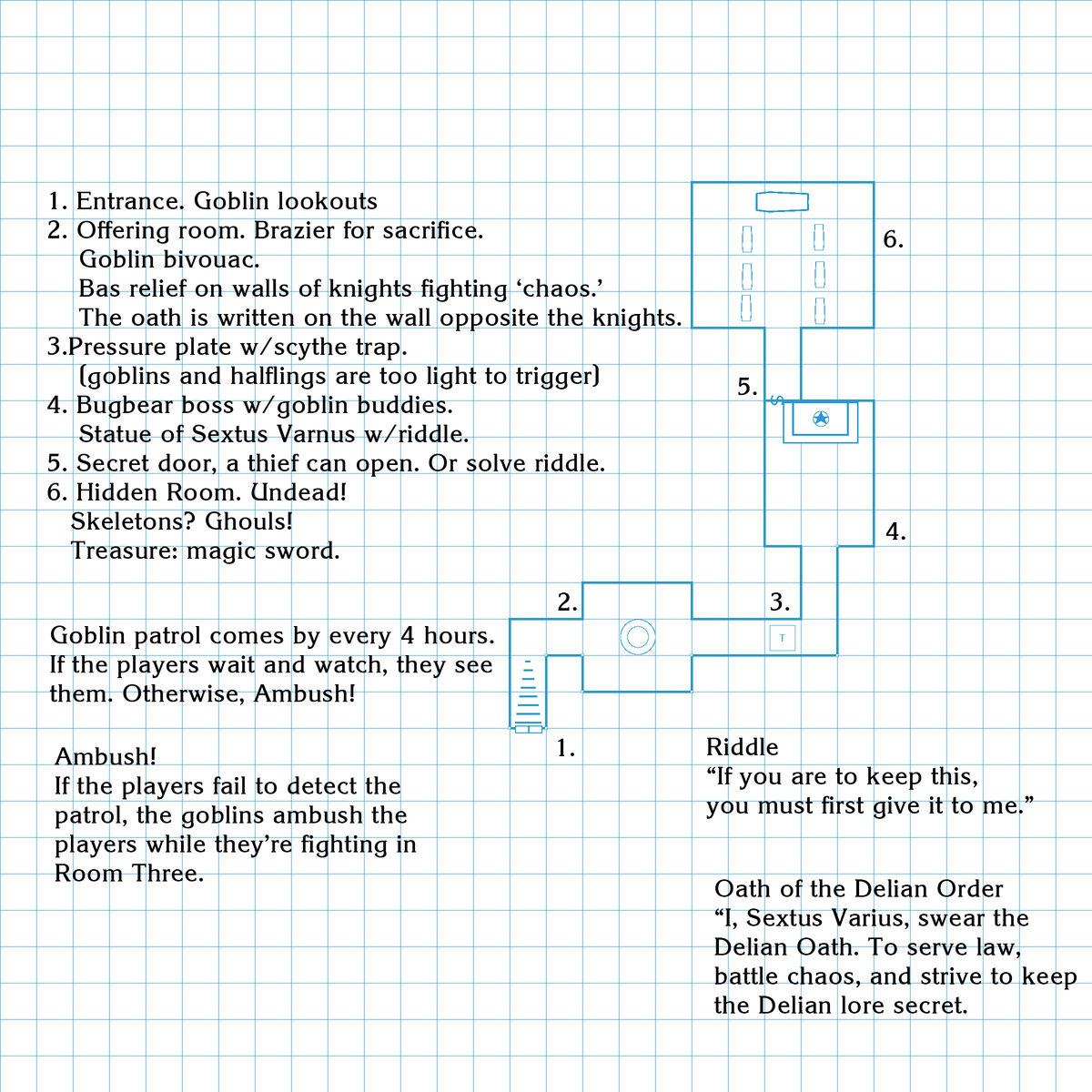
As a basis I am using the Delian Tomb, cannot really think of a more basic adventure, but it should be sufficient for this. Maybe some people are somewhat familiar with it already, if not, here is a link
The Delian Tomb is a low-level dungeon designed by Matt Colville using Dungeonographer in the first episode of his Running the Game series on Youtube. The dungeon is meant to serve as a simple ready-made adventure for a new dungeon master to run for new players on short notice, containing 5...

mcdm.fandom.com
You can basically get everything you need for this discussion from just the picture
<snip>
Who is coming up with the premise? I assume the players do, i.e. players decide 'we want to look for treasure in an old tomb and fight some goblins', or is any of that part not based on player input? E.g. do you pick the monsters?
Burning Wheel doesn't really use the concept of "the adventure" in the same way that D&D does.
Torchbearer can, although it doesn't need to. This is why some Torchbearer play involves me (as GM) knowing stuff that the players don't, but other Torchbearer play (such as my last session) does not.
The OP of
this thread explains how I wrote and played my first Torchbearer adventure, which was my third session (the first used an adventure that shipped with my rulebooks, and the second features a bit of that adventure followed by the PCs' travel to and time spent in town). You'll see that the "hook" into the adventure was an encounter with the horse of the Dreamwalker's friend, whom the PCs were on their way to try and rescue (following a failed Circles check in the previous session: the Dreamwalker had seen in a dream that her friend had been captured by Megloss).
The key elements of the adventure - the abandoned hold of the dead Petty-Dwarf; the Elfstone; the explosives; the inscriptions - were all designed to speak to various elements of theses particular PCs. The next dungeon was several sessions later -
this post, and some following, describe the action. It was not quite as "tailored" to the PCs, but was built around ideas that had been suggested to me by play, as well as some ideas I took from
some old modules.
In Burning Wheel, I just start with a situation. (
Here's an example: I post as thurgon on rpg.net.)
What if these are new players and instead they say 'we want to look for treasure in an old castle ruin and fight a dragon'? Are you thinking 'fine, if that is what they want, we figure out the rest along the way', or do you point out immediately that fighting a dragon is maybe not the best idea for a 1st level party?
Is it much less direct than that? The players just say something about looking for treasure and the rest is up to the GM / some random tables?
You will see some varieties of response just above. If players in Burning Wheel wanted to play dragon hunters, we would probably start at 6 or even 7 Lifepaths, to get relatively meaty characters.
Let's say the players made it close to the entrance, there are some goblin guards hiding in the bushes near the entrance. How did they get there? Did the GM decide to place them there because that is a reasonable thing to do? Are there some rules for generating random dungeons that would have had to result in this? Is that something the players must have hinted at for them to be there? Can the players ever be surprised by some goblins jumping out of the bushes? Not if they are the ones responsible for placing them there.. at least not the players, their chars still might, according to the rules.
For that matter, who decided the layout of the tomb? Some random dungeon generator in the rulebook, the GM based on descriptions the players gave (i.e. doing their best to incorporate everything the players said their chars have heard, but some stuff original to the GM), the GM based on their own ideas?
You will see some responses to these questions above, in my discussion of Torchbearer dungeon building.
In both Burning Wheel and Torchbearer, being ambushed by goblins would be the result of a failed check. Being
attacked by goblins could be the result of a failed check, or could be a situation that is framed by the GM. In my last Torchbearer session, when the PCs opened the door to Gerda's apartment I declared that they had triggered a deadfall of rocks set up by her - this is analogous to an attack by goblins, in that case requiring a Health test to try and dodge. I would regard that as at the harder end of reasonable GMing, but not outrageous.
In Burning Wheel, an ambush is harder than that as it triggers a Steel test, and hence the risk of hesitation and hence being unable to defend against attacks; while in Torchbearer it permits the GM to determine whether the conflict is Capture, Kill or Drive Off which in turn frames the possible stakes of losing.
things like traps and secret doors, these cannot really be placed by the players, do they have to at least mention them at some point?
Here's an example from the Burning Wheel Adventure Burner (p 232):
a group . . . needed to sneak into a well-guarded citadel tower. One player chimed in, "I have Architecture. I want to use my knowledge to find us a secret entrance."
There's intent and task - if it succeeds, the PC finds the secret entrance they are looking for; if it fails, the the GM establishes a consequence.
I gave an example of a trap as framing, just upthread. A different example would be where a trap or something similar is a consequence: for instance, when Thurgon was doing something-or-other in a ruined tower, and a stone fell on him and injured his shoulder (mechanically, I failed a test - I think Power, to try and open a sealed trapdoor or similar - and the consequence was a Midi injury and the door remained shut).
Finally, a fight, how was it decided who the enemies are, how many there are, etc. Again the random dungeon generator tables, the GM based on player input, the GM based on their own ideas?
Or the GM based on the cues provided by the players. I've posted various examples that illustrate different possibilities - Gerda attacked a PC; a PC attacked Megloss; the players decided that their PCs would try and Abjure one spirit, and Bind another.
Random encounters aren't a thing in Burning Wheel. Torchbearer uses Camp and Town Event tables, which can on occasion trigger encounters. The rules direct the GM to embellish these as fits the situation in their game - so, for instance, when I rolled a funeral as the Town Event when the PCs returned to the Wizard's Tower, I decided that the dead personage was the alchemist to whom they had sold some stirges; when I rolled a fire at the Hedge Wizard's, of course it was caused by the Cinder Imp the PCs had driven out of Megloss's house; etc.
I assume the actual actions taken by the enemies are up to the GM at least...
There are multiple ways to resolve combat in Burning Wheel, and in Torchbearer. The GM rolls dice for NPCs/creatures, and if extended conflict resolution is being used scripts for the NPCs/creatures.
Treasure seems straightforward, a combination of 'the player wished it here' and items from a random table.
Burning Wheel does not use random treasure. Torchbearer does.
This leaves out social interactions, I assume those are mostly persuasion rolls against some DC or the equivalent of that, i.e. the players obviously cannot decide whether the other side agrees and to what, and it does not sound like the GM has much of a say in that either (short of deciding the NPC was convinced by the arguments and no roll is needed)
The canonical way of resolving an argument in Burning Wheel is via Duel of Wits, a type of extended conflict resolution; in Torchbearer there is a more generic conflict resolution framework that uses different skills depending on the nature of the conflict, although versus tests are also used for lower stakes things.
The GM establishes what NPCs/creatures want from the PCs; if the players lose they are bound by the terms of the conflict. This is one reason the PCs in my Torchbearer game kept finding themselves having to do odd jobs for Megloss. The GM, in making decisions about what NPCs/creatures want, has regard to the same general considerations that govern framing in other contexts.