I haven't looked at the alignment sections of the 5E books in a long time. I am curious what they say about monster alignments. I would be surprised if "not all orcs" wasn't already built into the language.True. And now nuanced Humanoids are core.
Generally, in later books:I haven't looked at the alignment sections of the 5E books in a long time. I am curious what they say about monster alignments. I would be surprised if "not all orcs" wasn't already built into the language.
"Not all orcs" was built into the language of the 3.0e Monster Manual.I haven't looked at the alignment sections of the 5E books in a long time. I am curious what they say about monster alignments. I would be surprised if "not all orcs" wasn't already built into the language.
There are dozens of common magic items already. We need not guess how they expand story. They exist.Unless they are useless fluff like billowing cloaks and helmets that make the wearer's eyes glow they are almost certain to be just as overturning to PCs as not so common magic items already are. If they are useless fluff I'm not sure how it could impact world building beyond consuming a notable number of pages that could otherwise be better used to actually support the dungeon master in the dmg.
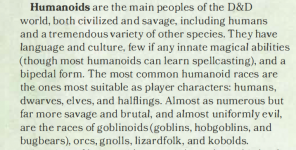
This is what the 5E MM says about humanoids. ::cringe::"Not all orcs" was built into the language of the 3.0e Monster Manual.
Edit: Indeed, even the 2nd Ed Monstrous Manual noted the possibility of exceptions to alignment, albeit rarely.
My game will still be my game. I expect the types of stories put out by WotC to start (?) looking like they were pulled from Baldur's Gate 3.How do the mechanical changes to the game (and how classes, monsters, spells, and etc) work change how the in-game world of a 5e game functions?
For example, does a larger list of "common" magic items mean a world in which magic items are more commonly assumed?
How do some of the changes influence the style of the game and the types of stories told through the game?
Misty Step is still a level 2 spell.Thanks for the responses.
To give some context, another example might be short-range teleporting becoming a more-common ability. (If true) that is something which would change assumptions about how things in the game world work.