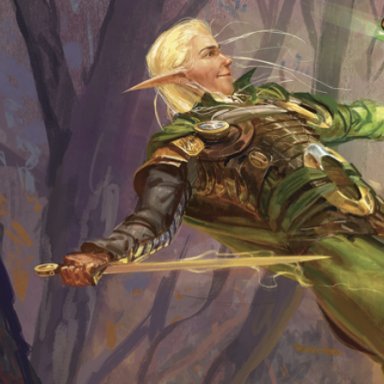
ok couldn't resist, so wrote up Dyson for use in your game.
DYSON
The Spherewright, Architect of Closed Systems
“I do not conquer.
I contain.”
— Dyson, recorded speaking to an archdevil whose name has since been redacted
Few beings inspire fear without cruelty, awe without worship, or obedience without command. Dyson is one of them.
Across the Astral Sea, in infernal archives, celestial observatories, and the sealed vaults of gnome space, Dyson’s name appears again and again—not as a conqueror, god, or destroyer, but as a
solution. When realities spiral toward collapse, when infinities bleed into one another, or when cosmic forces refuse to resolve, Dyson arrives not to rule the aftermath, but to prevent it from escalating further.
Dyson does not end worlds.
He
finishes problems.
The Gnome Who Built Around Reality
“Infinity is not strength.
It is a design flaw.”
— Dyson, lecture fragment recovered from a shattered inevitability
Dyson appears as a gnome—small of stature, calm of voice, dressed in layered coats of brass, starlight, and impossible geometry. This form is not an affectation. Dyson
is a gnome, and has never been anything else.
To those who underestimate him for this reason, the error is terminal.
Dyson rose not through divine apotheosis or infernal bargain, but through relentless artifice at scales previously thought impossible. Where other artificers build devices, Dyson builds
systems. Where others harness magic, Dyson treats it as raw material—measured, contained, and routed.
His greatest works are the structures that bear his name:
Dyson Spheres, immense containment lattices constructed around crystal spheres, unstable planes, god-corpses, and failed apocalypses. These constructs are not merely power collectors. They are prisons, laboratories, power plants, and museums of catastrophe.
Dyson names his works after himself because naming, to him, is an act of stabilization.
“Once I name a thing, it stops arguing with reality.”
What he names becomes fixed. What becomes fixed stops escalating.
The Fear of Gods and Devils
“We have fought gods.
We have broken inevitables.
We have survived the end of time more than once.”
— Infernal memorandum, Office of Strategic Damnation
“Dyson did not fight us.
He finished the argument.”
Dyson is not worshiped. He refuses faith, rejects clerical conduits, and grants no miracles. This alone makes him alien to the divine order. Gods draw strength from belief; Dyson draws strength from
closure.
Archdevils fear him not because he opposes Hell, but because he limits it. Demon lords fear him not because he destroys chaos, but because he renders it
finite. Dyson does not meet enemies on the battlefield. He removes the battlefield, closes the exits, and lets consequences resolve.
When Asmodeus himself attempted to assert contractual primacy over a plane Dyson had already stabilized, Dyson’s reply was reportedly polite.
“Yes, I’ve reviewed those.
They don’t apply outside an open system.”
The matter did not escalate further.
Dyson is classified in infernal records as a
Class-Absolute Threat: not because he seeks dominion, but because he cannot be bargained with through power, worship, or narrative leverage. He does not want thrones. He does not claim souls. He does not rewrite history.
He simply decides when something has gone on long enough.
Closed Systems and Cosmic Law
“You’re not chaos.
You’re a feedback loop that forgot its purpose.”
— Dyson, to Lolth, during the Quieting of the Demonweb
Dyson’s philosophy is simple, terrifying, and consistent:
no system is allowed to remain infinite and unbounded. Where others see eternal war, Dyson sees an uncontained feedback loop. Where others see divine mystery, Dyson sees unstable architecture.
When such systems threaten surrounding realities, he intervenes—not violently, but structurally.
This intervention often manifests as a sudden loss of options. Portals fail. Summoning falters. Reinforcements never arrive. Time resumes behaving properly. Outcomes stabilize.
Those caught within a closed system governed by Dyson often describe the experience as uncanny rather than painful.
“Reality became quieter.”
— Testimony of a surviving astral cartographer
Probability flattens. Grand rituals develop minor, fatal errors. Legends fail to escalate.
This is intentional.
Mortals and Variables
“Time is not a story.
It is material.”
— Dyson, responding to a failed attempt at temporal recursion
Despite his power, Dyson takes great care to avoid harming mortals. To him, mortals are not resources or worshipers, but
variables—sources of novelty within otherwise predictable systems. He has been known to reroute entire conflicts away from inhabited worlds, seal planar breaches at great personal cost, or pause intervention entirely to observe mortal ingenuity.
Adventurers who encounter Dyson are rarely attacked. More often, they are warned.
“Please don’t do that.
It makes the paperwork unbearable.”
Dyson respects cleverness, lateral thinking, and solutions that avoid escalation. He is patient with mortals in a way he is not with gods.
This patience should not be mistaken for mercy.
When Dyson Acts Directly
“Dyson does not break his laws.
He breaks last resorts.”
— Celestial marginal note, author unknown
Dyson almost never engages directly in combat. When he does, it is because containment has failed or because reality itself is destabilizing. Such moments are catastrophic. Planar boundaries weaken. Divine attention sharpens. Entire cosmologies take notice.
If Dyson is forced to raise his voice, to intervene personally, or to unname what he has stabilized, it is widely accepted among cosmic scholars that the situation has already passed the point of conventional salvation.
“If no one remembers it as an ending, it worked.”
The universe does not argue.
Using Dyson in Your Campaign
Dyson is not a villain to be slain, nor a patron to be exploited casually. He is a
cosmic constant, a living rule embedded in the structure of the multiverse. His presence signals that the scale of events has exceeded acceptable limits.
For Dungeon Masters, Dyson exists to:
- Provide an explanation for why infinities stop escalating
- Enforce consequences without arbitrary destruction
- Anchor Spelljammer-scale threats
- Offer a terrifyingly calm alternative to divine intervention
If Dyson appears, the rules have changed.
“I am not angry.
I am disappointed in your design assumptions.”



 www.dndbeyond.com