D&D General "True Neutral": Bunk or Hogwash

I will regret this, but meh.

So are there actual lore examples of "True Neutral" NPCs and their actions that have any justification for their positions beyond something supernatural, ie "good" and "evil" are fundamental forces that must exist in some degree of balance to maintain the spiritual health of the universe?

Laozi (老子) enters the chat.

A lot of decisions rooted in Daoism would look like neutrality imo.

Like other philosophical systems, it's subject to criticism which this thread likely doesn't warrant, but it's what immediately came to mind when I consider this question.
 

log in or register to remove this ad

I tend to see people playing a Neutral PC and then acting another way, which is according to my definitions and not theirs on what I think it means. Most of these PCs are acting more good because the other PCs are doing the same and saving the village and such. The player seems to just want options to be able to justify something.

In my game last night the PCs were in the feywild saving stolen kids from their village to being back home. They killed all the bad guys and now have the kids, but there are also like 50 other kids from who knows where. There was some discussion on what to do with these kids. They are freeing all of them, but do they bring all of them back to their village not knowing where on the world or if on this material plane they came from. They seem to be leaning that way since they have not thought to look for some kind of logbook to say where they came from. I might have to insert that clue into the next adventure.
 

Its a concept that is difficult to discuss on this forum.

First, to accept 'True Neutral' or Militant Neutral, we have to accept Good and Evil as cosmic forces.
Second, we have to accept that Good and Evil (not good and evil) have agreed upon definitions.

Since 2, is impossible here, and discussion invites the Red Text in all cases on a long enough timeline....

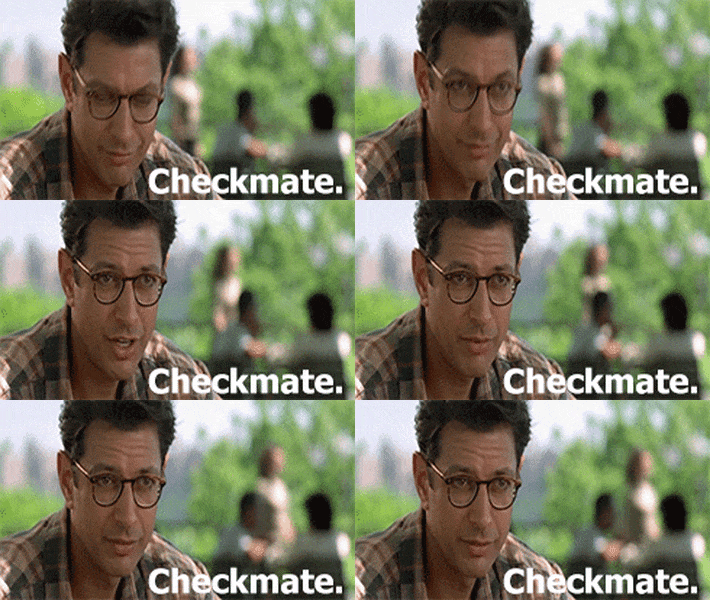
jeff goldblum checkmate GIF
Yeah the second point is the huge issue.

The whole thing is very firmly Gygax and Arneson's own stupid fault. They're both worthy of significant criticism for creating the whole situation.

True Neutral made sense when the Cosmic Forces were Chaos and Law, neither of which was inherently "good" or "evil" in a relative human sense, and some of which are required for a society to function, for freedom to exist meaningfully, for people to live their lives.

Whereas in any even vaguely conventional-adjacent definition of Good/Evil doesn't work remotely the same way. You have to start coming up with truly demented visions of what Good/Evil mean to try and argue opposing anyone doing "too much" Good is sane in the sane way too much Law might kind of obviously be. Gygax and Arneson also totally failed to provide a vision of what an all-Good or all-Evil universe would look like (particularly where both were negative and to be avoided), whereas Moorcock did provide ones for Chaos and Law.
 
Last edited:

Laozi (老子) enters the chat.

A lot of decisions rooted in Daoism would look like neutrality imo.

Like other philosophical systems, it's subject to criticism which this thread likely doesn't warrant, but it's what immediately came to mind when I consider this question.
I don't think Daoism can really be argued to oppose Good, or to promote Evil, in D&D senses, though. Daoism certainly fits with Moorcockian neutrality - i.e. between Chaos and Order, but ultimately it's actually pretty concerned with what it sees as "good".

I mean, for example, the "three treasures" in Daoism are compassion, humility and frugality. That's obviously totally incompatible with opposing Good at times and promoting Evil at times.
 

Remove ads

Top