On another forum, someone asked:
Quick question; in the 10th (so 900s) and 11th century, how did the decentralized Frankish state work? Particularly military-wise, what was the relationship between king and vassal in military matters, the type of troops (and their equipment) and so forth?
So Who Were the Franks
The late Frankish kingdom was a complex society, not really feudal in the 10th Century so much as still mostly tribal. Due to the relative paucity of surviving records we actually know far less about them than we do about the Romans or the later Medieval world. But we do know a few things I can review briefly here.
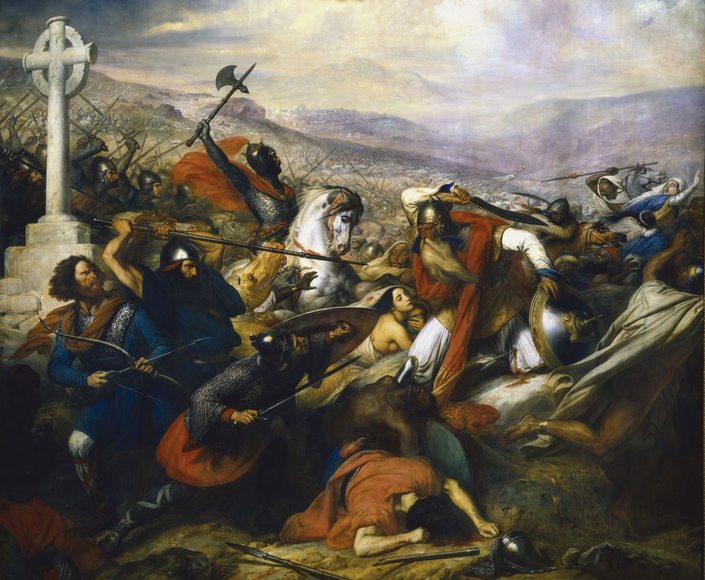
Charles Martel vanquishes the Moors at Tours in 732 AD
The Frankish top leadership (the Carolingian Dynasty) was very strong in the 8th Century from the victory of Charles Martel at Tours until the early 9th Century when Charlemagne died. During Charlemagnes reign the King of the Franks also became the Emperor of 'Rome'. After Charlemagnes death the Empire was split into three parts and the Frankish kingdom went into a period of decline through the 9th Century under a series of weak leaders with names like Charles the Fat, Charles the Simple and Louis the Stammerer. France was ravaged by the Vikings and fragmented by internal dissent well into the 10th Century. Meanwhile the other two branches of the Empire, Burgundy / Italy and Germany, went into a different direction, sealing the break up of the Frankish Empire into several parts by the late-9th Century. Finally from the early 11th Century the Capetians took over starting with Hugh Capet, which was a new stronger dynasty leading into the Medieval Kingdom of France. So that is the top leadership, complex enough to be sure, but that is actually the simplest part.
Probably the most important fact to keep in mind about the
Franks is that they were not an ethnic group per se, or a tribe, but
a large multi-ethnic tribal confederation. It was the same for all the other famous Barbarian 'tribes' of the Dark Ages.
So the original Franks included the
Salii, Sicambri, Chamavi, Bructeri, Chatti, Chattuarii, Ampsivarii, Tencteri, Ubii and
Batavi (Germanic tribes ranging from Germany to Flanders / Holland), one branch of the federation was dominated by the Salii which is why they were known as the Salian Franks. The name Franks probably means 'Free men' which is typcial of such early Germanic federations (the Allemani, which is still the French word for Germans, means literally
Alle - Mani or "All men"). As the Frankish tribes conquered Gaul, they heavily intermingled, intermarried and integrated with the
Romanized Gauls and picked up many of their habits and gradually, their language. As the Franks expanded they also absorbed other tribes including the
Saxons, Alans (Iranian / Persian people), the
Taifals (also Iranian), and the
Alemanni. This has a lot of significance on the Frankish military.
Frankish tribal law was of the traditional Germanic type, governed by independent "lawspeakers" (called
rachimburgs) who spoke at the tribal assembly similar to the Scandinavian 'Ting' and would make legal rulings but did not have direct authority. Judgments were carried out by jurors and tribal Chieftains were elected by the assembly (though the most powerful men were usually elected). Gradually Roman / Oriental style monarchy took hold inside the confederation, which was unified under the Merovingian 'Sea-Kings' and these lawmen were replaced with royal magistrates who were part of an administrative class called
centannae or
antrustiones (more about them a bit later) who played a similar role, but with loyalty to the King rather than the tribe (somewhat similar to Islamic
Qadi).
Frankish Sword
In terms of kit, while the Frankish confederation started out iron-poor, like many Germanic tribal groups, only more so. But by the 10th Century they had actually become one of the greatest iron producing people in the world. Frankish ('Ferrengi') armor and swords were among the most sought-after in the East by this time. So their armies were generally well equipped by the standards of the day, better than most late-Roman armies probably.
Command would break down by Dukes, Bishops, and tribal Chieftains (who would bear similar titles but with less formal meaning). At any one time depending on the strength of the King from 20 -80% of these Princes would fight on the side of the Kingdom. You would also have of course many smaller regional disputes going on between princes.
Political and military organization overlapped, by the 10th Century where you are focusing, the Frankish kingdom was much more sophisticated and organized, but still also pretty decentralized and multicultural, quite complex but you can break it down into four zones.
The City of Carcassone, France, today
Beziers, France, today
In parts of Flanders and the West of France there were many Gallo-Roman trading towns which were almost like smaller versions of Medieval city-states. These walled towns had their own militias made up of a special class of armed burghers called centannae who were called up under what the records refer to as 'local levies' which were well trained and well armed and equipped, like the urban militias of the later Medieval world, mostly as heavy infantry.
Feudalism wasn't very well established in Frankish lands by this point but in Central and Southern France there were some truly feudal fiefdoms based around Latifundia, traditional Roman villa - plantations worked by serfs (pagani), ruled over by Bishops or Dux (Dukes). There were also certain higher nobles such as the Bishop of Paris and the
Patrician of Burgundy who held special ranks and often acted as important military leaders with their own heavily armed (cavalry) retinues. These places had Romano-Gallic cavalry but little infantry (unless the 'General levy' was called in which case even serfs '
pauperes' and '
inferiores' would be armed and pressed into service, but that was very rare).
Around the Rhine and the tribes were more barbaric and organized as traditional Germanic light infantry equipped similarly to the Franks of a much earlier time.
Finally the Alans and
Taifals were settled in
certain areas of France. These Iranian / Saromatian nomads fought as light or as
heavy cavalry. In fact there is some argument that they may have introduced the culture of heavy cavalry to France. A Taifal uprising is mentioned in France in 565 AD by Gregory of Tours, so they were still considered a distinct ethnic group by then. The zones controlled by the Central Asians would have been aristocratic areas since they were a foreign people ruling over local tribes. They seem to have assimilated quickly a
Taifal Saint was canonized in the 6th Century.
So in the 10th Century, the urban militias of Paris and towns like Nantes, Bordeaux, Poitiers, Toulouse, Tours etc. would be heavy infantry called
centannae, armed with spears, shields, javelins, darts, swords and axes, and backed up by archers. Typical soldiers would wear helmets and many would have mail, others probably textile armor.
The Romano Gallic cavalry was probably armored, at least with a textile armor and a shield, probably with a byrnie as well, and would also carry lance, javelins, darts and a sword. A few would carry bows like Roman Sagitarii
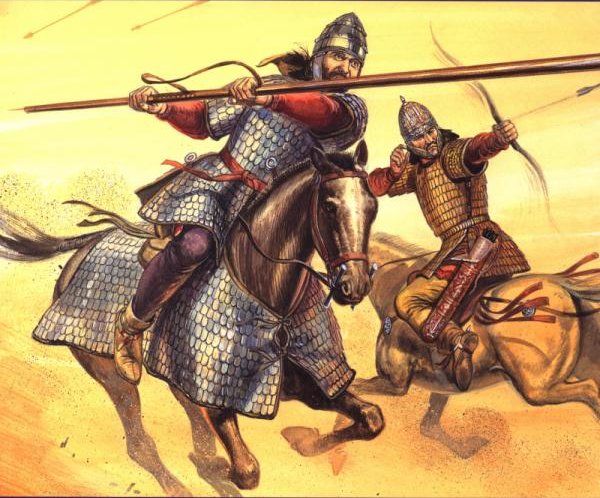
These Cataphracts are kitted out in Asian style, the Alans in Gaul would have probably been clothed and equipped somewhat more similarly to the locals.
The Saromatian (Alan, Taifal) cavalry would be split into light cavalry, some of whom may have had bows, most armed with javelins and darts and light lances, and heavy cavalry with real warhorses some of whom may have had armored horses, body armor (possibly including scale or lamellar armor as Spyrit showed above) axes, light maces, lassos, and lances.
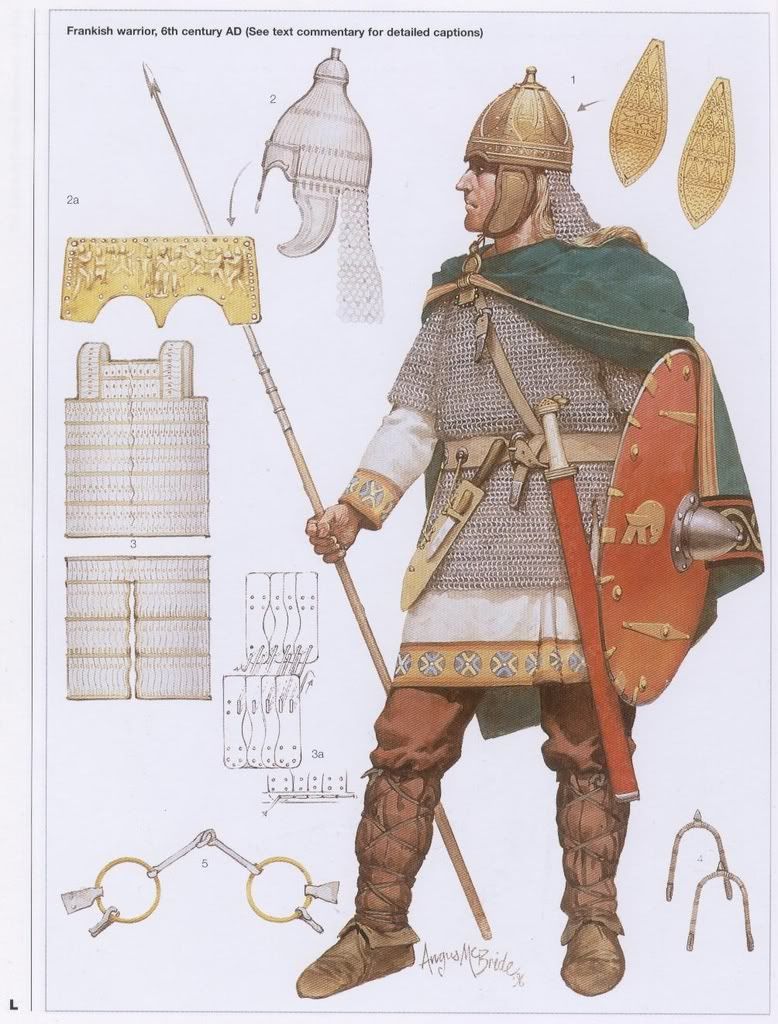
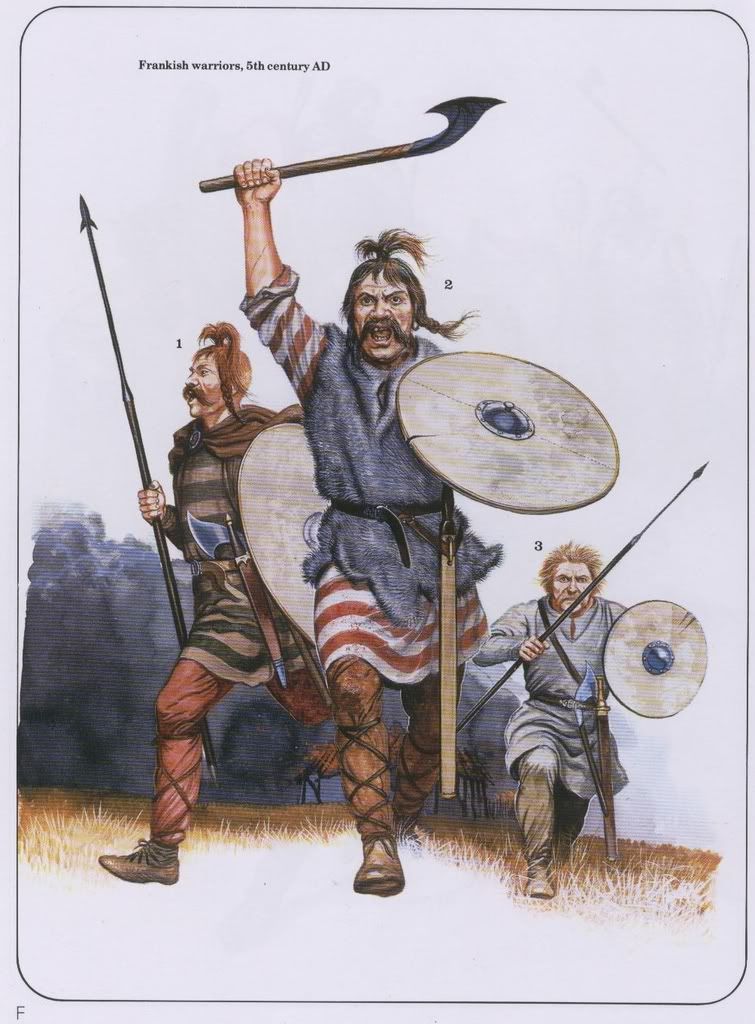
This image depicts Franks from the 5th or 6th Century, Franks in the 10th Century would probably have a more 'medieval' appearance in terms of dress and hair etc., but the weapons were similar.
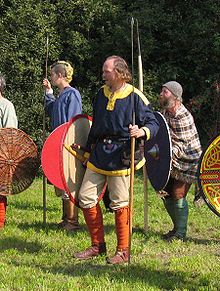
Re-enactors armed with Frankish kit, including angons.
The Germanic tribes would fight primarily as light infantry armed in the more traditional Frankish manner, with the
Angon / Francona (a heavy armor-piercing spear probably derived directly from the Roman Pilum) the
Francisca, a throwing axe, plus swords and axes.
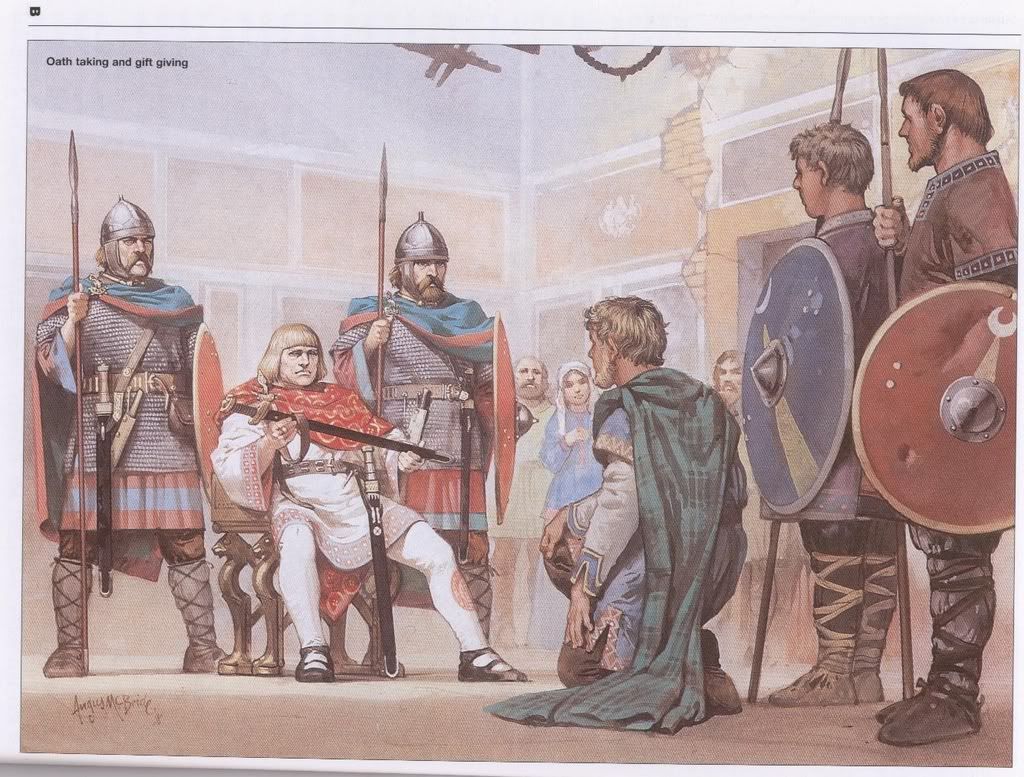
The chieftains would be armored with mail and helmets, and would be accompanied by an elite bodyguard called a
Commitatus or
Antrustiones. These men would be heavily armed and well mounted but many would prefer to fight as heavy infantry as they did so famously under Charles Martel.
The king himself had both heavy infantry
centannae and a large bodyguard of
Antrustiones called
comes palatii and
comes stabuli (palace guards and state police, respectively, some of whom were aristocrats but some of whom were recruited from tribesemen or serfs, creating a new class which came to be called
ministerials in the Holy Roman Empire, many ministerials eventually became the founders of the fighting Orders like the Teutonic Order), plus archers and probably Sarmatian cavalry as well.
The best source for the early Franks is Procopius, the best source for the Medieval Franks is (in my opinion) Hans Delbruck. The Osprey books are also, as always, useful particularly for the individual kit.
Amazon.com: History of the Wars, Books V and VI: The Gothic War (Dodo Press) (9781406566550): Procopius, H. B. Dewing: Books
Amazon.com: The Barbarian Invasions: History of the Art of War, Volume II (9780803292000): Hans Delbruck, Walter J. Renfroe Jr.: Books
Amazon.com: Medieval Warfare: History of the Art of War, Volume III (9780803265851): Hans Delbruck, Walter J. Renfroe Jr.: Books
Amazon.com: Warfare and Society in the Barbarian West 450-900 (Warfare and History) (9780415239400): Guy Halsall: Books
Amazon.com: The Age of Charlemagne (Men-at-Arms) (9780850450422): David Nicolle, Angus McBride: Books
Amazon.com: Carolingian Cavalryman AD 768-987 (Warrior) (9781841766454): David Nicolle, Wayne Reynolds: Books
G.