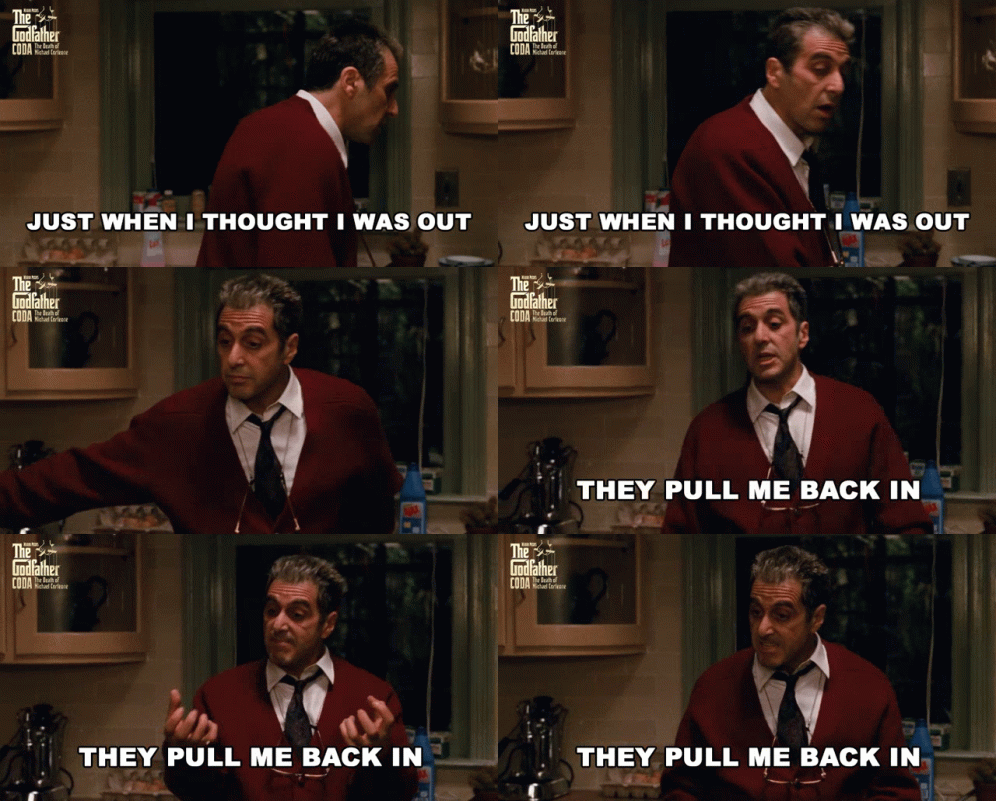
Very briefly- it depends on how you define rules. That's the only salient point.
If you don't understand, imagine the following conversation:
Snarf: Some people enjoy 5e because of the focus on rulings, not rules.
Ovi: What do you mean? 5e is all about rules, and rules.
Snarf: Huh? Everyone knows it's about rulings, not just rules.
Ovi: AHA! Don't you get it, Snarf? What is a ruling?
Snarf: Well, it can be a lot of things. For example, it can be the DM setting the DC check.
Ovi: That's a rule, Snarf. Maybe it's an ad hoc rule, maybe it's just a system of adjudication, but it's a rule.
Snarf: Um ... sure, but there is a salient difference that most people understand; there are different meanings of "rules." I feel like I just talked about this, somewhere?
Ovi: Doesn't matter. Rule rule rule. It's rules, all the way down. 5e is focused on Rules, not Rules. Game. Set. Ovi.
Snarf: Sure. What are we talking about again?
I kid, mostly, but I think you understand the point. I hope. People understand words in different contexts; rather than insisting on definitions of words, it's usually better to understand what the actual difference of opinion is instead of arguing over definitions.
"Rule" can mean different things to different people depending on context. That's why you can get joking comments like, "The only rule is I do what I want," or "The first rule is to break the rules." It's the frisson you get from the context-shift between ideas of "rule" in one sense (a more limited and formal sense) and "rule" in a second sense (a more expansive sense, as in a method of decision-making or adjudication; cf. a rule of thumb).
If you want to have a conversation with someone, it's better to discuss the underlying substance than to insist that they share your definitions. If you're going to talk to someone about 5e (for instance), you're probably going to get farther by meaningfully engaging them on the issue of ruling and rules than by insisting that rulings are rules and arguing over that.
YMMV. But seriously, I'm done. I am not getting involved any further in pointless semantic arguments.