Tell me about Star Wars: Edge of the Empire


log in or register to remove this ad


I'm someone that owned AoR and moved on from it for Star Wars roleplaying. I never did buy the EoE book, so I can't really tell you about it. In terms of the overall TTRPG - I think if you're joining a table in which the GM has been running it for a while and the players have been consistent, it'll be an enjoyable experience.

I ran it for my kids and friends and while they got the dice rolling combos without too much effort, I didn't care for the dice constantly throwing player agency at the GM. Part of that was my having to help players initially with dice rolls, but it also gave me that too many moving parts feeling too often. I also didn't like the idea of spending more for the F&D book, so we could own the optimal content for Force using PCs - I can see this being a problem too for GMs & Players that are mostly intereseted in EoE. The rules spread over 3 books and no PDF versions was by far my biggest dislike of it. I did buy AoR and F&D Beginner Game boxes, which were more than decent and in my city the easiest and most economical way to get another set of the proprietary dice.

I sold all I owned for not much less than I paid, so it wasn't like I was out many $.
 
Last edited:

@Whizbang Dustyboots each product line has a BEGINNER GAME box set that you can grab off Amazon for $40. Each box comes with 5 or 6 pregens, maps and tokens, a short rulebook, and an adventure that will last 2 or 3 sessions. The EoE adventure is generally considered the best and FoD the worst. There's also a free online expansion to each adventure of mostly middling quality. Any would be a respectable start to a longer campaign.

I bought all three a couple months ago because I'm definitely interested in a sample before I commit to anything serious, but haven't had the opportunity yet to play any of them.

IIRC you're located in LA. I live near LAX. You'd be welcome to borrow one if you want to DM me.


Of the three flavors of the system, Edge of the Empire is my favorite.

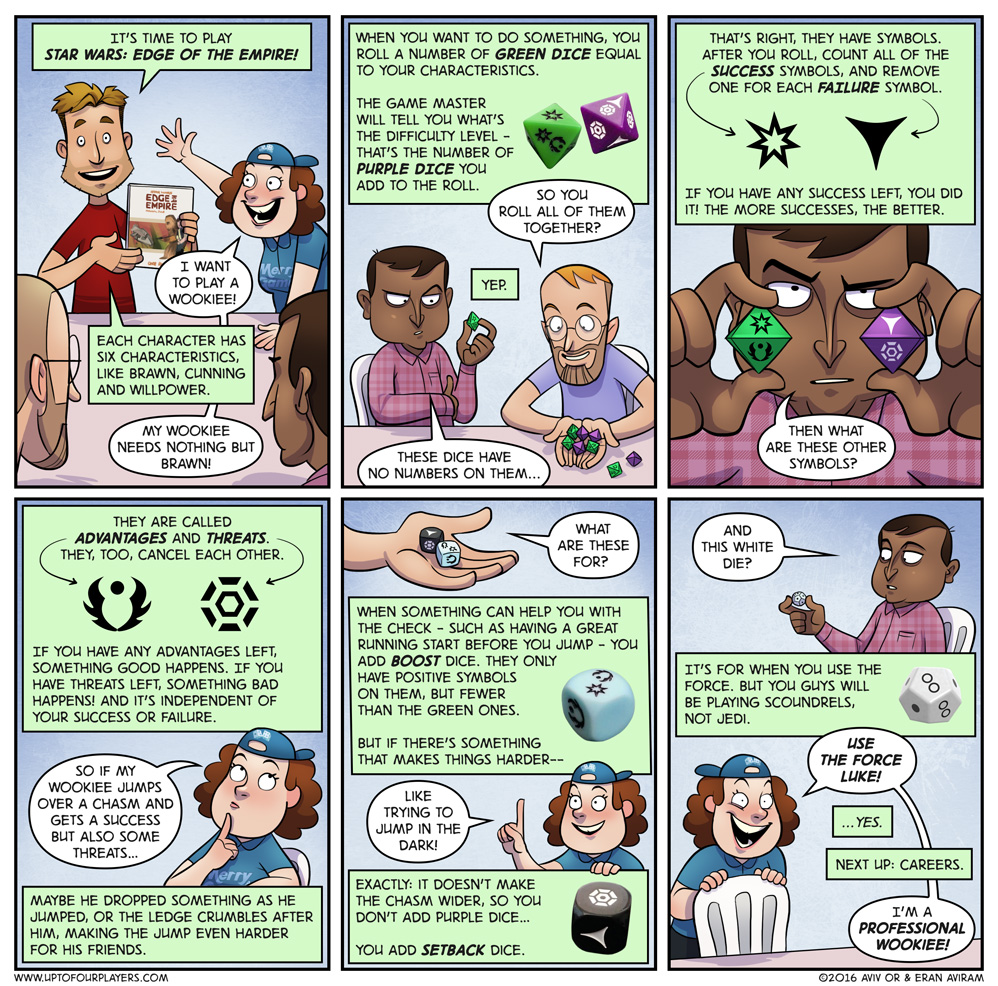
The funky dice are pretty easy to understand once you see how it works. Essentially, there are two pieces: 1) did I roll more success symbols than fail symbols? (If yes, I succeed.) 2) Did I roll more of the good narrative symbols than bad? If yes, I get to add something positive; if no, the DM adds something that makes the situation tougher. Where it gets interesting is that those two things also interact, so you might fail at what you're trying to do but fail in a way that produces something positive or you might succeed but the success comes with a cost.

The general vibe is like playing through episode of Firefly, but set in the Star Wars universe.

I'd also say that, despite being a "narrative" game, combat and action feels like it has teeth. What I mean by that is that there's a good risk/reward tension. Injuries and setbacks can happen in a way that matters more that just losing a chunk of HP.

Starship combat can be a little clunky at times. That's an area where later books and houserules help. If you're playing with a group experienced with the system, I doubt that will be an issue.

I feel that the system does a pretty good job of transitioning between different modes of play. I've had sessions that switched from ground combat to noncombat to space combat all as part of one encounter, and the game didn't bog down.
 

Of the three flavors of the system, Edge of the Empire is my favorite.

The funky dice are pretty easy to understand once you see how it works. Essentially, there are two pieces: 1) did I roll more success symbols than fail symbols? (If yes, I succeed.) 2) Did I roll more of the good narrative symbols than bad? If yes, I get to add something positive; if no, the DM adds something that makes the situation tougher. Where it gets interesting is that those two things also interact, so you might fail at what you're trying to do but fail in a way that produces something positive or you might succeed but the success comes with a cost.

The general vibe is like playing through episode of Firefly, but set in the Star Wars universe.

I'd also say that, despite being a "narrative" game, combat and action feels like it has teeth. What I mean by that is that there's a good risk/reward tension. Injuries and setbacks can happen in a way that matters more that just losing a chunk of HP.

Starship combat can be a little clunky at times. That's an area where later books and houserules help. If you're playing with a group experienced with the system, I doubt that will be an issue.

I feel that the system does a pretty good job of transitioning between different modes of play. I've had sessions that switched from ground combat to noncombat to space combat all as part of one encounter, and the game didn't bog down.
Yeah, It was pretty quick to pick up how the dice worked. One guy who even refused to use the game dice, just used ordinary dice and a conversion table (which folks often miss or disregard when talking about the dice).
 

I would truly love more discussion of this because I've tried to read the rules and they make my eyes just glass over. Something about the presentation just turns me off at every level, and yet I'm not fully happy with WEG D6 and would be interested in looking at other rule sets or at least learning something from this one.

So I saw this a few days ago and have been thinking about how I could assist.

Obviously I don't know you and your group personally, and what little I do know is from interactions on the forum here.

From our interactions, I do recall:
  • You have a long-standing house-ruled D&D 3.0 system that is your primary go-to for fantasy. I do seem to recall that you've specifically avoided most if not all of the D&D 3.5 system rules changes as part of your ongoing 3.0 + house rules.
  • Years ago you looked at GURPS wondering if "realism" was a solution to better gaming but ultimately concluded that whatever "things" GURPS gave in terms of "realism" significantly detracted from other, more important components of your enjoyment of roleplaying generally.
  • However, despite not going over to GURPS', I have historically detected from your posts that you generally lean as a GM toward discrete, action-resolution types of mechanics and systems because you feel they provide more internal consistency and verisimilitude, as opposed to more strongly freeform / narrative style mechanics and systems.
  • Your choice of WEG Star Wars D6 as your current "go to" for Star Wars seems to bear this out.
I've just re-read the thread you started, "Star Wars WEG D6 - The Force Point - 'Is it a good thing?'" (link), and tried to get a sense for the reasoning and underlying intent for you posing the question, and the descriptions of play you provided.

Quoting one of the exchanges in the thread ---
I can't recall having issues with force points in the WEG games we played, but I can think of possibly two ways to put more control on their use:

PALL OF THE DARK SIDE: At certain dramatic/climax points, death looms close and the light side of the force struggles to shine through. Mechanically, a player may need to spend double force points (or more) to overcome the dark side, or you may actually have named villians spend dark side points to counter the use of force points in these dramatic moments.

DESPERATION BREEDS HOPE: You mention Luke shooting his torpedoes into the the Death Star, but you neglect to realize that just before he did, he lost his best friend, Biggs Darklighter. You yourself gave the example of one character falling towards their doom and the Mando using a Force point to come to the rescue. Mechanically, before a player can spend Force points, they must suffer a disastrous setback first - someone must suffer life-threatening peril or a setback before they can draw on the Force. This could even be used to counter the Pall of the Dark Side, in certain situations.

I kind of like this idea but it needs some refinement to make it work. I don't usually run explicit "scenes" and for your suggestion to work the expenditure of the Force Point would need to be tied to something in the meta. But exactly how you define that in a way that just isn't moving the fiat around or clunky I'm not sure.

I bolded the phrase that stood out to me in the exchange as being most relevant to your approach/review/"grok"-ing of the Edge of the Empire system generally.

Despite having lots of "traditional" elements to the system---the character build system of attributes + skills + talents + career paths; the gear and equipment subsystem---the real "edge" to Edge of the Empire (to use a cheesy word-play) comes from the things that break from traditional, discrete action resolution-style gaming.

It's hard to get this through line in the rules, because the EotE rules don't really say this out loud, but if you're familiar with PbtA / Ironsworn / BitD style gaming, there's so many things in FFG Star Wars that have parallels to techniques you use in the narrative-style systems. But you won't get this from direct readings of the rules, it will only come through a learning the technique or mindset behind it.

Absolutely, 100%, you as a GM will be expected to insert "Quantum ogres" and "Schrodinger's cliffs" (to reference an old, old @pemerton post) all along the way---e.g., the players are trying to escape on horseback (or in the case of Star Wars, a hovercar) through a winding cliffside and canyon, when suddenly the players roll a riding/piloting check to evade their pursuers. The result is a successful evasion (they don't get hit by gunfire) but the dice show threat/disadvantage along with the success. They're safe for now, but suddenly what appeared to be a relatively clear route through the canyon is blocked.

Or conversely, you're throwing in "Quantum allies arriving from nowhere" and "Schrodinger's loot chests" when advantages and triumphs are rolled. Background elements you were planning to withhold "for internal consistency" may need to suddenly spring into action now, or if you were planning to insert them now, withhold them until later. GM's have to be ready and willing to let "unseen" and "offscreen" come to life on a moment's notice (or conversely hold them back).

The dice rolls will literally force you to make snap judgment calls to either insert or remove certain aspects of the game world to follow the narrative the dice are presenting. There are certain things happening both in the moment and in the broader world backstory that you may need to change on a micro- (and occasional macro-) transactional basis, because the dice are showing you that there is a state change or modification to the underlying current of the scene that neither you nor the players were previously aware of. These don't always have to be large changes (though sometimes they may), but the "fictional narrative state" is constantly being pushed/pulled in different directions by the dice rolls.

Anecdotally it's my observation that most GMs who express dislike for the FFG "Narrative Dice" system, this is the primary reason.

So why does the FFG system do this? In my opinion it's to push GMs into thinking about their games differently. For Star Wars games, it's about pushing GMs to view the game as a "Star Wars story" with Star Wars character arcs and narrative beats. For the generic Genesys system, it's the same, just applied more broadly---what kind of narrative beats are appropriate to the type of game that the system is driving?

So I'm saying this out of a desire to just level-set expectations around what your hopes are in trying to gain additional insight about the system. What is it you would like to see or experience or adapt around the FFG system?

Because to be honest, there's really not a lot of terribly interesting things mechanically about the FFG "Narrative Dice" system otherwise. The physical representation of the rules are massively less important than the mindset ("Be comfortable with 'Quantum ogres' and 'Schrodinger's cliffs'") that lives underneath it.
 

Some additional explanation of FFG Narrative Dice combat ---

So in a certain sense, FFGND combat uses a fairly structured "subroutine" that will feel familiar on the surface to D&D players, but the underpinning mechanics cause the tenor and pace of combat to be different.

Mechanically, PC health + stamina are fixed values that do not ever change or increase. Furthermore, in the Star Wars games, there are extremely limited ways to increase defensive stats, and even the best armors are only marginally effective.

So how does this play out in combat?

Single attack hits against a PC aren't necessarily fully detrimental, but because overall health and stamina values are small and fixed, every "hit" is felt. And because players can't statistically boost their defenses in most cases, they have to really think narratively (within the fictional scene) about how they're going to expose themselves to risk to gain the reward. How do they stay under cover? What resources do they have to shift odds in their favor?

Because straight-on, bull-in-the-china-shop combat is going to be punitive to health and stamina.

Sure, you can send the tough guy Wookie or Trandoshan out in the open to start hewing down mobs with a vibroblade --- But it's a guarantee that with a big enough mob or tough enough bosses, they're going to take hits. A squad of 5 stormtroopers, at full strength, isn't going to necessarily hinder a party fully, but they're certainly going to do some real grind and wear down on the party before they move on.

What ends up happening is that combats start to take on a sort of general feel, or tone---There's an early back and forth as foes exchange blows / fire, then each side starts to dig into their bag of tricks / gear to push the action, then as one side sees that they're getting ground away and close to tapping out, even bigger moves or a change in tactics become the priority.

I've played 3 total sessions of D&D 4e ever, but I seem to recall that some players had similar thoughts about combat there as well. That 4e combat has a particular kind of "narrative feel" where the PCs get hit hard up front, take some lumps, but then expend their resources and pull their reserves / daily powers, and pull victory out after coming back from an early brink.

FFG Narrative Dice has a similar sort of thing, in my experience, though a slightly different narrative feel. FFG is more like an endurance race --- The early portion / start is a "feeling out", seeing who is going to set the tone, then as things progress, the party has to rely on moxie and guts and fortitude and good tactics to pull out victory in the end. And when reserves go to critical level, maybe even the Force shows its hand. The classic Star Wars scene that always comes to mind for me that represents this flow is Han and Leia trying to hold out at the shield bunker in RotJ.
 
Last edited:

Enchanted Trinkets Complete

Recent & Upcoming Releases

Remove ads

Top