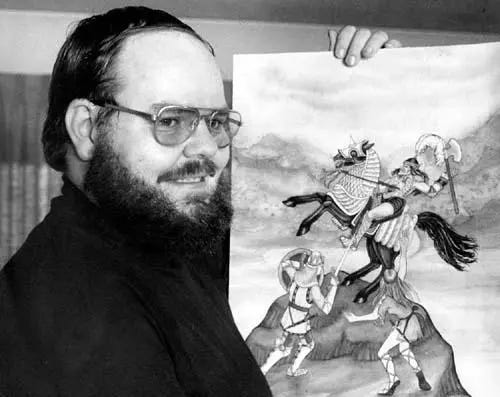
Gygax was no businessman. If he was, Arneson would have gotten zero credit and no royalties. Instead, he got credit and TSR got lawsuits. If Gygax were a businessman, I'd say Arneson was underappreciated. Instead, I have a very different take. Overrated? No, and this coming from the once young man who fell in love with all things Blackmoor (playing an Assassin and later a Monk in D&D from the very beginning). I don't think it's controversial to say, "An Arneson is rated precisely how he means to." Which is to say, as the co-creator of D&D. Dave Arneson was not a prolific writer, or even an average volume writer. In the early days of D&D he wasn't cranking out products like Gary and company. I still have a stack of original print modules and Arneson's name is only on a few. If you want understand the D&Differences between Gygax and Arneson then look at their modules. If you look at Keep on the Borderlands, and then compare it to Temple of the Frog you will see two very different styles of D&D. The Keep is designed for tactical play: tips on monster strategies, tactics, and playstyle while never delving into the roleplay of NPCs. Temple of the Frog delves into local history and the convoluted happenings surrounding the Temple. Today, we tend to see a LOT both in our modules allowing us as DMs to choose was is best for our group. So let's be real here, modules helped create D&D as much as, and in some ways more than, the rule books; and that doesn't look good for Dave.
Unlike so many other campaign settings, Greyhawk was built from the actual campaigns of DMs that later became modules. There are several campaigns of DMs turned entire module series: L-Series (Lendore Isles; Lakofka passed away last year), R-Series (Lost Oeridian lands of Greyhawk), T-Series (Temple of Elemental Evil, or Gygax's campaign with Kuntz's Lord Robilar), and so on. It was a world that was played in first, and then later designed to be explore by everyone else. Dave Arneson's campaign world, as compelling as it is, was barely published. Campaign super modules like The Temple of Elemental Evil completely changed the way everyone plays RPGs and designs their home campaigns forever. The Village of Hommlet changed the way DMs build their quaint little towns or even think about them. Ravenloft changed the way modules themselves are written by professionals, baking intrigue and randomness into the design so it can be played over and over again with different outcomes. Mind you, I'm not even getting into the later 2e modules that improved on what we learned during 1e era and have stood the test of time only to inform us on the games we play today. But where is Dave Arneson's Blackmoor in all of this?
View attachment 145833
And the only prescription is more Blackmoor!
Dave Arneson's D-Series is a unique blend of sci-fi tantasy that was a welcome break from the standard folklore (Tolkenism, Orientalism, Paganism, et al), but it was never fully realized. Like Gygax's later T-Series, Arneson was creating a sandbox, a very clumsy, dirty sandbox built in a swamp. This is where I suspect Dave Arneson wasn't invested in RPGs. He had amazing creativity, but poor execution of his ideas in publication. The modules Dave Arneson created are just disorganized. Often they lack good descriptions, don't reuse language to reinforce themes, and lack sound structure. Each of the module reads like a DM's campaign notes, which I suspect that's what they are. If someone told me to take one of my campaigns and publish it, you'd probably get something like the D-Series and I'd get the stink-eye from today's editors. For me, this tells me a lot about what was happening in those days before the split, who was doing what, and how invested they were in D&D. I wanted more modules about Blackmoor, especially something grandiose like a Temple of Elemental Evil for Blackmoor, but it appears Dave wanted out long before he officially left.