I would truly love more discussion of this because I've tried to read the rules and they make my eyes just glass over. Something about the presentation just turns me off at every level, and yet I'm not fully happy with WEG D6 and would be interested in looking at other rule sets or at least learning something from this one.
What do you want to know? I'll start with the elements I tell players ahead of character gen...
The most important element is building the dice pools.
Take as many yellows as the lower of Att or Skill.
Take greens equal to the difference of Att and Skill.
Take blues as directed or previously bought with advantage.
"Upgrade" means convert a green to a yellow; if you have no greens, instead add one.
"Downgrade" means convert a yellow to a green.
The GM also assigns purple, red, and black.
Purple base difficulty (in opposed situations, opponent green), red is risky difficulty (opponent's yellows).
Black and Blue are both situational (or talent) modifiers, and cannot be upgraded.
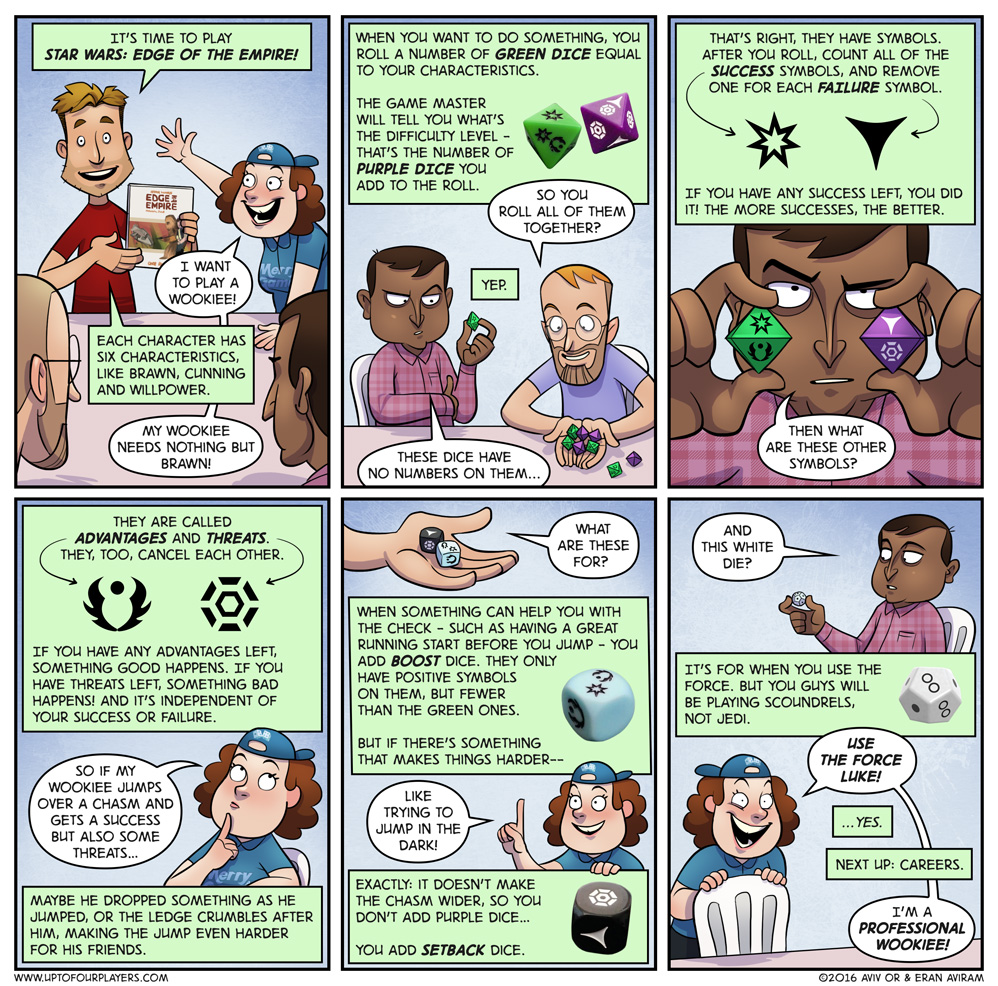
The bullet holes are successes, the Jedi wreathes are advantage, 3-point stars are "failure" (anti-successes), the imperial hexagons are threat.
The lightsaber is a triumph, and only on yellows.
The circled failure star is a despair.
Successes and Failures cross cancel; to succeed, you must have a remaining success. No fails isn't enough.
Advantage and Threat also cross cancel.
Triumph count twice: once for the success total, and separately for the triumph spends.
Despair also count twice, once as a failure, and once as a despair foe spend.
Note that the success/failure carried is cancelled, but the triumph spends and despair spends cannot be.
Thus, you get 4 totals in your outcome:
- Success - failure
- Advantage - Threat
- Rolled Triumphs
- Rolled Despairs
RAI, the players spend their advantage and Triumphs and the GM's threat and Despair; the GM spends PC threat & Despair and GM Advantage and Triumphs. RAW, the GM can simply assign the results.
Talents generally come in several flavors:
Increases to a secondary score (Maximum Strain, Maximum Wounds, Armor value, damage)
Increases to an Attribute
Bonus blue to own
Bonus black to foe
Reduce black on own
Upgrade green in pool (essentially, a +1 to the lower score in the task)
Downgrade red in pool (essentially, a -1 to the higher score opposing you)
special abilities.
Change skill from non-career to career.
The talent trees are paths, you can always take top row talents in a tree you've opened. Ones further down must follow paths from the top of the table, but not always downwards.
Every corebook has 6 careers (≅classes), with 3 specialization trees. Every career book has another 3 specialization trees. Specialization is immediate. Career determines only which trees are available, and there are a number duplicated across the three lines.
I playtested the Smuggler, Ace, and Bounty Hunter books, and the F&D Chronicles of the Gatekeeper...
I've run more Star Wars than D&D; much of that was over 10 campaign-years worth of FFG Star Wars (often 2, for a while, 3, campaigns at a time.) WEG is about 5 campaign years total.
Note that Force Users are in every core, and in the black covered universal splats; F&D has the majority of the power trees, which, except for costs, work like Talent Trees, but are not free to open even the first, and you have to have gotten a force rating from a talent tree or a class first. The one in Edge is an emulation of both pre-training Anakin and pre-training Ezra. Using force adds 2 more symbols: rings and dots. Dots are dark side, rings light side; they cross cancel. Most have a specified task, and the force add to the pool, both success on the normal dice and enough force to trigger the specific sub-abilities are needed... To have full-power Jedi/Sith/Tyia/etc, you need F&D.
Every F&D Splat adds another power (or more), in addition to more specializations.
Career Splats for every career also have a pair of extensions to the Talent Trees - you can only take each once, and only if in that career, and it must be bound to a talent tree from that career, AND they cost extra to open... but they add REALLY strongly thematic special abilities. They can be safely ignored, for complexity reasons.
Generally, the default difficulty for "This has a chance to fail a competent normal" (who rolls 1 green 1 yellow 1 blue) is 2 purple. 2 red is marginally harder, but has a chance of despair.
Wounds/Hull Capacity and Stress/System Strain are counted up, as you can go up to double the capacity. Going over damage capacity causes a critital roll, and until double, the amount over matters.
Also, Genesys dice are usable for Star Wars, but the iconography is different, and don't include a
stress Force die.


www.uptofourplayers.com









