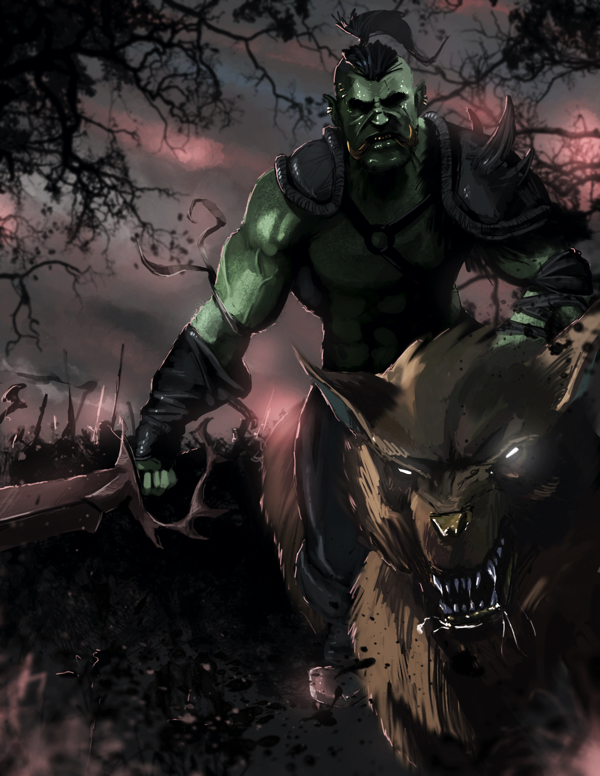
If we want to defy Tolkien, how about getting rid of elves and finally letting rogues eat rangers and take their stuff instead of the guys we only just started doing interesting things with?
Choosing not to imitate Tolkien isn't "defying" him. It's just... not imitating him.
I'd be quite happy to see more settings without
any of orcs, elves, dwarves, halflings, or the dozen other Tolkienisms that are taken for granted in D&D. As for rangers, that's a bit of a different concern (classes are not a defined "in-fiction" element the way races are), but I wouldn't be opposed to streamlining the class list a bit, and rangers would be one of the first to go if that happened.
That just shows terrible creativity and lack of worldbuilding because should said player/PC looks into the reasons why, then the DM has no choice but to answer.
The answer is the same as if the player asked why the setting does not contain dinosaurs, black holes, Jane Austen, the Battle of Waterloo, social media, or Daleks: "Because we didn't put those things in this setting." The
absence of an element does not have to be justified--it's the
presence of that element that requires justification.
If the lore is isolated to just a region and a DM handwaves other worlds/planes/gods etc., that's different. But if the established lore is everything is connected, as it originally was in 2E, it's not a bad thing to please fans by delving into deeper lore of the bigger questions.
The decision to make everything connected was one of 2E's worse ideas. A DM who wants to run a game in the Dragonlance setting should not also be shackled to the Forgotten Realms, Greyhawk, Dark Sun, and Planescape. Each setting should be free to stand on its own.
Anyhow, Dragonlance was published five years before Spelljammer. It's a 1E setting; there was no assumption of "everything's connected" when it was made.