Thanks for this work, @Dungeonosophy. I appreciate your commitment to presenting this in a scholarly fashion. While I'm well aware of the racism baked in to many RPG materials, it is occasionally astonishing to see how very blatant it can get.
Out of curiosity, is this part of a larger project or something you're planning to do for other RPG materials?
I loved the silly parts of Gaz 10 and Orc Wars is a fun game. And modeling a fantasy culture on something real world isn't problematic or it would be near impossible to have anything anyone could relate to. Using a term like "gris gris" isn't a problem. If it is, the only thing that would be allowable would be borrowing from Western European culture. And how is that any better? All fantasy RPGs are western European focused from now on to prevent appropriation?
No, the real problem is presentation in a derogatory manner, like using "red" and "yellow" Orc and making it clearly based on Native Americans and Asians. I grew up in Montana and played D&D off and on through junior high and high school with a Crow Indian and he had no real problem with the parody aspect Gaz 10. He did have a problem with "red" orcs, though, as that, even to us teenagers, was clearly an out-of-fashion term that should have died years before.
Gaz10 is a parody of lots of modern cultures. The kobolds, for example, are a parody of Italian culture. The possibility of you writing a post deriding any of that is exactly zero. I'm partly of Italian ancestry and it didn't bother me. At no point did I think Bruce Heard was actually being derogatory towards real world Italians. Many of Mystara's biggest fans are Italians and I'm unaware of any of them being offended by the Kobold Italian parody in Gaz 10.
The OP makes reference to the "sacred" land at the Battle of the Little Big Horn. For those who are unaware, the land the battle was fought on was Crow land. The Sioux, Arapahoe, and Cheyenne who fought the battle had, for lack of a better word, invaded Crown land and the Crow supported the US in expelling the invaders.
I think this is a poor excuse, and simply untrue. People in the United States in 1988 (the date this work was published) were well aware issues facing Native Americans. The Wounded Knee Occupation took place in 1973 just two states over from Wisconsin, where TSR was headquartered. It raised country-wide awareness of the inequalities facing Native Americans.
Rather than seeing this as a product of its time, we should be seeing it as a product of centuries of subjugation of native peoples of North America. If Bruce Heard, the author, had healthy relationships with peers of Native American ancestry, I doubt he would have written something so cruel to native cultures. At the same time, we can't let people off the hook for publishing something with racist imagery and text just 33 years ago.
I was born in 1986 in the US. I remember watching a TV show in which a kid was chastised for wearing a feathered headdress and making warcries while pretending to be Native American. So these issues were known at the time, and reflected in the media.
I loved the silly parts of Gaz 10 and Orc Wars is a fun game. And modeling a fantasy culture on something real world isn't problematic or it would be near impossible to have anything anyone could relate to. Using a term like "gris gris" isn't a problem. If it is, the only thing that would be allowable would be borrowing from Western European culture. And how is that any better? All fantasy RPGs are western European focused from now on to prevent appropriation?
No, the real problem is presentation in a derogatory manner, like using "red" and "yellow" Orc and making it clearly based on Native Americans and Asians. I grew up in Montana and played D&D off and on through junior high and high school with a Crow Indian and he had no real problem with the parody aspect Gaz 10. He did have a problem with "red" orcs, though, as that, even to us teenagers, was clearly an out-of-fashion term that should have died years before.
Gaz10 is a parody of lots of modern cultures. The kobolds, for example, are a parody of Italian culture. The possibility of you writing a post deriding any of that is exactly zero. I'm partly of Italian ancestry and it didn't bother me. At no point did I think Bruce Heard was actually being derogatory towards real world Italians. Many of Mystara's biggest fans are Italians and I'm unaware of any of them being offended by the Kobold Italian parody in Gaz 10.
The OP makes reference to the "sacred" land at the Battle of the Little Big Horn. For those who are unaware, the land the battle was fought on was Crow land. The Sioux, Arapahoe, and Cheyenne who fought the battle had, for lack of a better word, invaded Crown land and the Crow supported the US in expelling the invaders.
I think this is a poor excuse, and simply untrue. People in the United States in 1988 (the date this work was published) were well aware issues facing Native Americans. The Wounded Knee Occupation took place in 1973 just two states over from Wisconsin, where TSR was headquartered. It raised country-wide awareness of the inequalities facing Native Americans.
Rather than seeing this as a product of its time, we should be seeing it as a product of centuries of subjugation of native peoples of North America. If Bruce Heard, the author, had healthy relationships with peers of Native American ancestry, I doubt he would have written something so cruel to native cultures. At the same time, we can't let people off the hook for publishing something with racist imagery and text just 33 years ago.
I was born in 1986 in the US. I remember watching a TV show in which a kid was chastised for wearing a feathered headdress and making warcries while pretending to be Native American. So these issues were known at the time, and reflected in the media.
These are the problematic facets in GAZ10: (Note: "PG" refers to the Players' Guide; "DMG" refers to the DM's Booklet.)
#1: Misappropriation of "gris-gris", from the Vodun culture of West Africa. "Then his gri-gri fell into the water and drifted slowly south. The tribe followed." Players' Guide, p.2
"The goblin drops his gri-gri, trinkets, fetiches, and baubles, and drops to the ground. [...] With a final rattle of his gri-gri, the goblin closes his bulging eyes and passes out." -DMB, p.8
#2: The use of the term "yellow orc" and "Yellow Orkia" to refer to an East Asian (Mongolian/Chinese/Tibetan/Bhutanese)-inspired orcish culture. The basis for the term "yellow orc" is clearly "yellow man", which is an offensive racial slur in present-day English.
Quotes: "Akkila-Khan's son's parted and formed two tribes: Hobgobland and Yellow Orkia, on the east side of the Broken Lands." PG, p.2
"Yellow Orkia
[...] It is ruled by Moghul-Khan, orcish rival of Hutai-Khan the Hobgoblin." PG, p.12
"Moghul-Khan is the head of an eleven-horde strong army. Each is commanded by a high level yellow orc[.]" PG, p.13
Note the Mongolian cultural motifs ("moghul, khan, horde") in connection with the yellow orcs.
The army of Yellow Orkia includes an "orientalis" subspecies of goblin:
"Storm Raiders: [...] 60 goblins of the orientalis sort[.]"
"Seven Warlords: [...] 40 orientalis goblins[.]"
"Moghul's Guards: [...] 40 orientalis goblins[.]" PG, p.13
**Jigme appears to be of Dzonkha (Bhutanese) origin. Many Bhutanese historical figures are named "Jigme", for example: Jigme Chhoeda - Wikipedia
***Some names appear to be of Chinese origin:
Wuhai is the Chinese name for a city in Inner Mongolia, China: Wuhai - Wikipedia
Zhongbai
"Yellow Orkians and Hobgolanders call their horde chiefs 'Khan,' and their tribal chief 'Aga Khan. In a conversation, they simply add '-Khan' after the chief's name." -PG, p.41
Hobgobland is also a Mongolian-themed culture. Of the Khan of Hobgobland, it is said:
"Hutai is a middle-aged hobgoblin with Asian features." -DMB, p.12
Of the Khan of Yellow Orkia, it is said:
"[Ethengarian] nomads he has been stalking in the past years call him the Yellow Demon[.]" -DMB, p.14
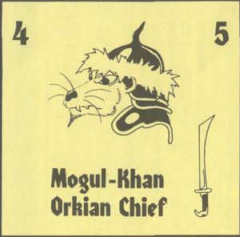
Here's the illustration of Moghul-Khan from GAZ10's Orc Wars! boardgame:
Note: This character specifically has a yellow-colored playing piece to match his "yellow orc" identity; whereas other playing pieces are of other colors (purple, blue, green).
#3: Misappropriation of the honored Lakota leader Tȟatȟáŋka Íyotake "Sitting Bull", in the form of "Big Chief Sitting Drool."
Quotes: "Among the greatest chiefs were Queen Udbala and Big Chief Sitting Drool. [...] Later Big Chief Sitting Drool united the tribes again. A new menace was rising to the south. Humans built a city at the gates of our sacred lands, surely a menace to our tribes. Sitting Drool besieged the city, ransacked it, took many slaves, and massacred human armies that followed him into the hills. These were great years.
"Later he was captured, but humans could not keep him long. They let him go for a small price: a few slaves. They had a treacherous plan. He was assassinated by human adventurers shortly after his departure, a deed they will pay for." PG, p.2
Note: In real life, Sitting Bull was "captured" by U.S. forces multiple times, and interned as a prisoner of war. The final U.S. plan to "capture" him resulted in his assassination.
Chronology: "500 AC: Big Chief Sitting Drool unites Broken Lands."
"523 AC: Big Chief Sitting Drool ransacks Corunglain."
"525 AC: Third Punitive Expedition from Glantri and Darokin. Sitting Drool brought back in chains."
"526 AC: Sitting Drool traded for slaves and gold[.]"
"527 AC: Adventurers assassinate Sitting Drool."
-DMB p.4
#4: The use of the term "red orc" and "Red Orcland" to refer to an American Indian-inspired orcish culture. The basis for the term "red orc" is clearly "red man" or "redskin", both of which are offensive racial slurs in present-day English:
Quotes: "Red Orcland:
[...] Orclanders are similar to Atruaghin Clans*, wearing feathers on their heads, and fighting with arrows and hatchets." p.10
"The old Atruaghin* faith of the Orclanders has been supplanted by other races' religions after being invaded several times after the fall of Sitting Drool." p.11
*Explanatory note: the humans of the Atruaghin Clans are Known World of Mystara's main Indigenous North American cultural analog.
The Red Orcland army is equipped with American Indian style weaponry:
"War Hordes: [...] 75 orcs with bows and axes [...] 30 goblins with hatchets [.]" p.10
"Red Orc:
"This is a sub-race of the orcs, recognizable by their generally red hides and simian features." p.18
"Orcus Rubeus Vulgaris [=Common Red Orc] [...] Simian features emulating many of the various monkey faces found in nature. [...] Southern Red Orcland natives[.]" p.31
"Orcus Simius Terribilis [=Terrible Simian Orc] Natives of northern Red Orcland[.]" p.31
"Naming Your Character: [...]
"Atruaghin Origins:
"These names are more commonly used by Red Orcland hordes. Red orcs are usually named according to circumstances at their birth. They sound more like American Indian names, although cruder and certainly grosser as befits orcs:
Bag-Cheek, Bone-Fist, Black-Blood, Broken-Fang, Cave-Hop, Dirt-Ball, Double-Tongue, Fat-Pot, Flat-Skull, Flat-Foot, Flea-Bag, Fork-Chin, Gloom-Mud, Crim-Claw, Gut-Worm, Hare-Snout, Iron-Butt, Little-Big-Snout*, Muck-Bag, Nose-Pick, One-Eye, Ooze-Lip, Pimple-Drip, Pus-Pop, Rattle-Bone, Red-Eye, Red-Hand, Red-Stone, Rot-Finger, Scare-Belly, Scar-Snout, Sitting-Drool*, Skunk-Hide, Slime-Tongue, Stale-Water, Stink-Puff, Stomp-Foot, Stutter-Bug, Two-Feathers, Wart-Bag, Wolf-Head, Wood-Hand, Yellow-Dust, Yawning-Bear, Zorn-Breath.
"Red Orclanders call their tribal chief 'Big Chief.'" p.41
*Note: "Little-Big-Snout" is an appropriation of "Little Bighorn", a sacred site: Battle of the Little Bighorn - Wikipedia
"Sitting-Drool" is an appropriation of "Sitting Bull."
Hool is the Big Chief of Red Orcland: "Hool: Supreme of Orcland:
"Hool is a tall Orcus Simius Terribilis [Terrible Simian Orc] with long, red, shaggy hair which he wears braided with feathers. A magical headband +2, stolen from an Atruaghin brave, improves his Armor Class and Saving Throws[.] [...] Hool is easy to recognize with his facial paints (his face is black from the eyes up). When needed, Hool will use an ornately carved hatchet to fight[.]" -DMB, p.12
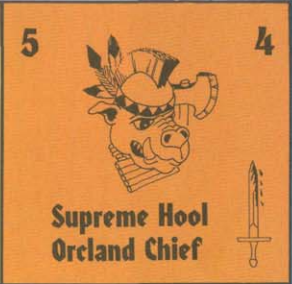
Here's the illustration of Hool, from GAZ10's Orc Wars! boardgame:
Note the mohawk, feathered headband, hatchet, and American Indian-style breastplate. And, this character has a red-colored playing piece to match his "red orc" identity.
#5: A "notorious" misappropriation of the name of the Nakota (Assiniboine/Stoney) nation.
"A deserted plateau called Nakota's Grave, covers central Red Orcland between two mountain ranges. Nakota's Grave is notorious for being the red orcs' sacred burial grounds[.]" p.10
It's pretty much a brutal and heartless mockery of Native American culture, and the attitude toward Asian culture is absolutely typical Orientalism of the hateful kind, with wild racism and shoving all these cultures together just because it "sounds Oriental" to the authors of GAZ10 and so on. Cripes.
I think this is a poor excuse, and simply untrue. People in the United States in 1988 (the date this work was published) were well aware issues facing Native Americans. The Wounded Knee Occupation took place in 1973 just two states over from Wisconsin, where TSR was headquartered. It raised country-wide awareness of the inequalities facing Native Americans.
Rather than seeing this as a product of its time, we should be seeing it as a product of centuries of subjugation of native peoples of North America. If Bruce Heard, the author, had healthy relationships with peers of Native American ancestry, I doubt he would have written something so cruel to native cultures. At the same time, we can't let people off the hook for publishing something with racist imagery and text just 33 years ago.
I was born in 1986 in the US. I remember watching a TV show in which a kid was chastised for wearing a feathered headdress and making warcries while pretending to be Native American. So these issues were known at the time, and reflected in the media.